


Health conspiracy theories: a scoping review of drivers, impacts, and countermeasures
- PMID: 40181408
- PMCID: PMC11969846
- DOI: 10.1186/s12939-025-02451-0
Health conspiracy theories: a scoping review of drivers, impacts, and countermeasures
Abstract
Background: Health-related conspiracy theories undermine trust in healthcare, exacerbate health inequities, and contribute to harmful health behaviors such as vaccine hesitancy and reliance on unproven treatments. These theories disproportionately impact marginalized populations, further widening health disparities. Their rapid spread, amplified by social media algorithms and digital misinformation networks, exacerbates public health challenges, highlighting the urgency of understanding their prevalence, key drivers, and mitigation strategies.
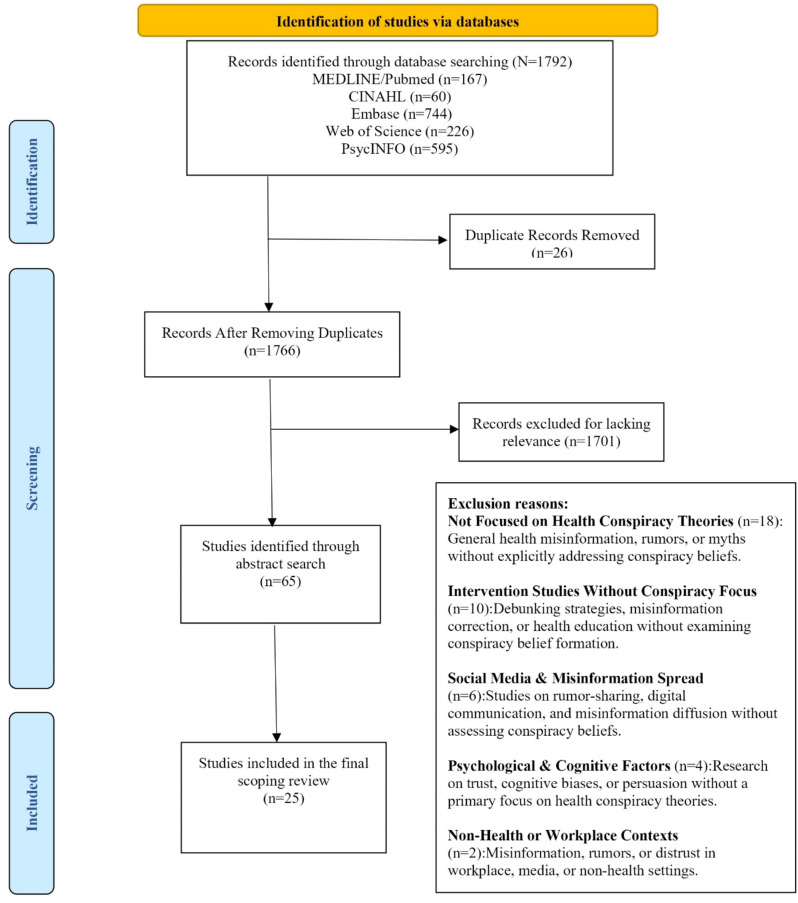
Methods: This scoping review synthesizes research on health-related conspiracy theories, focusing on their prevalence, impacts on health behaviors and outcomes, contributing factors, and counter-measures. Using Arksey and O'Malley's framework and the Joanna Briggs Institute guidelines, a systematic search of six databases (PubMed, Embase, Web of Science, CINAHL, PsycINFO, and Scopus) was conducted. Studies were screened using predefined inclusion and exclusion criteria, with thematic synthesis categorizing findings across diverse health contexts.
Results: The review revealed pervasive conspiracy beliefs surrounding HIV/AIDS, vaccines, pharmaceutical companies, and COVID-19, linked to reduced vaccine uptake, increased mistrust in health authorities, and negative mental health outcomes such as anxiety and depression. Key drivers included sociopolitical distrust, cognitive biases, low scientific literacy, and the unchecked proliferation of misinformation on digital platforms. Promising countermeasures included inoculation messaging, media literacy interventions, and two-sided refutational techniques. However, their long-term effectiveness remains uncertain, as few studies assess their sustained impact across diverse sociopolitical contexts.
Conclusion: Health-related conspiracy theories present a growing public health challenge that undermines global health equity. While several interventions show potential, further research is needed to evaluate their effectiveness across diverse populations and contexts. Targeted efforts to rebuild trust in healthcare systems and strengthen critical health literacy are essential to mitigate the harmful effects of these conspiracy beliefs.
Keywords: Health conspiracy theories; Health equity; Health literacy; Marginalized groups; Misinformation mitigation; Trust in healthcare.
© 2025. The Author(s).
Conflict of interest statement
Declarations. Ethics approval and consent to participate: Not applicable. Consent for publication: Not applicable. Competing interests: The authors declare no competing interests.
References
-
- Featherstone JD, Zhang J. Feeling angry: the effects of vaccine misinformation and refutational messages on negative emotions and vaccination attitude. J Health Communication. 2020;25(9):692–702. - PubMed
-
- Loomba S, et al. Measuring the impact of COVID-19 vaccine misinformation on vaccination intent in the UK and USA. Nat Hum Behav. 2021;5(3):337–48. - PubMed
-
- McCarthy M, Murphy K, Sargeant E, Williamson H. Examining the relationship between conspiracy theories and COVID-19 vaccine hesitancy: A mediating role for perceived health threats, trust, and anomie? Analyses Social Issues Public Policy. 2022;22(1):106–29.
Publication types
MeSH terms
LinkOut - more resources
Full Text Sources
