


Reference levels of mean and peak anaerobic power for male and female long-track speed skaters
- PMID: 40182707
- PMCID: PMC11963126
- DOI: 10.5114/biolsport.2025.144407
Reference levels of mean and peak anaerobic power for male and female long-track speed skaters
Abstract
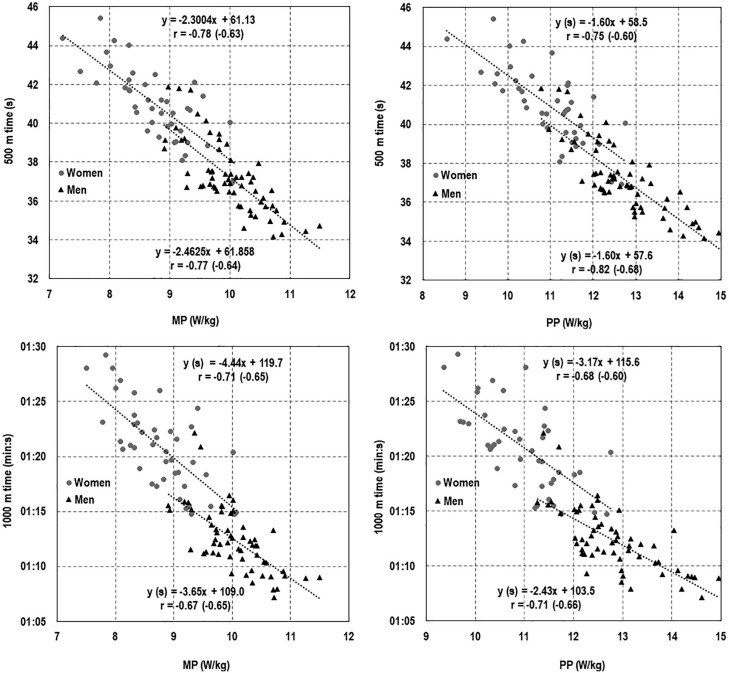
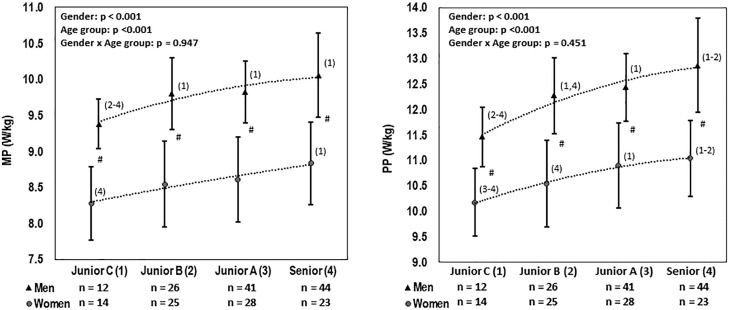
The ability to generate and maintain high power is a prerequisite for success in many sports, including long-track speed skating. A common method of determining this ability is the Wingate test, but surprisingly, normative data necessary to objectively assess the performance of speed skaters is lacking. Therefore, the present study aimed to develop reference levels for peak power (PP) and mean power (MP) on a Wingatetype test for speed skaters using a Monark 874E ergometer with a load equivalent to 7.5% of body mass. Over 15 years, 635 test results were collected from 120 junior and senior athletes (all national representatives); 380 from men and 255 from women. We found that in men and women, personal best in relative PP and MP (W/kg body mass) correlated significantly (all p < 0.001) with altitude-adjusted times over distances of 500 (r = -0.75 to -0.82) and 1000 m (r = -0.67 to -0.71), thus confirming the validity of this test for assessing the on-ice sprinting ability of speed skaters. Moreover, the two-way ANOVA models revealed significant effects of gender (p < 0.001) and age (p < 0.001) on relative MP and PP (W/kg) values, but the interaction effect was not significant (p > 0.05). The 7-stage classification system constructed on the basis of the obtained results enables the assessment of relative MP and PP in Wingate tests, taking into account the age category and gender of the athletes. This system can be used by sports researchers and coaches to assess the sprinting ability of speed skaters from novice to world-class levels.
Keywords: Age and gender differences; Anaerobic capacity; High-level athletes; Laboratory testing; Sprinting ability; Wingate test.
Copyright © Institute of Sport – National Research Instutite.
Conflict of interest statement
All authors declare no conflict of interest.
Figures
References
-
- Konings MJ, Elferink-Gemser MT, Stoter IK, van der Meer D, Otten E, Hettinga FJ. Performance characteristics of long-track speed skaters: a literature review. Sports Med. 2015; 45(4):505–16. - PubMed
-
- Sovak D, Hawes MR. Anthropological status of international calibre speed skaters. J Sports Sci. 1987; 5(3):287–304. - PubMed
-
- de Koning JJ, Bakker FC, de Groot G, van Ingen Schenau GJ. Longitudinal development of young talented speed skaters: physiological and anthropometric aspects. J Appl Physiol. 1994; 77(5):2311–7. - PubMed
-
- Akahane K, Kimura T, Ah-Cheng G, Fujiwara T, Yamamoto I, Hachimori A. Relationship between Balance Performance and Leg Muscle Strength in Elite and Non-Elite Junior Speed Skaters. J Phys Ther Sci. 2006; 18:149–54.
-
- van Ingen Schenau GJ, de Koning JJ, de Groot G. A simulation of speed skating performances based on a power equation. Med Sci Sports Exerc. 1990; 22(5):718–28. - PubMed
LinkOut - more resources
Full Text Sources
Miscellaneous
