


The investigation of molecular epidemiological characteristics and resistance mechanism of tigecycline resistant Klebsiella pneumoniae from a large teaching hospital in southwest China, Chongqing
- PMID: 40182765
- PMCID: PMC11965929
- DOI: 10.3389/fcimb.2025.1540967
The investigation of molecular epidemiological characteristics and resistance mechanism of tigecycline resistant Klebsiella pneumoniae from a large teaching hospital in southwest China, Chongqing
Abstract
Background: Klebsiella pneumoniae is one of the main pathogens of nosocomial infection, among which carbapenems can be used for multidrug-resistant Klebsiella pneumoniae. However, in the past decade, the resistance rate of carbapenem-resistant Klebsiella pneumoniae has increased yearly. Tigecycline has good antibacterial activity in treating severe bacterial infections, but the reports of tigecycline resistance are increasing. This study aimed to investigate the mechanism of drug resistance and epidemiological characteristics of tigecycline-resistant Klebsiella pneumoniae (TRKP) in a large teaching hospital in southwest China, Chongqing.
Methods: We isolated 30 TRKP strains from this hospital between August 2021 and December 2023. By PCR and sequencing, we examined the presence and mutation rates of genes associated with tigecycline resistance, including acrR, oqxR, ramR, tmexC, tet(x), tet(A), tet(L), and rpsj, and performed efflux pump inhibition experiments to verify efflux pump activity. At the same time, real-time RT-PCR was used to detect the expression levels of efflux pump genes (acrB and oqxB) and ramA. To investigate the prevalence trend of TRKP in our hospital, we performed multi-site sequence typing (MLST) analysis.
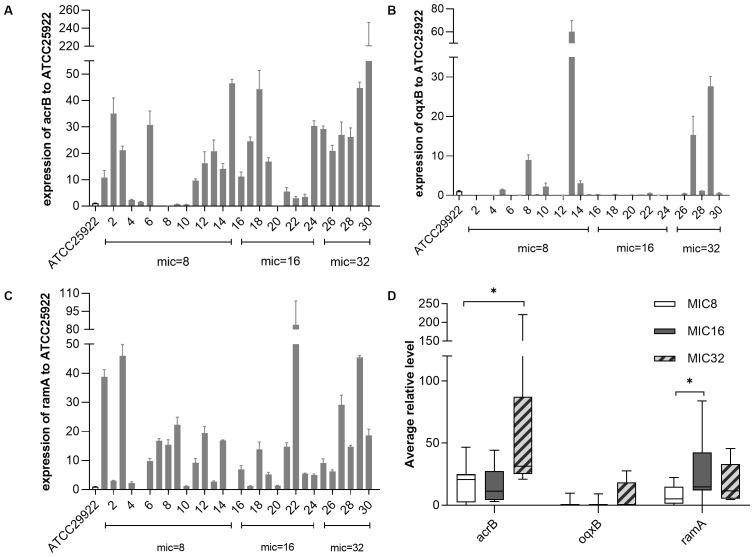
Results: The mutation rates of ramR (73.3%) and tet(A) (63.3%) were significant. In efflux pump inhibition experiments, PaβN could reverse the resistance of 29 TRKP strains (96.7%) to tigecycline. Real-time RT-PCR results showed that acrB and ramA genes were up-regulated in 22 strains, while oqxB genes were overexpressed in only 4 strains. MLST analysis showed that these strains could be divided into 25 different ST subtypes, indicating that no outbreak of TRKP occurred in our hospital. In addition, two tmexCD-torpj positive strains, ST661 and ST1561, were identified for the first time.
Conclusion: The efflux pump acrB and tet(A) mutations are the primary mechanisms of resistance to tigecycline-resistant Klebsiella pneumoniae at our hospital. The ramR mutation can mediate efflux pump activity of acrB by up-regulating ramA overexpression.
Keywords: Klebsiella pneumoniae; RND efflux pump; resistance mechanism; tet(A); tigecycline-resistance.
Copyright © 2025 Li, Tang, Han, Xia, Si, Song and Xia.
Conflict of interest statement
The authors declare that the research was conducted in the absence of any commercial or financial relationships that could be construed as a potential conflict of interest.
Figures
References
-
- Bialek-Davenet S., Leflon-Guibout V., Tran Minh O., Marcon E., Moreau R., Nicolas-Chanoine M. H. (2013). Complete deletion of the ramR gene in an in vitro-selected mutant of Klebsiella pneumoniae overexpressing the AcrAB efflux pump. Antimicrob. Agents Chemother. 57, 672–673. doi: 10.1128/aac.01410-12 - DOI - PMC - PubMed
MeSH terms
Substances
LinkOut - more resources
Full Text Sources
Medical
Molecular Biology Databases
Miscellaneous
