


Effects of a multicomponent training and a detraining period on cognitive and functional performance of older adults at risk of frailty
- PMID: 40192885
- PMCID: PMC11976811
- DOI: 10.1007/s40520-025-03011-w
Effects of a multicomponent training and a detraining period on cognitive and functional performance of older adults at risk of frailty
Abstract
Aims: This study analyzes the effects of a 6-month multicomponent exercise program (MCT) followed by a 4-month detraining period on functional and cognitive status in pre-frail and frail older adults.
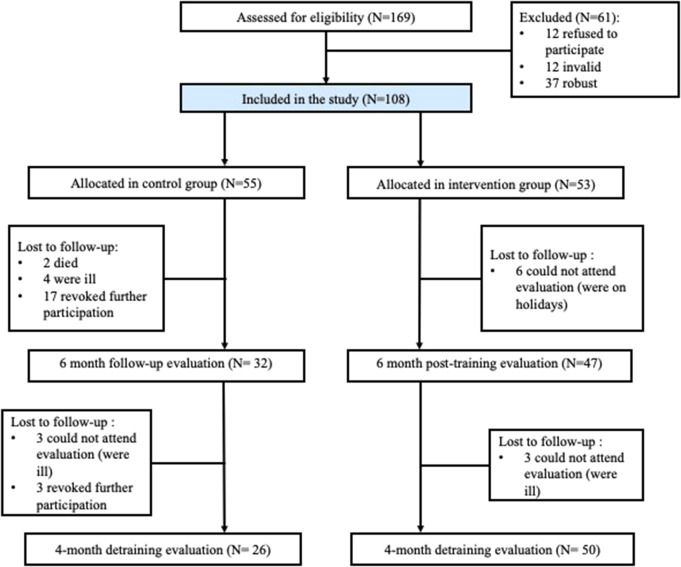
Methods: A total of 108 pre-frail and frail adults aged 65 and older participated in the study. They were assigned by convenience to either a control group (CG) or an intervention group (IG). The IG underwent a 6-month MCT followed by a 4-month detraining period. Assessments included a DT test, the Timed Up and Go (TUG) test, the Mini-Mental State Examination (MMSE), and evaluations of basic and instrumental activities of daily living. Data were analyzed using repeated-measures ANOVA.
Results: Significant group-by-time interactions were observed for the DT test (p < 0.05). The IG showed improved DT performance after the 6-month MCT (4.0, 95% CI: 2.2 to 5.7 s), followed by a decline after the detraining period (-1.1, 95% CI: -2.1 to -0.2 s). However, performance after detraining remained higher than at baseline (2.9, 95% CI: 1.0 to 4.6 s, p < 0.05). No statistically significant changes were observed in the CG. Additionally, no significant effects were found for MMSE scores or daily activity questionnaires.
Conclusion: MCT had beneficial effects on functional and cognitive performance in older adults, as assessed by the DT test. However, improvements in DT performance did not translate into better daily life activities. Although the 4-month detraining period negatively impacted DT performance, the results remained superior to baseline levels.
Trial registration number: NCT03831841 and date of registration: 5th of November 2018.
Keywords: Ageing; Cognition; Dementia; Dual tasks; Physical exercise.
© 2025. The Author(s).
Conflict of interest statement
Declarations. Ethical standards: The study protocol was approved by the Clinical Research Ethics Committee of “the Hospital Universitario Fundación de Alcorcón (16/50)”, in 2016 following the ethical guidelines of the Declaration of Helsinki 1961, revised in the General Assembly held in Fortaleza, Brazil in 2013. All older adults in the study agreed to participate voluntarily and signed an informed consent form after receiving detailed information about the purpose, procedures, benefits and risks of the study. Competing interests: The authors declare no competing interests.
References
-
- World Health Organization (2015) World report on ageing and health. World Health Organization, Geneva PP - Geneva
Publication types
MeSH terms
Associated data
LinkOut - more resources
Full Text Sources
Medical
