


doi: 10.1038/s41746-024-01401-4.
The role of open standards in catalysing knowledge transfer to deliver climate adaptive care
Affiliations
- PMID: 40195416
- PMCID: PMC11977215
- DOI: 10.1038/s41746-024-01401-4
Item in Clipboard
The role of open standards in catalysing knowledge transfer to deliver climate adaptive care
NPJ Digit Med.
.
Abstract
As climate change threatens to destroy health gains, digital health provides infrastructure that is well-placed to offer patient-centred health insights. These insights are important to advance research to explore the intersection of climate and health. We present a proposal to leverage open data standards to more seamlessly collect, exchange, and use a combination of environmental and health data to assess climate-health risks to improve patient and population outcomes.
Conflict of interest statement
Competing interests: The authors declare no competing interests.
Figures
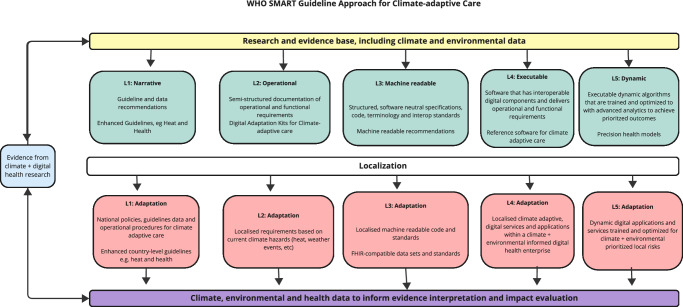
Evidence of the influence of climate and environment on health outcomes is health impacts (blue) generated by research generated from digital health platforms (yellow); WHO Guidelines are produced that follow climate-related clinical practice recommendations (green); localized guidelines are developed considering direct health impacts mediated by primary environmental impacts of climate change (red); and climate, environmental and health data resulting from digital health programs built on SMART guidelines inform further guideline development processes (purple); tertiary effects (upward-pointing arrows). Adapted from {Mehl, 2021} under Creative Commons V.4 licensing from Mehl G, et al..

Taken from {Mehl, 2023} with written permission from author and adapted under Creative Commons License V.4. Patient-centred care is enabled for climate-adaptive care as a result of climate and environmental data enhancing Open Standards (yellow); efficiencies gained by modularizing software to allow developers to work with FHIR data (green); national architectures which provide specific and clear governance models for both health and climate data use (red); content including resulting care plans which can be transparently shared, evaluated and understood (blue). Adapted under Creative Commons license 4.0 from Mehl et al. A full-STAC remedy for global digital health transformation: open standards, technologies, architectures, and content. Oxford Open Digital Health. 1, 1–5 (2023).
References
-
- The World Bank Group. Press Release [Website] Available from: https://www.worldbank.org/en/news/press-release/2024/04/09/world-bank-gr... (2024).
-
- Ebi, K. L. et al. Hot weather and heat extremes: health risks. Lancet398, 698–708 (2021). - PubMed
Grants and funding
LinkOut - more resources
Full Text Sources
Research Materials
