


Novel digital markers of sleep dynamics: causal inference approach revealing age and gender phenotypes in obstructive sleep apnea
- PMID: 40200042
- PMCID: PMC11978946
- DOI: 10.1038/s41598-025-97172-3
Novel digital markers of sleep dynamics: causal inference approach revealing age and gender phenotypes in obstructive sleep apnea
Abstract
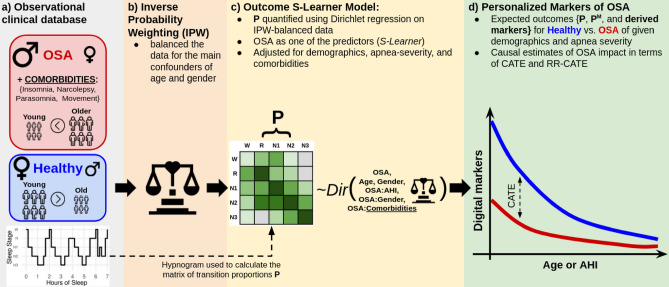
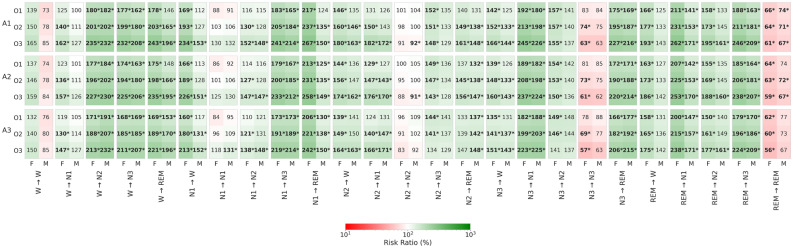
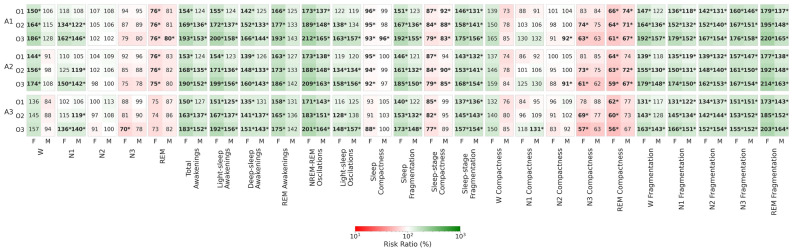
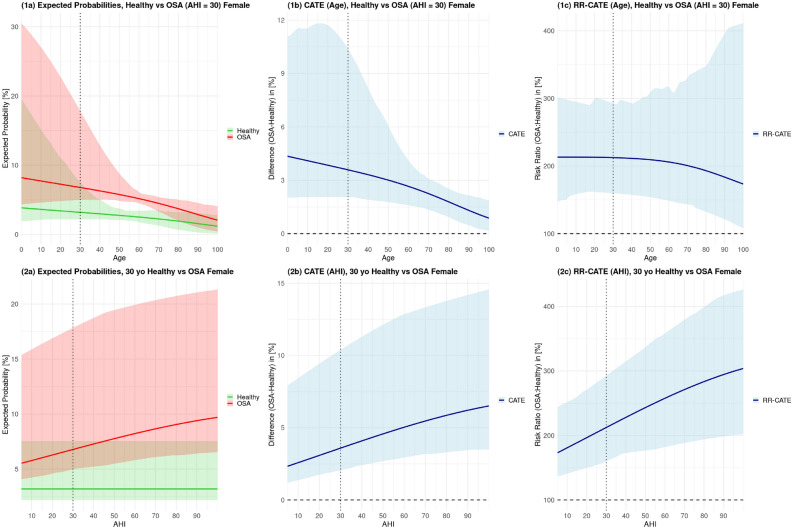
Despite evidence that sleep-disorders alter sleep-stage dynamics, only a limited amount of these parameters are included and interpreted in clinical practice, mainly due to unintuitive methodologies or lacking normative values. Leveraging the matrix of sleep-stage transition proportions, we propose (i) a general framework to quantify sleep-dynamics, (ii) several novel markers of their alterations, and (iii) demonstrate our approach using obstructive sleep apnea (OSA), one of the most prevalent sleep-disorder and a significant risk factor. Using causal inference techniques, we address confounding in an observational clinical database and estimate markers personalized by age, gender, and OSA-severity. Importantly, our approach adjusts for five categories of sleep-wake-related comorbidities, a factor overlooked in existing research but present in 48.6% of OSA-subjects in our high-quality dataset. Key markers, such as NREM-REM-oscillations and sleep-stage-specific fragmentations, were increased across all OSA-severities and demographic groups. Additionally, we identified distinct gender-phenotypes, suggesting that females may be more vulnerable to awakenings and REM-sleep-disruptions. External validation of the transition markers on the SHHS database confirmed their robustness in detecting sleep-disordered-breathing (average AUROC = 66.4%). With advancements in automated sleep-scoring and wearable devices, our approach holds promise for developing low-cost screening tools for sleep-, neurodegenerative-, and psychiatric-disorders exhibiting altered sleep patterns.
Keywords: Causal inference; Digital markers; Dirichlet regression; Obstructive sleep apnea; Polysomnography; Sleep disorders; Sleep dynamics.
© 2025. The Author(s).
Conflict of interest statement
Declarations. Competing interest: Mr Akifimi Kishi is supported by JST FORESTO program (grant no. JPMJFR2156), outside the submitted work. All authors declare no financial or non-financial competing interests.
Figures
References
-
- Redline, S. et al. The effects of age, sex, ethnicity, and sleep-disordered breathing on sleep architecture. Arch. Intern. Med.164, 406–418 (2004). - PubMed
-
- Carskadon, M. A. et al. Normal human sleep: An overview. Prin. Pract. Sleep Med.4, 13–23 (2005).
-
- Sahlin, C., Franklin, K. A., Stenlund, H. & Lindberg, E. Sleep in women: normal values for sleep stages and position and the effect of age, obesity, sleep apnea, smoking, alcohol and hypertension. Sleep Med.10, 1025–1030 (2009). - PubMed
-
- Luca, G. et al. Age and gender variations of sleep in subjects without sleep disorders. Ann. Med.47, 482–491 (2015). - PubMed
MeSH terms
Substances
Grants and funding
LinkOut - more resources
Full Text Sources
