


Essential oil of Rosmarinus officinalis induces in vitro anthelmintic and anticoccidial effects against Haemonchus contortus and Eimeria spp. in small ruminants
- PMID: 40201135
- PMCID: PMC11975360
- DOI: 10.17221/139/2020-VETMED
Essential oil of Rosmarinus officinalis induces in vitro anthelmintic and anticoccidial effects against Haemonchus contortus and Eimeria spp. in small ruminants
Abstract
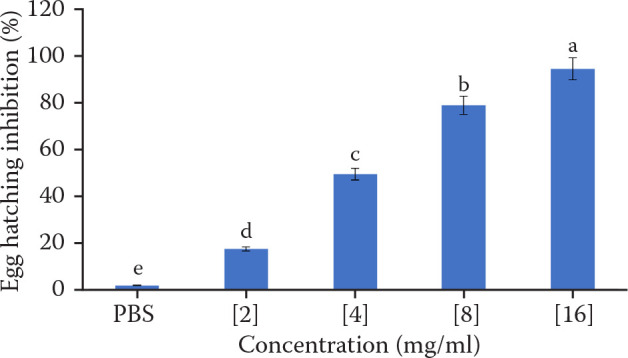
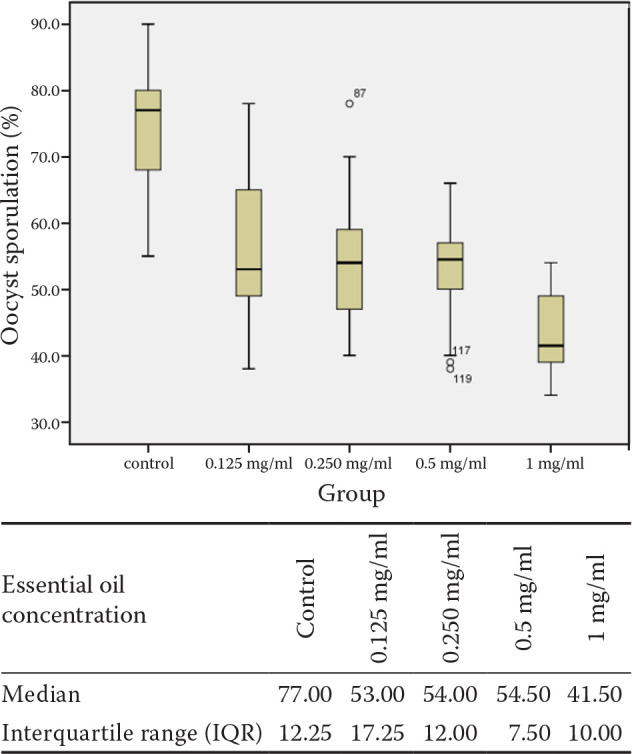
This work aimed to evaluate the valorisation of the volatile oil of "Rosmarinus officinalis L.", a spontaneously growing medicinal plant in Tunisia, by studying its chemical composition, anthelmintic and anticoccidial potentials against Eimeria spp. and Haemonchus contortus at different essential oil concentrations. The main compounds of the R. officinalis essential oil identified by GC/MS were three monoterpenes: 1,8-cineole (52.06%), α-pinene (15.35%) and camphor (7.69%). The anticoccidial activity was estimated by the inhibition percentage of the oocyte sporulation in addition to the unsporulated and degenerated Eimeria oocysts using a haemocytometer after exposure to different essential oil concentrations. The essential oil was active against Eimeria spp. oocysts of sheep at IC50 = 1.82 ug/ml. Therefore, the IC50 values of the anticoccidial activity of this oil examined was 1.82 mg/ml. The anthelmintic efficacy of the rosemary volatile oil against Haemonchus contortus was realised by two in vitro tests: the egg hatch assay (EHA) and the adult worm's motility assay (AWMA), by comparing this efficacy with albendazole (anthelmintic, of reference). In the egg hatch assay, the percentage of inhibition was observed at 16 mg/ml and was 73.76% after 2 days of incubation (IC50 = 11.41 mg/ml) and for the adult worm's motility assay, it was 100% inhibition.
Keywords: Eimeria spp.; Haemonchus contortus; Rosmarinus officinalis; coccidia; essential oil; small ruminants.
Copyright: © 2021 CAAS.
Conflict of interest statement
The authors declare no conflict of interest.
Figures
References
-
- Aboukhalid K, Lamiri A, Agacka-Moldoch M, Doroszewska T, Douaik A, Bakha M, Casanova J, Tomi F, Machon N, Al Faiz CA. Chemical polymorphism of Origanum compactum grown in all-natural habitats in Morocco. Chem Biodivers. 2016 Sep;13(9):1126-39. - PubMed
-
- Adams RP. Identification of essential oil components by gas chromatography/mass spectrometry. 4th ed. Carol Stream, IL: Allured Publishing Corporation; 2007. 811 p.
-
- Akkari H, Jebali J, Gharbi M, Mhadhbi M, Awadi S, Darghouth MA. Epidemiological study of sympatric Haemonchus species and genetic characterization of Haemonchus contortus in domestic ruminants in Tunisia. Vet Parasitol. 2013 Mar;193(1-3):118-25. - PubMed
-
- Akrout A, Hajlaoui H, Mighri H, Najjaa H, El Jani H, Zaidi S, Neffati M. Chemical and biological characteristics of essential oil of Rosmarinus officinalis cultivated in Djerba. J Essent Oil Bear Pl. 2010;13(4):398-411.
-
- Allen PC, Lydon J, Danforth HD. Effects of components of Artemisia annua on coccidia infections in chickens. Poult Sci. 1997 Aug;76(8):1156-63. - PubMed
LinkOut - more resources
Full Text Sources
Miscellaneous