


Stuttering: Our Current Knowledge, Research Opportunities, and Ways to Address Critical Gaps
- PMID: 40201450
- PMCID: PMC11977836
- DOI: 10.1162/nol_a_00162
Stuttering: Our Current Knowledge, Research Opportunities, and Ways to Address Critical Gaps
Abstract
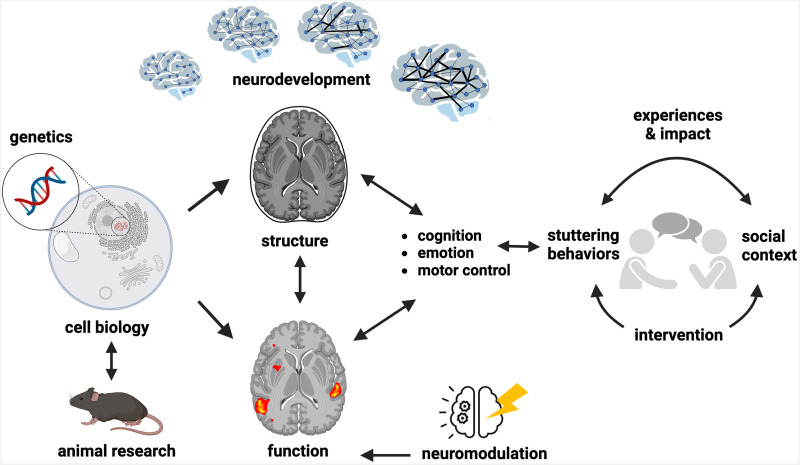
Our understanding of the neurobiological bases of stuttering remains limited, hampering development of effective treatments that are informed by basic science. Stuttering affects more than 5% of all preschool-age children and remains chronic in approximately 1% of adults worldwide. As a condition that affects a most fundamental human ability to engage in fluid and spontaneous verbal communication, stuttering can have substantial psychosocial, occupational, and educational impacts on those who are affected. This article summarizes invited talks and breakout sessions that were held in June 2023 as part of a 2-day workshop sponsored by the US National Institute on Deafness and Other Communication Disorders. The workshop encompassed topics including neurobiology, genetics, speech motor control, cognitive, social, and emotional impacts, and intervention. Updates on current research in these areas were summarized by each speaker, and critical gaps and priorities for future research were raised, and then discussed by participants. Research talks were followed by smaller, moderated breakout sessions intended to elicit diverse perspectives, including on the matter of defining therapeutic targets for stuttering. A major concern that emerged following participant discussion was whether priorities for treatment in older children and adults should focus on targeting core speech symptoms of stuttering, or on embracing effective communication regardless of whether the speaker exhibits overt stuttering. This article concludes with accumulated convergent points endorsed by most attendees on research and clinical priorities that may lead to breakthroughs with substantial potential to contribute to bettering the lives of those living with this complex speech disorder.
Keywords: genetics; intervention; neurobiology; research priorities; speech disorder; treatment.
© 2025 Massachusetts Institute of Technology.
Conflict of interest statement
Competing Interests: The authors have declared that no competing interests exist.
Figures
References
-
- Ajdacic-Gross, V., Bechtiger, L., Rodgers, S., Müller, M., Kawohl, W., von Känel, R., Mutsch, M., Rössler, W., Seifritz, E., Castelao, E., Strippoli, M.-P. F., Vandeleur, C., Preisig, M., & Howell, P. (2018). Subtypes of stuttering determined by latent class analysis in two Swiss epidemiological surveys. PLOS ONE, 13(8), Article e0198450. 10.1371/journal.pone.0198450, - DOI - PMC - PubMed
Publication types
Grants and funding
LinkOut - more resources
Full Text Sources
Research Materials