


Evaluation of Nosocomial Infection Management Efficiency Based on the Data Envelopment Analysis Model
- PMID: 40201767
- PMCID: PMC11977550
- DOI: 10.2147/RMHP.S520382
Evaluation of Nosocomial Infection Management Efficiency Based on the Data Envelopment Analysis Model
Abstract
Background: This study used data envelopment analysis (DEA), to assess relative efficiency of infection control in different clinical departments of the hospital for performance evaluation purposes.
Methods: All wards and departments from January to December 2022 were selected as decision units, and five input and two output indicators related to infection prevention and control were determined using DEA. Pure technical efficiency was evaluated using the Banker-Charnes-Cooper (BCC) model.
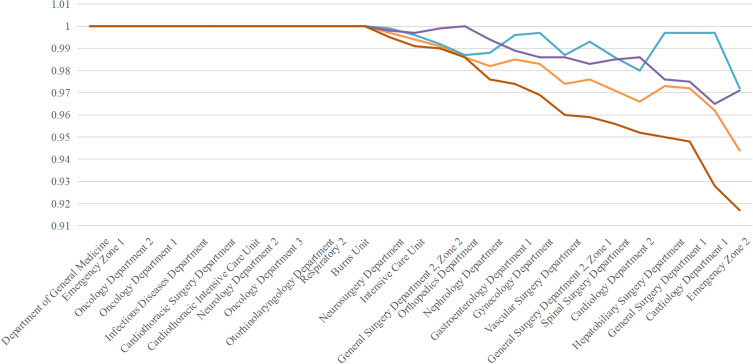
Results: In the study, the input-output indexes of the 27 clinical departments varied significantly. The average values of technical efficiency, pure technical efficiency, scale efficiency, and comprehensive benefit were 0.987, 0.995, 0.992, and 0.980, respectively. Among the 27 departments, 52% exhibited constant returns to scale, 44% showed increasing returns to scale, and 4% had decreasing returns to scale. In the context of DEA, 44% of the departments were classified as highly efficient, indicating that their input-output ratios had reached an optimal state. Meanwhile, 56% of the departments were identified as non-DEA efficient, suggesting that there was room for improvement in their input-output efficiency.
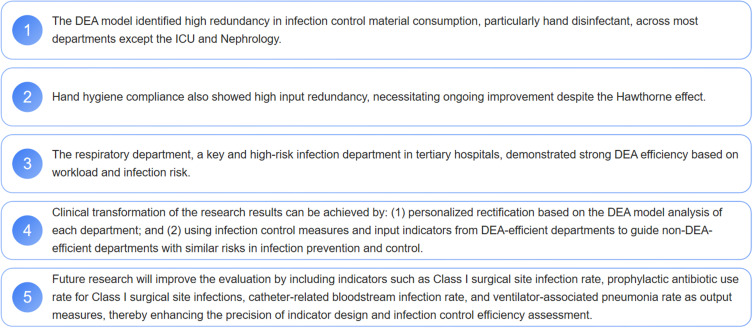
Conclusion: The improvement of input-output indexes of non-DEA effective clinical departments was defined by the BCC model. Use of DMUs could improve the efficiency of inventory control by optimizing the allocation of inventory control resources and refining inventory control measures.
Keywords: data envelopment analysis; efficiency; hospital infection; performance evaluation.
© 2025 Wang et al.
Conflict of interest statement
The authors declare that they have no conflicts of interest to this work.
Figures
References
-
- Charnes A, Cooper WW, Rhodes E. Measuring the efficiency of decision making units. Eur J Oper Res. 1978;2(6):429–444. doi:10.1016/0377-2217(78)90138-8 - DOI
LinkOut - more resources
Full Text Sources
