


Toward Optimizing the Impact of Digital Pathology and Augmented Intelligence on Issues of Diagnosis, Grading, Staging, and Classification
- PMID: 40204094
- PMCID: PMC12272330
- DOI: 10.1016/j.modpat.2025.100765
Toward Optimizing the Impact of Digital Pathology and Augmented Intelligence on Issues of Diagnosis, Grading, Staging, and Classification
Abstract
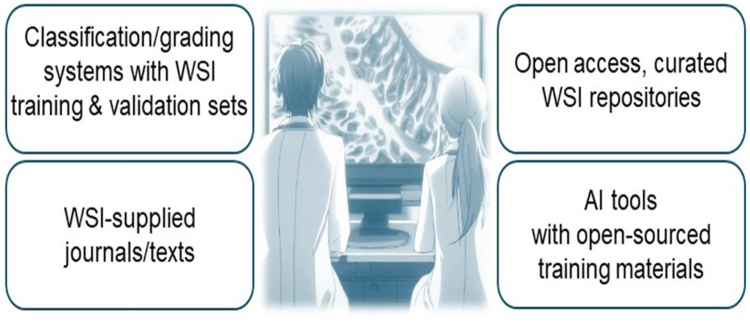
The introduction of new diagnostic information in pathology requires effective dissemination and adoption strategies. Although traditional methods like journals, meetings, and atlases have been used, they pose challenges in accessibility, interactivity, and performance validation. Digital pathology (DP) and artificial or augmented intelligence (AI) offer promising solutions to address these limitations. This paper advocates the use of DP and AI tools to facilitate the introduction of new diagnostic information in pathology. It highlights the importance of standardized training and validation sets, digital slide libraries, and AI-enhanced diagnostic tools. Although AI can improve efficiency and accuracy, it is crucial to address potential pitfalls such as over-reliance on AI, bias, and the need for human oversight. By leveraging DP and AI, the efficiency and accuracy of diagnosis, grading, staging, and classification can be augmented, ultimately improving patient care.
Keywords: artificial intelligence; classification systems; competency; diagnosis; digital pathology; grading; training sets; validation.
Copyright © 2025. Published by Elsevier Inc.
Figures
References
Publication types
MeSH terms
Grants and funding
LinkOut - more resources
Full Text Sources
