


Systematic review of AI/ML applications in multi-domain robotic rehabilitation: trends, gaps, and future directions
- PMID: 40205472
- PMCID: PMC11984262
- DOI: 10.1186/s12984-025-01605-z
Systematic review of AI/ML applications in multi-domain robotic rehabilitation: trends, gaps, and future directions
Abstract
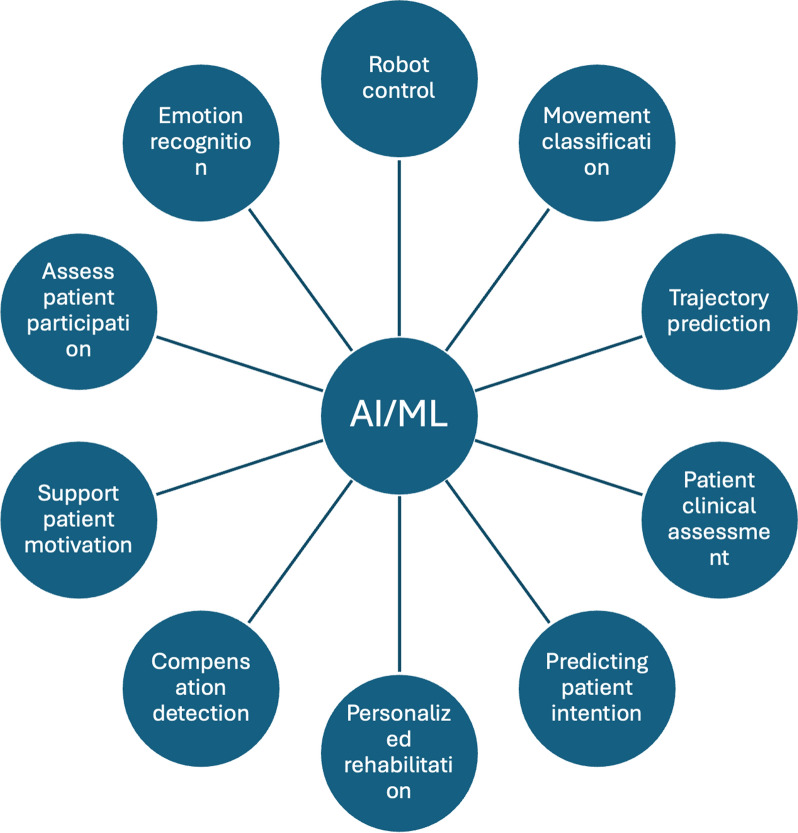
Robotic technology is expected to transform rehabilitation settings, by providing precise, repetitive, and task-specific interventions, thereby potentially improving patients' clinical outcomes. Artificial intelligence (AI) and machine learning (ML) have been widely applied in different areas to support robotic rehabilitation, from controlling robot movements to real-time patient assessment. To provide an overview of the current landscape and the impact of AI/ML use in robotics rehabilitation, we performed a systematic review focusing on the use of AI and robotics in rehabilitation from a broad perspective, encompassing different pathologies and body districts, and considering both motor and neurocognitive rehabilitation. We searched the Scopus and IEEE Xplore databases, focusing on the studies involving human participants. After article retrieval, a tagging phase was carried out to devise a comprehensive and easily-interpretable taxonomy: its categories include the aim of the AI/ML within the rehabilitation system, the type of algorithms used, and the location of robots and sensors. The 201 selected articles span multiple domains and diverse aims, such as movement classification, trajectory prediction, and patient evaluation, demonstrating the potential of ML to revolutionize personalized therapy and improve patient engagement. ML is reported as highly effective in predicting movement intentions, assessing clinical outcomes, and detecting compensatory movements, providing insights into the future of personalized rehabilitation interventions. Our analysis also reveals pitfalls in the current use of AI/ML in this area, such as potential explainability issues and poor generalization ability when these systems are applied in real-world settings.
Keywords: Artificial intelligence; Cognitive; Deep learning; Gait; Movement; Patient assessment; Physical therapy; Sensor; Stroke; Trauma.
© 2025. The Author(s).
Conflict of interest statement
Declarations. Ethics approval and consent to participate: Not applicable. Consent for publication: Not applicable. Competing interests: The authors declare no competing interests.
Figures



References
-
- Nicholson S, Sniehotta FF, van Wijck F, Greig CA, Johnston M, McMurdo MET, et al. A systematic review of perceived barriers and motivators to physical activity after stroke. Int J Stroke. 2013;8(5):357–64. - PubMed
Publication types
MeSH terms
Grants and funding
- # PNC0000007/Ministero dell'Istruzione, dell'Università e della Ricerca
- # PNC0000007/Ministero dell'Istruzione, dell'Università e della Ricerca
- # PNC0000007/Ministero dell'Istruzione, dell'Università e della Ricerca
- # PNC0000007/Ministero dell'Istruzione, dell'Università e della Ricerca
- # PNC0000007/Ministero dell'Istruzione, dell'Università e della Ricerca
LinkOut - more resources
Full Text Sources
Medical
