


Attitudes towards living organ donation: a cross-sectional survey study
- PMID: 40206178
- PMCID: PMC11979268
- DOI: 10.3389/fpubh.2025.1552393
Attitudes towards living organ donation: a cross-sectional survey study
Abstract
Objective: Only 18% of kidneys and livers transplanted in the United States come from living donors, and increasing rates of living organ donation could help decrease the critical organ deficit. Non-directed living donation is even less common, with only 1.4% of kidney and liver transplants coming from anonymous donors (1). This study aimed to determine which factors are considered more motivating and more discouraging to living organ donation, how characteristics of potential recipients affect willingness to consider living liver donation, and whether there are any associations related to a person's willingness to consider non-directed living organ donation.
Method: A cross-sectional survey was distributed in-person on a large medical campus, and participation was incentivized with the opportunity to spin a prize wheel. In addition to participant characteristics, the survey queried awareness of directed and non-directed living donation, whether or not the participant would consider directed donation and non-directed donation, motivating and discouraging factors to living donation, vignettes to assess willingness to donate to recipients with different characteristics, and an altruism personality inventory. An optional interpersonal reactivity index was included as well.
Results: Three hundred twenty-six participants scanned a QR code to take the survey. Most participants (299 of 318, 94%) were aware of living donation. Participants who said yes to considering non-directed living donation (67 of 305, 22%) had significantly higher altruism scores than those who said no (123 of 305, 40%). Willingness to consider living liver donation varied based on recipient characteristics, with participants reporting they would be more willing to donate to a recipient with an immune disorder over alcohol-related liver disease, an infant over an adult, a relative over a nonrelative, and a sibling with alcohol-related liver disease over a nonrelative with alcohol-related liver disease.
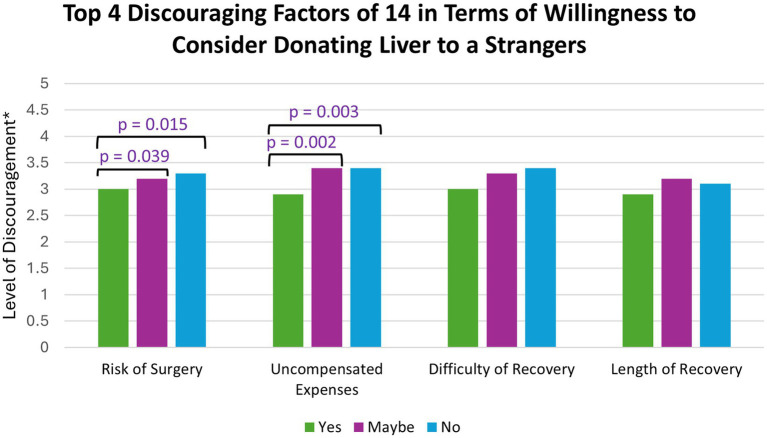
Conclusion: The most motivating factors for considering living donation were having a child recipient, helping someone in need, high transplant center success rate, and helping a family member or friend. The most discouraging factors were uncompensated expenses, difficulty of surgery recovery, risk of surgery, and length of recovery. Participants were less willing to donate to adults, strangers, and recipients with alcohol-related liver disease.
Keywords: altruism; altruistic living donor; living kidney donation; living liver donation; living organ donation; non-directed living donation; organ donation.
Copyright © 2025 Naibauer, Branagan, Lehto, Reynolds, Mikulich-Gilbertson, Page and Davis.
Conflict of interest statement
The authors declare that the research was conducted in the absence of any commercial or financial relationships that could be construed as a potential conflict of interest.
Figures



References
-
- National Data . (1988–2024). U.S. Department of Health & Human Services. [Accessed December 27, 2024].
MeSH terms
LinkOut - more resources
Full Text Sources
Medical
