


Trajectories of depressive symptoms of mothers and fathers over 11 years
- PMID: 40207920
- PMCID: PMC12037347
- DOI: 10.1017/S2045796025000174
Trajectories of depressive symptoms of mothers and fathers over 11 years
Abstract
Aims. Parental postpartum depressive symptoms have been extensively studied, but the combined longitudinal depression trajectories of parents and their long-term development beyond the postpartum period remain largely underexplored. We identified dyadic longitudinal depressive symptom trajectories in new parents, followed over an 11-year period, and compared parental characteristics, as well as child temperament and mental health factors, across different parental trajectory classes.
Methods. A prenatal cohort of 5,518 couples was studied. Depressive symptoms were measured using the Edinburgh Postnatal Depression Scale at eight time points: in the prenatal stage, in the newborn stage, and at 6 months, 18 months, 3 years, 5 years, 7 years and 11 years after the birth of the child.
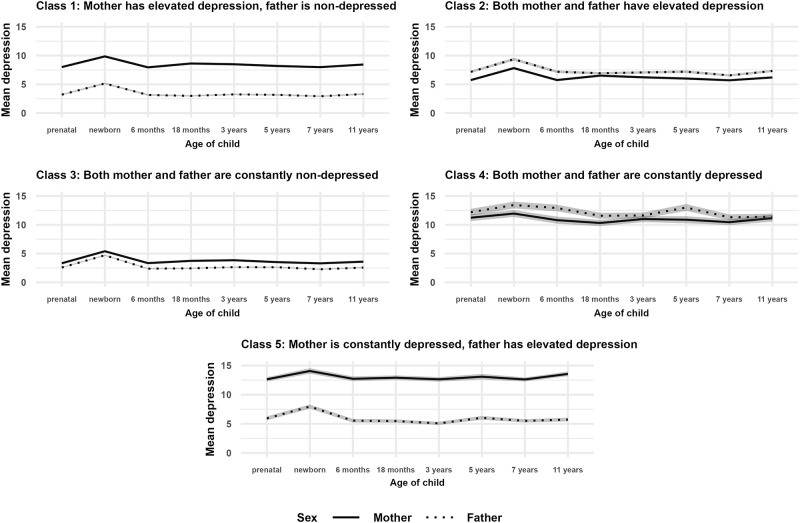
Results. Dyadic Latent Class Growth Modelling identified five classes of couples: (1) mother has elevated depressive symptoms, father is non-depressed (24%); (2) both mother and father have elevated depressive symptoms (20%); (3) both mother and father are constantly non-depressed (42%); (4) both mother and father are constantly depressed (5%); and (5) mother is constantly depressed, father has elevated depressive symptoms (9%). Relationship maintenance (particularly being married or separated) was the most strongly associated with the classes. Socio-economic resources, emotional well-being, health, obstetric history and parental background also served as meaningful covariates. Child temperament and mental health showed weak correlations with parental trajectory classes.
Conclusions. Parents with postpartum depressive symptoms often experience depressive symptoms long-term. Separated parents are particularly vulnerable to adverse depressive trajectories. Our findings underscore the importance of dyadic methods in estimating unique combinations of parental depression trajectories.
Keywords: depressive symptoms; dyadic trajectories; latent trajectories; postpartum depression; relationship maintenance.
Conflict of interest statement
The authors disclose no conflict of interest.
Figures
References
-
- Allen NB and Badcock PBT (2003) The social risk hypothesis of depressed mood: Evolutionary, psychosocial, and neurobiological perspectives. Psychological Bulletin 129, 887–913. - PubMed
-
- Amendola S, Hengartner MP, Ajdacic-Gross V, Angst J and Rössler W (2022) Longitudinal reciprocal associations between depression, anxiety, and substance use disorders over three decades of life. Journal of Affective Disorders 302, 315–323. - PubMed
-
- American Psychiatric Association (2013) Depressive disorders. In Diagnostic and Statistical Manual of Mental Disorders. 5th edition. Arlington, VA: American Psychiatric Publishing Inc., 153–188.
-
- Ando H, Shen J, Morishige KI, Suto S, Nakashima T, Furui T, Kawasaki Y, Watanabe H and Saijo T (2021) Association between postpartum depression and social support satisfaction levels at four months after childbirth. Archives of Psychiatric Nursing 35, 341–346. - PubMed
LinkOut - more resources
Full Text Sources
