Clinical Trial
. 2025 May:82:103592.
doi: 10.1016/j.redox.2025.103592. Epub 2025 Mar 28.

Accelerating inflammatory resolution in humans to improve endothelial function and vascular health: Targeting the non-canonical pathway for NO

Affiliations
Clinical Trial

Accelerating inflammatory resolution in humans to improve endothelial function and vascular health: Targeting the non-canonical pathway for NO

Clement Lau et al. Redox Biol. 2025 May.

Abstract

Background: Chronic cardiovascular diseases (CVD) are characterised by low-grade systemic inflammation in part due to reduced nitric oxide (NO) bioavailability associated with endothelial dysfunction. Bioavailability of NO can be enhanced by activation of the non-canonical pathway, through increased dietary inorganic nitrate consumption with the potential to attenuate inflammation.

Methods: We sought to determine whether dietary inorganic nitrate influences the inflammatory response in models of localised (cantharidin-induced blisters) and systemic inflammation (typhoid vaccine), in healthy male volunteers and conducted two clinical trials; Blister-NITRATE and Typhoid-NITRATE respectively.

Results: We show that dietary nitrate attenuates endothelial dysfunction following typhoid vaccine administration and accelerates resolution of cantharidin-induced blisters. Both phenomena were associated with an increased level of pro-resolving mediators consequent to a reduction in the expression and activity of pro-inflammatory monocytes. Moreover, we show that leukocytes of the monocyte lineage express the nitrite reductase XOR, that may drive localised nitrite reduction to elevate NO (and cGMP) to drive the protective phenotype.

Conclusions: Inorganic nitrate improves endothelial function in the setting of systemic inflammation. Whilst the immediate inflammatory response appeared unaffected by inorganic nitrate treatment, during the resolution phase of the acute inflammatory response lower levels of pro-inflammatory classical inflammatory and intermediate monocytes and attenuated levels of inflammatory cytokines and chemokines were evident. We propose that this reflects a pro-resolution phenotype that may be of potential therapeutic benefit in patients with established CVD.

Clinical trial registration: URL: https://www.

Clinicaltrials: gov; unique identifiers NCT02715635, NCT03183830.

Keywords: Blister; Endothelium; Inflammation; Inorganic; Nitrate; Typhoid.


Conflict of interest statement

Declaration of competing interest The authors declare the following financial interests/personal relationships which may be considered as potential competing interests: Prof A Ahluwalia is a Director of Heartbeet Ltd and IoNa Therapeutics. A Ahluwalia holds two relevant patents: WO2024160924A1; WO2024160921A1.

Figures

Fig. 1
Fig. 1
Consort flow charts for (A) Typhoid-NITRATE and (B)Blister-NITRATE. BP, blood pressure; FMD, flow-mediated dilatation; GTN, glyceryl trinitrate.
Fig. 2
Fig. 2
Dietary nitrate prevents systemic inflammation-induced endothelial dysfunction. (A) Typhoid-NITRATE Part I: FMD response 8 and 32 h following typhoid vaccination in placebo versus nitrate treated groups. n = 78. B) Comparison between the treatment groups of the change in FMD response at 8h from baseline. Typhoid-NITRATE Part II: (C) GTN induced brachial artery dilatation. Maximal dilatation of brachial artery in response to GTN in volunteers treated with placebo versus nitrate measured at 8- and 32-h post-vaccination n = 16. D) Comparison between the treatment groups of the change in GTN response at 8h from baseline.Statistical significance determined by 1-way ANOVA, with Dunnett's post hoc analysis for multiple group analysis and unpaired t-test for comparison of change in response at 8h compared to baseline. All data are expressed as mean ± SEM. FMD, flow-mediated dilation; GTN, glyceryl trinitrate.
Fig. 3
Fig. 3
Dietary nitrate suppresses systemic inflammation. The proportion of leukocyte subtypes CD16b+ neutrophils (A,B), CD14++/CD16- classical monocytes (C,D), CD14++/CD16+intermediate monocytes (E,F) and CD14+/CD16++ non-classical monocytes (G,H) at 8 and 32h following typhoid vaccination in placebo versus nitrate treated groups n = 62 and change from baseline in proportion respectively. Panel I shows the change from baseline in the proportion of CD62L+/CD14++/CD16+ monocytes, (I) change in % intermediate pro-inflammatory monocytes expressing CD62L at 8h from baseline. Individual paired datasets are shown with paired t-test for comparison of 8h to baseline. Circulating levels of pro-inflammatory IL-6 (J) and CCL2 (K) and anti-inflammatory TGFbeta (L) at baseline and at 8h following Typhoid vaccine administration in placebo following typhoid vaccination in placebo versus nitrate treated groups. Statistical significance determined by mixed effects analysis with Dunnett's post hoc analysis for within group comparison to baseline over time in Figure A,E,C,G and unpaired t-test for comparison of change in response at 8h compared to baseline in B,D,F,H and I. For cytokine analysis paired t-tests were conducted within groups (panels J,K,L). All data are expressed as mean ± SEM.
Fig. 4
Fig. 4
Dietary nitrate treatment does not alter the acute 24h leukocyte response to Cantharidin but does accelerate resolution. Data is shown as scatter with the mean ± SEM indicated at the 24h timepoint for n = 17 volunteers with paired samples in the placebo limb and in the dietary nitrate limb N = 14, and then for the 72h blisters with n = 11 paired samples for the Placebo and N = 12 for the dietary nitrate. No significant differences found in any parameters using paired t-test for within group comparison and unpaired t-test for comparison of change from baseline.
Fig. 5
Fig. 5
Dietary nitrate treatment leads to significant reductions in the proportion of neutrophils and intermediate pro-inflammatory monocyte levels at 72h. Leukocyte subtypes were identified using specific fluorescence-tagged antibodies and visualised using flow cytometry and are shown as at 24 h A) % neutrophil, B) change in the % neutrophil content from control, C) % classical monocyte and D) change from control, E)% intermediate monocyte and F) change from control, G) % non-classical monocyte and H) change from control. Similar leukocyte sub-populations are shown for the 72h timepoint with neutrophils (I,J) classical monocytes (K,L), intermediate monocytes (M,N) and non-classical monocytes (O). Data is shown as scatter with the mean ± SEM indicated at the 24h timepoint for n = 17 volunteers with paired samples in the placebo limb and in the dietary nitrate limb N = 14, and then for the 72h blisters with n = 11 paired samples for the Placebo and N = 12 for the dietary nitrate. Statistical analysis conducted using paired t-test for within group comparison and unpaired t-test for comparison of change from baseline.
Fig. 6
Fig. 6
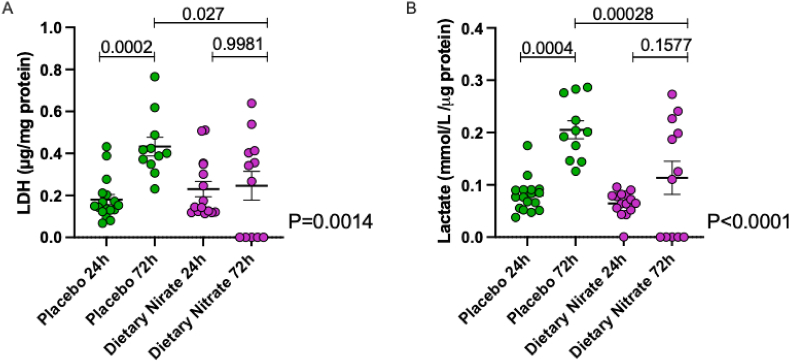
Dietary nitrate treatment is associated with an accelerated resolution of inflammation as reflected by a faster return to a low metabolism setting. Data shows the lactate dehydrogenase activity (LDH, A) and lactate (B) levels ion the blister supernatant and is shown as scatter with the mean ± SEM indicated at the 24h timepoint for n = 17 volunteers in the placebo arm and N = 14 in the dietary nitrate arm, and then for the 72h blisters with n = 11 for the Placebo and N = 12 for dietary nitrate. Statistical significance determined using one-way ANOVA, with Bonferroni's post hoc analysis for multiple group comparison.
Fig. 7
Fig. 7
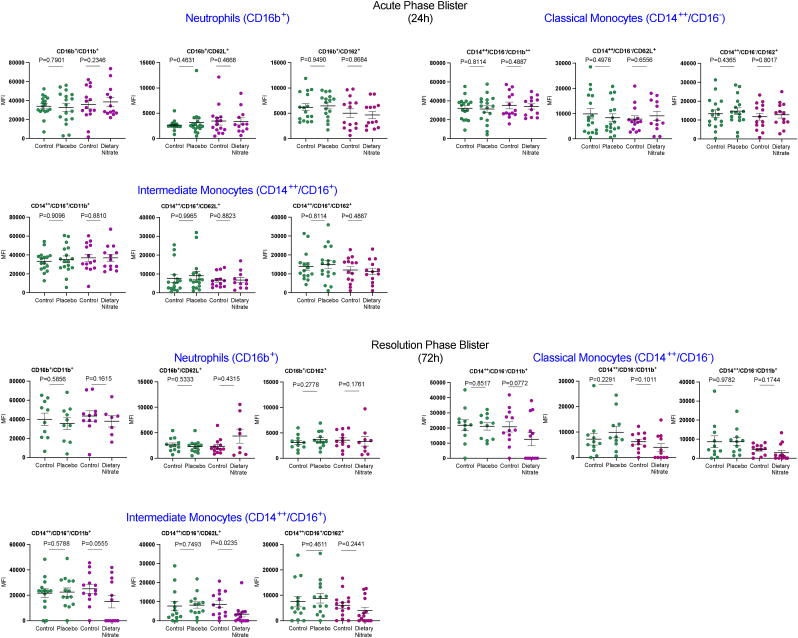
Dietary nitrate attenuates the activation state of inflammatory and intermediate monocytes during the resolution stage of inflammation whilst having no impact upon neutrophil and monocyte activation state during the acute 24 h response to cantharidin. Data is shown as scatter with the mean ± SEM indicated at the 24h timepoint for n = 17 volunteers with paired samples in the placebo limb and N = 14 in the dietary nitrate limb. For the 72h blisters data is shown for N = 11 paired samples for the Placebo and N = 12 for the dietary nitrate limb. Data shows the expression of the CD11b, CD62L and CD162 activation markers on leukocyte subtypes identified within blister fluid in volunteers prior to and following treatment with placebo or dietary nitrate treatment. Leukocyte subtypes were identified using specific fluorescence-tagged antibodies and visualised using flow cytometry and expression shown as mean fluorescence intensity (MFI) for each marker. Statistical analysis conducted using paired t-test for within group comparison.
Fig. 8
Fig. 8
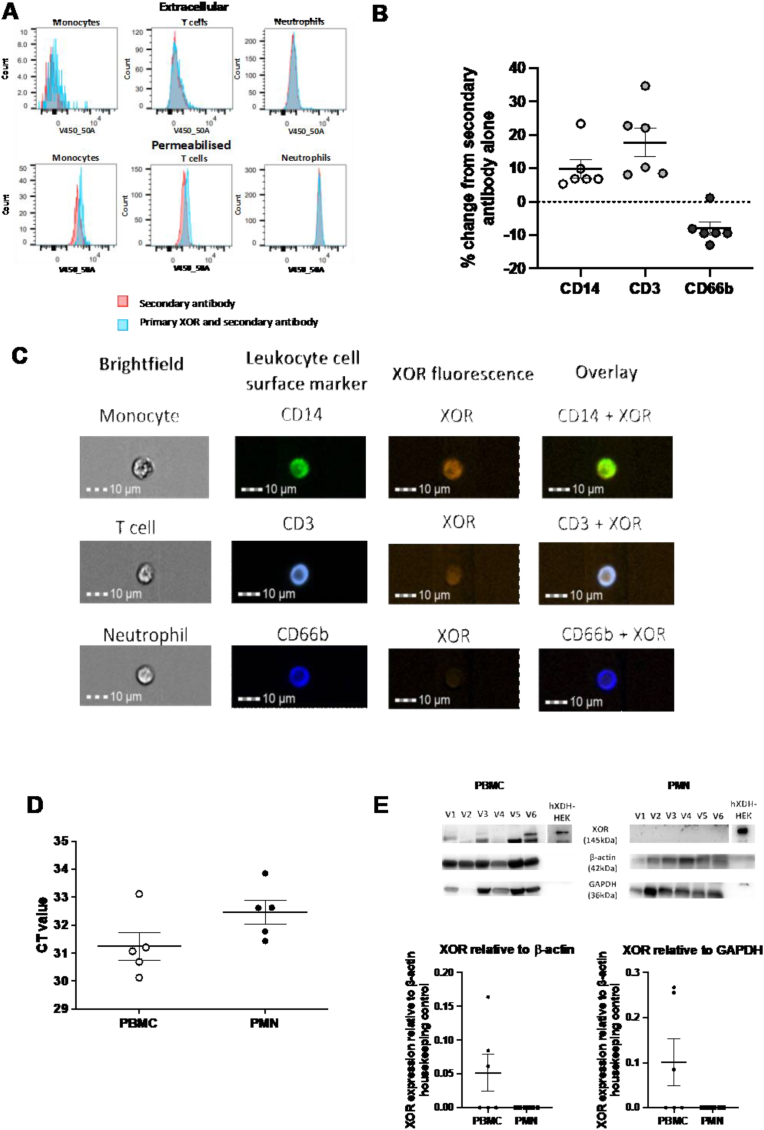
XOR expression and activity evident in PBMCs. XOR is absent on the leukocyte cell surface but is present intracellularly in CD14+ (monocytes) and CD3+ cells (T cells) and absent on CD66b+ cells (neutrophils) in healthy individuals. A) Representative histograms of flow cytometry show a rightward shift in permeabilised monocytes and T cells, that is absent in neutrophils and B) shows quantification of this. C) shows images acquired on Image stream confirming the flow cytometry observations. Isolated leukocyte populations were subjected to qPCR (D) and Western blotting (E) PBMCs = monocytes and T cells n = 6. All data is shown of n = 6 healthy volunteers with individual volunteers represented as single points or with the icon V 1–6.

References

    1. Libby P. Inflammation in atherosclerosis. Arterioscler. Thromb. Vasc. Biol. 2012;32(9):2045–2051. - PMC - PubMed
    1. Kohchi K., Takebayashi S., Hiroki T., Nobuyoshi M. Significance of adventitial inflammation of the coronary artery in patients with unstable angina: results at autopsy. Circulation. 1985;71(4):709–716. - PubMed
    1. Zhao T.X., Mallat Z. Targeting the immune system in atherosclerosis: JACC state-of-the-art review. J. Am. Coll. Cardiol. 2019;73(13):1691–1706. - PubMed
    1. Libby P. The changing landscape of atherosclerosis. Nature. 2021;592(7855):524–533. - PubMed
    1. Cai H., Harrison D.G. Endothelial dysfunction in cardiovascular diseases: the role of oxidant stress. Circ. Res. 2000;87:840–844. - PubMed

Publication types

Associated data

LinkOut - more resources