


Relationship between psychological resilience and quality of life in cancer patients and the multiple mediating roles of stigma and self perceived burden
- PMID: 40210934
- PMCID: PMC11985974
- DOI: 10.1038/s41598-025-96460-2
Relationship between psychological resilience and quality of life in cancer patients and the multiple mediating roles of stigma and self perceived burden
Abstract
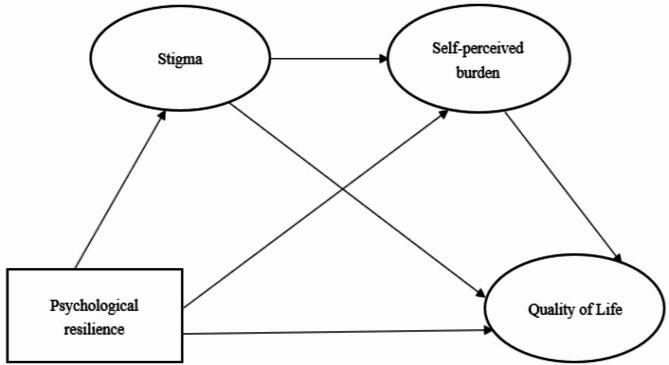
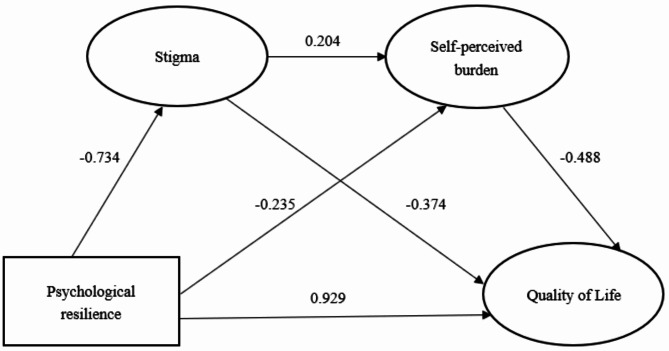
The goal of this study was to explore the impact of psychological resilience on the QOL of cancer patients and the multiple mediating roles of stigma and self-perceived burden. This study utilized a cross-sectional design. The study population consisted of 364 cancer patients selected by convenience sampling method between November 2022 and May 2023 in two tertiary hospitals in Jinzhou City, Liaoning Province. All participants volunteered to participate in the study and signed an informed consent form. Data were collected using questionnaires. The questionnaires included the General Information Questionnaire, the Psychological Resilience Scale, the Stigma Scale, the Self-Perceived Burden Scale, and the Quality of Life Questionnaire. SPSS 25.0 and PROCESS 3.5 macros were employed for description statistics and related analyses of the data, as well as multiple mediation effect tests. Psychological resilience directly affects QOL (β = 0.929, 95% CI 0.729-1.130) and indirectly through three mediating pathways: stigma (β = 0.275, 95% CI 0.154-0.398, 19.76% of total effect), self-perceived burden (β = 0.115, 95% CI 0.046-0.205, 8.26% of total effect), and both stigma and self-perceived burden (β = 0.073, 95% CI 0.029-0.132, 5.24% of total effect), accounting for 33.26% of the overall mediated effect. Stigma and self-perceived burden act as mediators in influencing psychological resilience and QOL of cancer patients. Enhancing psychological resilience and reducing stigma and self-perceived burden is crucial for improving their QOL.
Keywords: Cancer patients; Psychological resilience; Quality of life; Self-perceived burden; Stigma.
© 2025. The Author(s).
Conflict of interest statement
Declarations. Competing interests: The authors declare no competing interests. Ethics approval and consent to participate: All individuals have provided informed consent before the data collection. Participating patients were promised that the information provided would remain anonymous. Approval for the study was obtained from the College of Nursing’s Research Committee at Jinzhou Medical University (JZMULL2022086), and all methods were performed following the relevant guidelines and regulations.
Figures
References
MeSH terms
LinkOut - more resources
Full Text Sources
Medical
