


Insight into public sentiment and demand in China's public health emergency response: a weibo data analysis
- PMID: 40211194
- PMCID: PMC11983825
- DOI: 10.1186/s12889-025-22553-2
Insight into public sentiment and demand in China's public health emergency response: a weibo data analysis
Abstract
Background: During the COVID-19 pandemic, public sentiment and demands have been prominently reflected on social media platforms like Weibo. Understanding these sentiments and demands is crucial for governments, health officials, and policymakers to make effective responses and adjustments.
Objective: The study aims to analyze public sentiment and identify key demands concerning COVID-19 policies and social issues using Weibo data, providing insights to improve China's policies and legal systems in public health emergencies.
Methods: The study used Python tools to collect public opinion data from Weibo regarding policy adjustments, social issues, and livelihood concerns. A total of 50,249 valid comments on 100 blog posts were collected from December 2019 to October 2023 in China. The SnowNLP algorithm was employed for sentiment analysis, Latent Dirichlet Allocation was used for topic clustering, and sampling coding was applied to further explore public demands by condensing the comment texts.
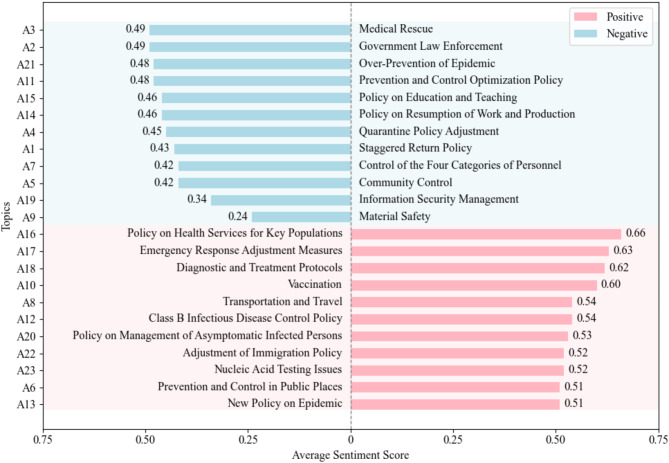
Results: The study categorized 100 blog posts into 23 important topics, with average sentiment scores ranging from 0.24 to 0.66. These scores ranging from 0 to 1 reflect sentiment polarity, where lower values indicate more negative public sentiment. The topics of material safety and information security management had the lowest scores, at 0.24 and 0.34, respectively. The analysis further revealed that the 23 topics could be classified into 57 subtopics, and a total of 101 concepts were identified through coding. The study found that public demands fall into five key categories: transportation and travel security, epidemic protection and health security, law building and policy implementation, social services and public demand, and education demand.
Conclusions: The study underscores the complexity of public sentiment during the epidemic, with significant concerns about material safety and information security management. Public demands span basic survival needs to higher-order concerns such as education and legal protections. The findings suggest that policy-making processes must become more responsive, transparent, and equitable, incorporating real-time public feedback and ensuring comprehensive policies and legal systems are in place to address multifaceted public demands effectively.
Keywords: COVID-19; Latent dirichlet allocation; Public health emergency; Public opinion; Sentiment analysis.
© 2025. The Author(s).
Conflict of interest statement
Declarations. Ethics approval and consent to participate: Not applicable. Consent for publication: Not applicable. Conflict of interest: The authors declare no conflict of interest.
Figures

References
-
- Speech at the meeting to. coordinate the promotion of the prevention and control of the new crown pneumonia epidemic and the deployment of economic and social development. [https://www.gov.cn/xinwen/2020-02/24/content_5482502.htm]
-
- Prybyla JS. China’s long march toward rule of law. Cambridge University Press; 2002.
-
- Song L. Legal regulation and reflection of public health emergencies in China on the example of coronavirus pandemic. Probl Sustainable Dev / Problemy Ekorozwoju 2021, 16(2).
-
- James P, Kingdon JW. Agendas, alternatives, and public policies. J Policy Anal Manag 1985.
MeSH terms
Grants and funding
LinkOut - more resources
Full Text Sources
Medical
