


Impact of metabolically healthy obesity on post percutaneous coronary intervention outcomes in patients with acute myocardial infarction: A nationwide propensity matched analysis
- PMID: 40212728
- PMCID: PMC11985055
- DOI: 10.1016/j.obpill.2025.100167
Impact of metabolically healthy obesity on post percutaneous coronary intervention outcomes in patients with acute myocardial infarction: A nationwide propensity matched analysis
Abstract
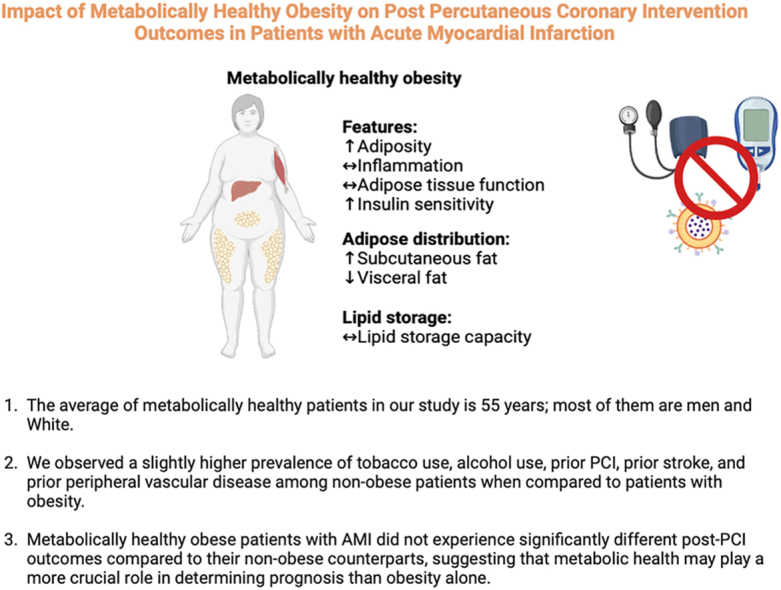
Background: Obesity paradox in post-percutaneous coronary intervention (PCI) outcomes among acute myocardial infarction (AMI) patients is a known controversy. However, these studies included patients who had diabetes, hypertension, or hyperlipidemia. We studied relationship between metabolically healthy obesity (MHO-without diabetes, hypertension, or hyperlipidemia) and in-hospital post-PCI outcomes among AMI patients.
Methods: We extracted data from National Inpatient Sample 2020 using International Classification of Diseases, Tenth Revision, Clinical Modification (ICD-10-CM) codes for admissions of AMI patients who underwent PCI. We then identified patients with diabetes, hypertension, and hyperlipidemia using Elixhauser comorbidity index and Clinical Classifications Software and excluded them. Then, using Elixhauser comorbidity index, we identified patients with and without obesity, defined as BMI > 30 kg/m 2 and propensity score matching was done for age and sex. Later, multivariable regression analysis was done for in-hospital post-PCI outcomes.
Results: Among 25605 metabolically healthy patients who had AMI and underwent PCI, 2825 had obesity, and 22780 didn't. After propensity score matching (PSM) for age and sex, both cohorts had 2795 patients each. There was no statistically significant difference in in-hospital all-cause mortality (adjusted odds ratio [OR] 1.14, 95 % confidence interval [CI] 0.63-2.10, p = 0.661), post-PCI stroke (aOR 1.17, 95 % CI 0.50-2.75, p = 0.714), acute kidney injury (aOR 1.20, 95 % CI 0.84-1.72, p = 0.322), post-PCI bleeding (aOR 1.04, 95 % CI 0.35 to 3.12, p = 0.940) and intra or post-PCI cardiac arrest (aOR 1.14, 95 % CI 0.30 to 4.42, p = 0.835) between both cohorts.
Conclusions: No statistically significant association was found between obesity and post-PCI outcomes in metabolically healthy patients with AMI. Larger studies are needed to explore the controversial "obesity paradox" in cardiovascular diseases.
Keywords: Body mass index; Metabolically healthy obesity; Myocardial infarction; Obesity; Percutaneous coronary intervention.
© 2025 Published by Elsevier Inc. on behalf of Obesity Medicine Association.
Conflict of interest statement
The authors declare that they have no known competing financial interests or personal relationships that could have appeared to influence the work reported in this paper.
References
-
- Holroyd E.W., Sirker A., Kwok C.S., Kontopantelis E., Ludman P.F., De Belder M.A., Butler R., Cotton J., Zaman A., Mamas M.A., British Cardiovascular Intervention Society and National Institute of Cardiovascular Outcomes Research The relationship of body mass index to percutaneous coronary intervention outcomes: does the obesity paradox exist in contemporary percutaneous coronary intervention cohorts? Insights from the British cardiovascular intervention society registry. JACC Cardiovasc Interv. 2017;10(13):1283–1292. doi: 10.1016/j.jcin.2017.03.013. - DOI - PubMed
LinkOut - more resources
Full Text Sources
Miscellaneous
