


Transmission of autochthonous Aedes-borne arboviruses and related public health challenges in Europe 2007-2023: a systematic review and secondary analysis
- PMID: 40213502
- PMCID: PMC11984593
- DOI: 10.1016/j.lanepe.2025.101231
Transmission of autochthonous Aedes-borne arboviruses and related public health challenges in Europe 2007-2023: a systematic review and secondary analysis
Abstract
Background: Local transmission of dengue, chikungunya, and Zika infection is an emerging public health threat in Europe. Monitoring the epidemiological trends can help define the intervention strategy. The aim of this work was to analyse epidemiological characteristics of autochthonous transmission of Aedes-borne arboviruses in Europe.
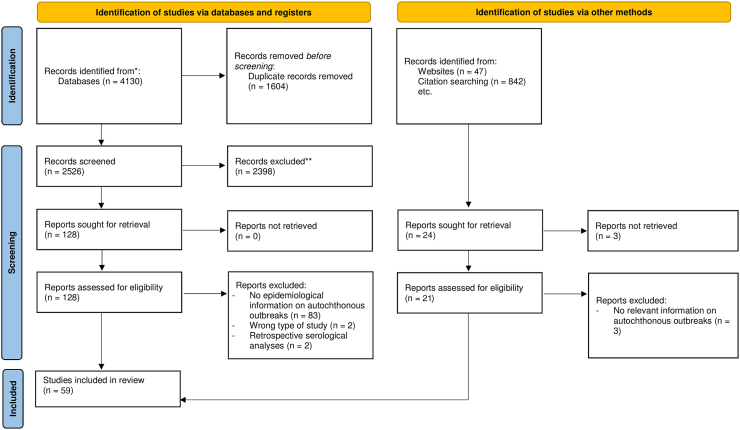
Methods: A systematic review of the literature published from January 1, 2007, to January 31, 2024, reporting autochthonous cases of dengue, chikungunya, and Zika detected in Europe was performed. We searched MEDLINE, EMBASE, and the ECDC reports. Descriptive statistics and a secondary analysis were used to summarize the epidemiological characteristics of local transmission events (LTEs), explore potential temporal trends and identify relevant associations between epidemiological variables. Time intervals between key events were analysed to identify potential delays in LTE identification and intervention.
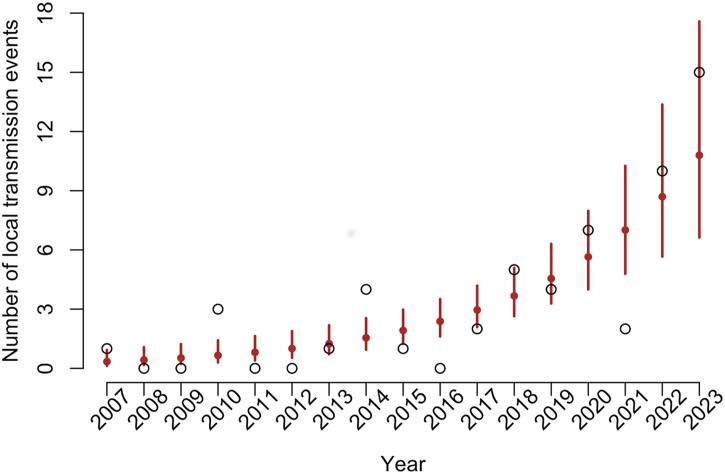
Findings: A total of 59 studies were included, describing 56 LTEs. The frequency of LTEs increased over time, with an average of 1.25 (95% CI: 1.17-1.35) times increment every year. While the highest number of dengue LTEs was reported in France (N = 37), Italy faced the largest number of cases detected in an LTE (N = 41). Considering all the arboviral LTEs, the median time between the symptom onset of the primary case and the diagnosis of the index case ("outbreak detection") was 35.5 days (range 23.0-76.0). Only for chikungunya, higher delays correlated with higher cumulative number of cases detected per LTE, though this may be biased due to the low sample size.
Interpretation: We have observed a gradual increase of Aedes-borne arboviral LTEs in Europe over time, and a considerable delay in outbreak detection. Improving the timeliness of LTE identification is essential.
Funding: This work was partly funded by the Italian Ministry of Health (Ricerca corrente) and by the European Union (Next Generation EU, Missione 4 Componente 1 CUP H93C22000640007).
Keywords: Arbovirus; Chikungunya; Dengue; Europe; Local transmission event; Zika.
© 2025 The Author(s).
Conflict of interest statement
None.
Figures


References
-
- Barzon L. Ongoing and emerging arbovirus threats in Europe. J Clin Virol Elsevier BV. 2018;107:38–47. - PubMed
LinkOut - more resources
Full Text Sources
