


Synthesis and Characterization of a Novel Sol-Gel-Derived Ni-Doped TiO2 Photocatalyst for Rapid Visible Light-Driven Mineralization of Paracetamol
- PMID: 40214575
- PMCID: PMC11990163
- DOI: 10.3390/nano15070530
Synthesis and Characterization of a Novel Sol-Gel-Derived Ni-Doped TiO2 Photocatalyst for Rapid Visible Light-Driven Mineralization of Paracetamol
Abstract
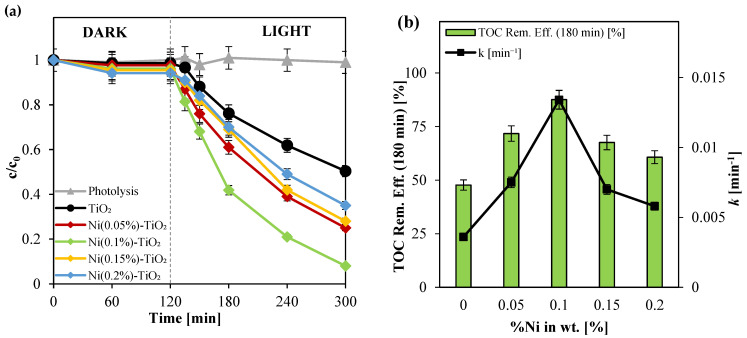
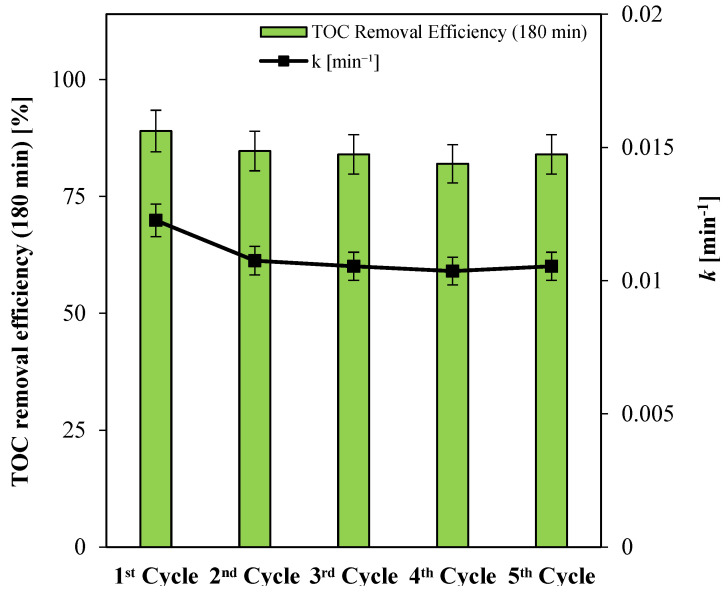
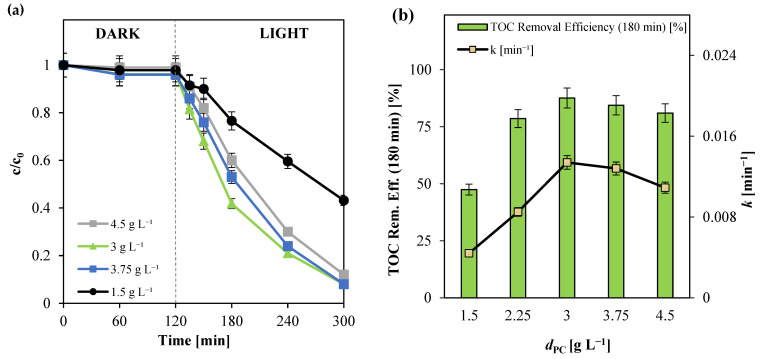
The increasing presence of pharmaceutical contaminants, such as paracetamol, in water sources necessitates the development of efficient and sustainable treatment technologies. This study investigates the photocatalytic degradation and mineralization of paracetamol under visible light using nickel-doped titanium dioxide (Ni-TiO2) catalysts synthesized via the sol-gel method. The catalysts were characterized through Raman spectroscopy, UV-Vis diffuse reflectance spectroscopy (UV-Vis DRS), and surface area measurements. Ni doping enhanced the visible light absorption of TiO2, reducing its band gap from 3.11 eV (undoped) to 2.49 eV at 0.20 wt.% Ni loading, while Raman analysis confirmed Ni incorporation with anatase as the predominant phase. The Ni(0.1%)-TiO2 catalyst exhibited the highest photocatalytic activity, achieving 88% total organic carbon (TOC) removal of paracetamol (5 ppm) after 180 min under optimal conditions (catalyst dosage, 3 g L-1). Stability tests demonstrated 84% retained efficiency over five cycles, with a kinetic rate constant of 0.010 min-1. Hydroxyl radicals were identified as the main reactive species. The catalyst maintained high performance in tap water, achieving 78.8% TOC removal. These findings highlight the potential of Ni(0.1%)-TiO2 as a cost-effective, visible light-active photocatalyst for the removal of pharmaceutical pollutants, with promising scalability for industrial water treatment applications.
Keywords: Ni-TiO2; catalyst stability; heterogeneous photocatalysis; paracetamol; pharmaceutical pollutants; slurry photoreactor; sol-gel synthesis; visible light driven.
Conflict of interest statement
The authors declare no conflicts of interest.
Figures
References
-
- Peralta-Hernández J.M., Brillas E. A Critical Review over the Removal of Paracetamol (Acetaminophen) from Synthetic Waters and Real Wastewaters by Direct, Hybrid Catalytic, and Sequential Ozonation Processes. Chemosphere. 2023;313:137411. - PubMed
-
- Brillas E., Manuel Peralta-Hernández J. Removal of Paracetamol (Acetaminophen) by Photocatalysis and Photoelectrocatalysis. A Critical Review. Sep. Purif. Technol. 2023;309:122982.
-
- Al-howri B.M., Azha S.F., Shamsudin M.S., Hamid N.A., Alsobaai A.M., Ismail S. Paracetamol in Diverse Water Sources: Health Hazards and Treatment Efficacy Emphasizing Adsorption Techniques—A Review. Int. J. Environ. Sci. Technol. 2024;21:9743–9762. doi: 10.1007/s13762-024-05581-0. - DOI
-
- Ghanbari F., Hassani A., Wacławek S., Wang Z., Matyszczak G., Lin K.Y.A., Dolatabadi M. Insights into Paracetamol Degradation in Aqueous Solutions by Ultrasound-Assisted Heterogeneous Electro-Fenton Process: Key Operating Parameters, Mineralization and Toxicity Assessment. Sep. Purif. Technol. 2021;266:118533. doi: 10.1016/j.seppur.2021.118533. - DOI
-
- Eniola J.O., Kumar R., Barakat M.A., Rashid J. A Review on Conventional and Advanced Hybrid Technologies for Pharmaceutical Wastewater Treatment. J. Clean. Prod. 2022;356:131826.
Grants and funding
LinkOut - more resources
Full Text Sources
Miscellaneous
