


Impact of prenatal, neonatal, and postnatal factors on epilepsy risk in children and adolescents: a systematic review and meta-analysis
- PMID: 40217357
- PMCID: PMC11960244
- DOI: 10.1186/s42494-023-00143-2
Impact of prenatal, neonatal, and postnatal factors on epilepsy risk in children and adolescents: a systematic review and meta-analysis
Abstract
Background: Epilepsy is a common, long-term neurological condition. Several previous case-control, cohort and cross-sectional studies have highlighted the role of prenatal, delivery and postnatal factors in the onset of epilepsy. In this systematic review, we evaluate the impact of these factors on the development of epilepsy in children and adolescents.
Methods: We searched PubMed and Google Scholar for literature on the relationship between prenatal, delivery and postnatal factors and the occurrence of epilepsy. The research was performed according to the PRSIMA 2020 flowchart and checklist. Data were extracted and pooled according to the ReviewManager 5.3 software using a random-effects model. Sensitivity analysis and subgroup analysis were used to evaluate the source of heterogeneity.
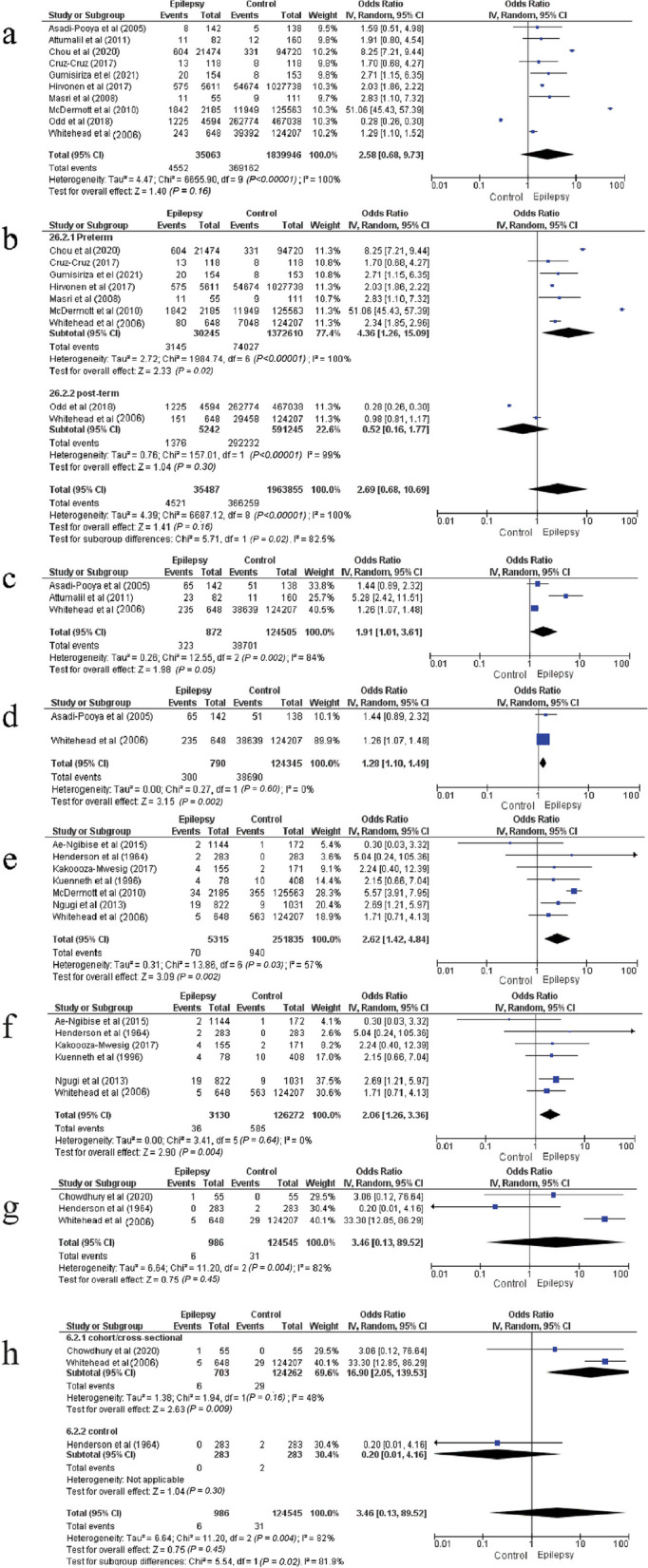
Results: We identified 25 reports, including 45,044 cases with confirmed epilepsy and 2,558,210 controls. Premature birth is significantly associated with the risk of epilepsy (pooled OR = 4.36 [95% CI: 1.26-15.09], P = 0.02). Smoking during pregnancy significantly increases this risk by 28% (pooled OR = 1.28 [95% CI:1.1-1.49], P = 0.002). Furthermore, maternal epilepsy confers a pooled OR of 2.06 [95% CI:1.26-3.36]. Eclampsia is linked to a 16.9-fold increased risk of epilepsy. In addition, both pregnancy metrorrhagia and maternal infection are significantly associated with the epilepsy risk (pooled OR = 2.24 [95% CI: 1.36-3.71] and 1.28 [95% CI: 1.17-1.41], respectively). For delivery conditions, cord prolapse (pooled OR = 2.58 [95% CI: 1.25-5.32]), prolonged labor (> 6 h) (OR = 6.74 [95% CI: 3.57-12.71]) and head trauma (pooled OR = 2.31 [95% CI: 1.54-3.48]) represent a meaningful risk of epilepsy occurrence. Moreover, birth complications (OR = 3.91 [95% CI: 2.43-6.29]), low birth weight (pooled OR = 1.83 [95% CI: 1.5-2.23]) and male birth (pooled OR = 1.18 [95% CI: 1.06-1.32]) are associated with an elevated risk of epilepsy in childhood and adolescence.
Conclusions: Epilepsy in children and adolescents can be attributed to a multitude of intricate factors, notably those during pregnancy, delivery and the postnatal period. These findings highlight the crucial role of prenatal and postnatal care in reducing the impact of these factors on epilepsy occurrence.
Keywords: Adolescents; Children; Delivery factors; Epilepsy; Postnatal factors; Prenatal factors.
© 2024. The Author(s).
Conflict of interest statement
Declarations. Ethics approval and consent to participate: Not applicable. Consent for publication: Not applicable. Competing interests: All authors declare that they have no conflict of interest.
Figures



References
-
- Fisher RS, Acevedo C, Arzimanoglou A, Bogacz A, Cross JH, Elger CE, et al. ILAE official report: a practical clinical definition of epilepsy. Epilepsia. 2014;55:475–82. - PubMed
-
- Beghi E. The epidemiology of epilepsy. Neuroepidemiology. 2020;54:185–91. - PubMed
-
- Christensen J, Vestergaard M, Pedersen MG, Pedersen CB, Olsen J, Sidenius P. Incidence and prevalence of epilepsy in Denmark. Epilepsy Res. 2007;76:60–5. - PubMed
-
- Daoud AS, Batieha A, Bashtawi M, El-Shanti H. Risk factors for childhood epilepsy: a case-control study from Irbid. Jordan Seizure. 2003;12:171–4. - PubMed
LinkOut - more resources
Full Text Sources