


The Relation of Angiotensin-Converting Enzyme 2, Renin-Angiotensin-Aldosterone System Inhibitors, and Arterial Stiffness in Acute COVID-19 Emergency Department Patients-A Prospective Observational Study
- PMID: 40217682
- PMCID: PMC11989675
- DOI: 10.3390/jcm14072233
The Relation of Angiotensin-Converting Enzyme 2, Renin-Angiotensin-Aldosterone System Inhibitors, and Arterial Stiffness in Acute COVID-19 Emergency Department Patients-A Prospective Observational Study
Abstract
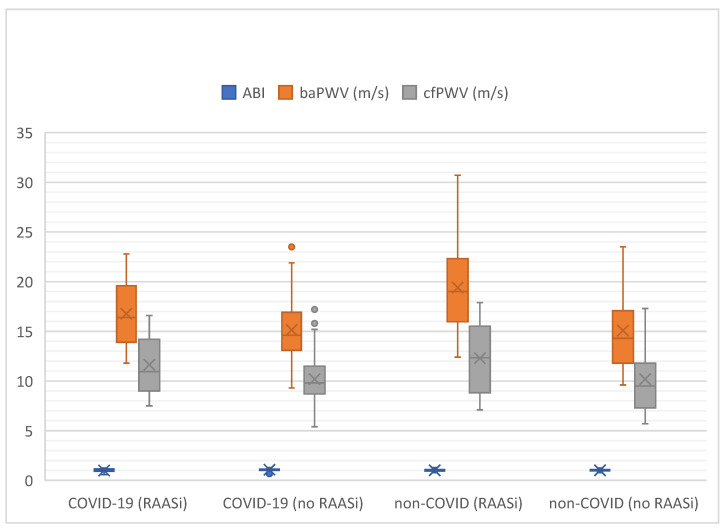
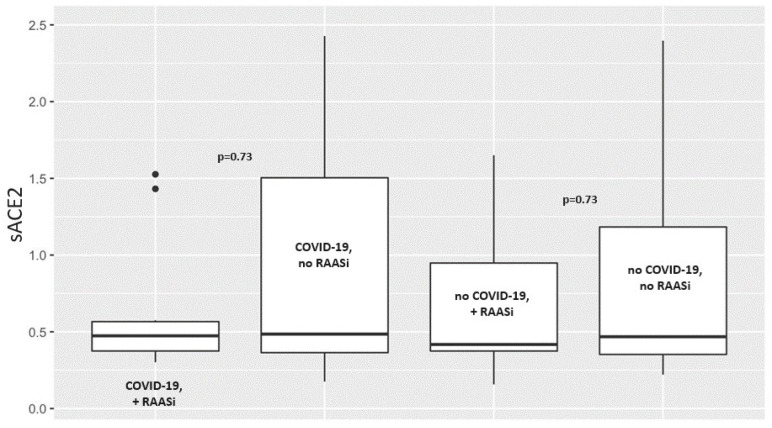
Background: Severe acute respiratory syndrome coronavirus 2 (SARS-CoV-2) causing coronavirus disease 2019 (COVID-19) can damage the endothelium and increase arterial stiffness, potentially leading to adverse cardiovascular events. In parallel, systemic inflammation in COVID-19 also impacts endothelial function. Angiotensin-converting enzyme 2 (ACE2) promotes vasodilation and anti-inflammatory effects, but also facilitates SARS-CoV-2 entry into human cells. Thus, concerns have been raised about the use of RAAS inhibitors (RAASi) in COVID-19 patients due to potential ACE2 upregulation. However, the clinical significance of increased plasma ACE2 (sACE2) in RAASi-treated COVID-19 patients remains unclear. Methods: This prospective, single-centre study evaluated RAASi, sACE2, and vascular function in acutely ill patients with COVID-19 in comparison with acutely ill patients without COVID-19. Adult emergency department patients with confirmed or suspected COVID-19 were enrolled and underwent pulse wave velocity, ankle brachial index, and sACE2 measurements. Results: In the 152 included patients (50% female, median age 62 years, 68% COVID-19 positive), the sACE2 values were slightly higher in the COVID-19 (0.485 [0.364-1.329]) than in the non-COVID-19 subgroup (0.458 [0.356-1.138]; p = 0.70). No significant differences in sACE2 were observed between patients with and without RAASi, regardless of COVID-19 status. Pulse wave velocity values differed significantly between groups (p = 0.015). Conclusions: In emergency department patients, sACE2 was upregulated in COVID-19 patients, probably due to oxidative stress and inflammation. RAASi did not increase sACE2, but may have protective effects against inflammation. Elevated sACE2 appeared to have a beneficial effect on arterial stiffness in all patients. These findings support continued RAASi therapy in COVID-19 patients to protect against chronic inflammation and apoptosis.
Keywords: ACE2; COVID-19; RAAS inhibitors; ankle-brachial index; arterial stiffness; pulse-wave velocity.
Conflict of interest statement
The authors declare no conflicts of interest.
Figures
References
-
- World Health Organisation WHO COVID-19 Dashboard. COVID-19 Cases|WHO COVID-19 Dashboard. [(accessed on 24 August 2024)]. Available online: https://data.who.int/dashboards/covid19/cases.
-
- Lopes R.D., Macedo A.V.S., de Barros ESilva P.G.M., Moll-Bernardes R.J., Feldman A., D’Andréa Saba Arruda G., de Souza A.S., de Albuquerque D.C., Mazza L. Continuing versus suspending angiotensin-converting enzyme inhibitors and angiotensin receptor blockers: Impact on adverse outcomes in hospitalized patients with severe acute respiratory syndrome coronavirus 2 (SARS-CoV-2)--The BRACE CORONA Trial. Am. Heart J. 2020;226:49–59. doi: 10.1016/j.ahj.2020.05.002. - DOI - PMC - PubMed
LinkOut - more resources
Full Text Sources
Miscellaneous
