


Point-of-Care Ultrasound Pulse Checks During Cardiopulmonary Resuscitation on a Patient Simulator (PUPRAS)
- PMID: 40218209
- PMCID: PMC11988479
- DOI: 10.3390/diagnostics15070858
Point-of-Care Ultrasound Pulse Checks During Cardiopulmonary Resuscitation on a Patient Simulator (PUPRAS)
Abstract
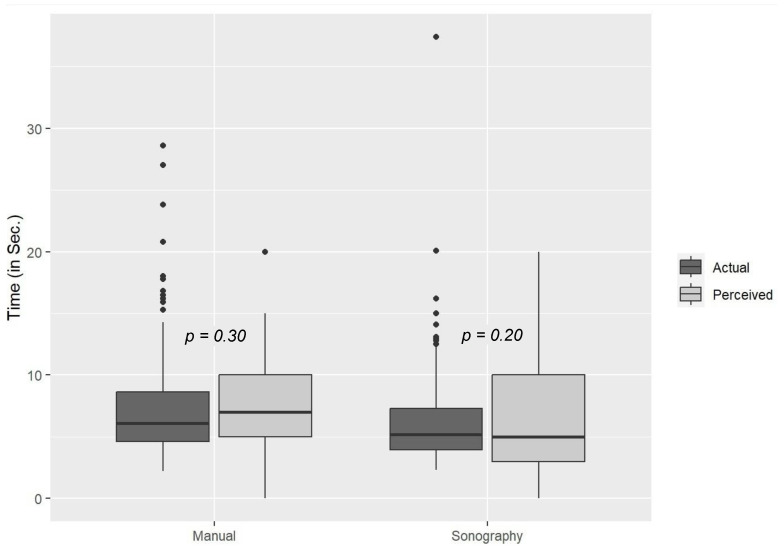
Background/Objectives: During cardiopulmonary resuscitation (CPR), patients must be checked for signs of return of spontaneous circulation (ROSC). Point-of-care ultrasound (POCUS) may be more reliable for detecting the ROSC. We investigated whether a POCUS pulse check algorithm could be used in compliance with the CPR guidelines. Methods: This was a prospective controlled and blinded multicentre manikin study involving staff from two tertiary clinical centres and their emergency medical services. A standard operating procedure for POCUS pulse checks during CPR was evaluated using a simulator in a team of four. The POCUS pulse checks were performed at the central artery following basic and advanced life support. The first pulse check was performed in the setting of pulseless electrical activity, and the second was performed in the presence of ROSC. The participants also completed a questionnaire. Results: A total of 444 pulse checks (244 manual/200 POCUS) were performed in 100 scenarios. The participants comprised physicians (34%), nurses (15%), non-physician emergency medical services personnel (37%), and other medical personnel (14%). The pulse checks took an average of 6.7 s (SD 3.9 s). Manual pulse checks (7.3 s) took longer than ultrasound pulse checks (6.1 s; p < 0.01), which were performed after a mean of 7.1 min (SD 1.7 min), during the fourth rhythm analysis in 93% of cases, and at the femoral artery in 62% of cases. They were rated as "easy" to perform by 77% and "useful" by 94%. Conclusions: POCUS pulse checks basically seem easy to implement and appear to be feasible during CPR.
Keywords: cardiac arrest; pulse; resuscitation; sonography; ultrasound.
Conflict of interest statement
Author Stephan Grosch was employed by the company Mittelhessen gGmbH. The remaining authors declare that the research was conducted in the absence of any commercial or financial relationships that could be construed as a potential conflict of interest.
Figures


References
-
- Soar J., Nolan J.P., Böttiger B.W., Perkins G.D., Lott C., Carli P., Pellis T., Sandroni C., Skrifvars M.B., Smith G.B., et al. European Resuscitation Council Guidelines for Resuscitation 2015: Section 3. Adult advanced life support. Resuscitation. 2015;95:100–147. doi: 10.1016/j.resuscitation.2015.07.016. - DOI - PubMed
-
- Truhlář A., Deakin C.D., Soar J., Khalifa G.E.A., Alfonzo A., Bierens J.J., Brattebø G., Brugger H., Dunning J., Hunyadi-Antičević S., et al. European Resuscitation Council Guidelines for Resuscitation 2015: Section 4. Cardiac arrest in special circumstances. Resuscitation. 2015;95:148–201. doi: 10.1016/j.resuscitation.2015.07.017. - DOI - PubMed
LinkOut - more resources
Full Text Sources
