


Sex Bias in Frailty Screening: A Cross-Sectional Analysis of PRISMA-7 and the Clinical Frailty Scale in Primary Care
- PMID: 40218265
- PMCID: PMC11989021
- DOI: 10.3390/diagnostics15070915
Sex Bias in Frailty Screening: A Cross-Sectional Analysis of PRISMA-7 and the Clinical Frailty Scale in Primary Care
Abstract
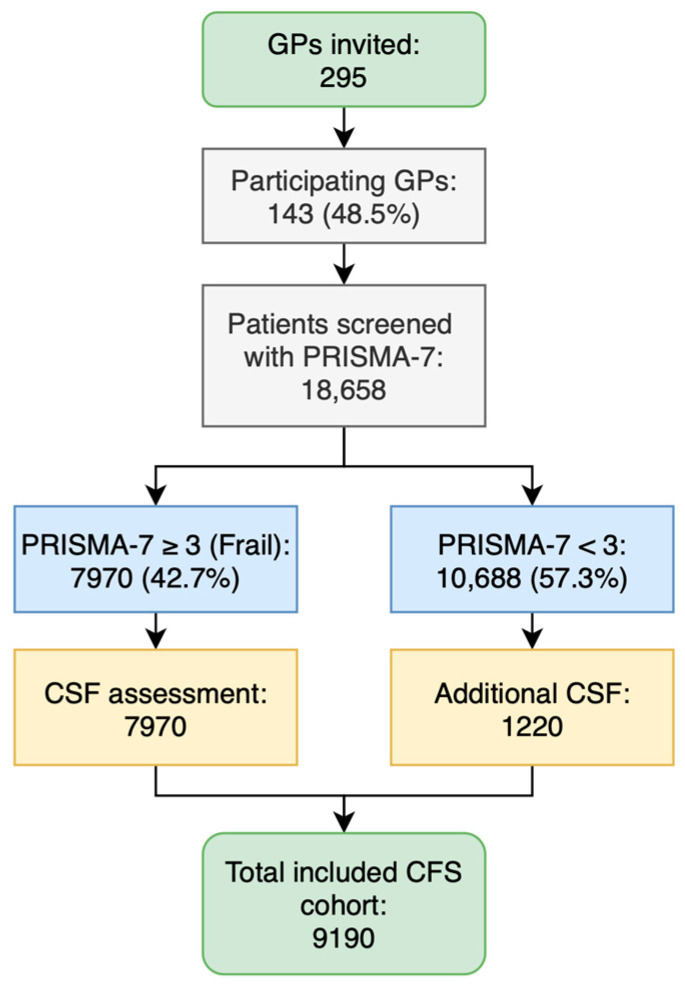
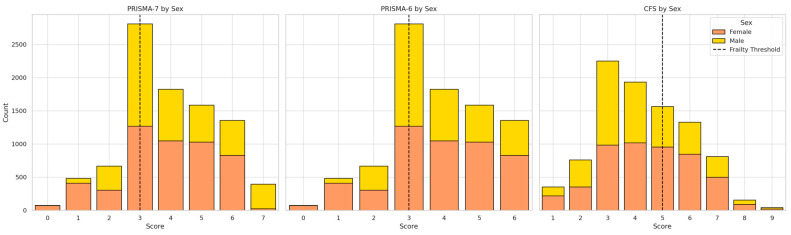
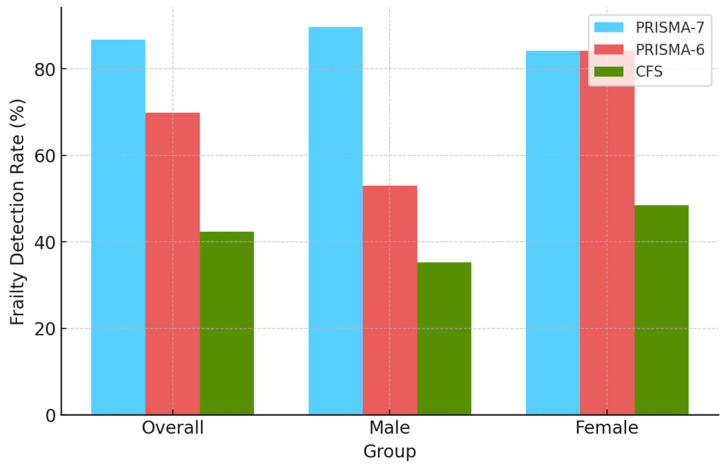
Background/Objectives: Frailty screening is essential in primary care for the early identification of vulnerable older adults. PRISMA-7 is a widely used screening tool, but Item 2 ("Are you male?") introduces potential sex bias and overestimates frailty in men. PRISMA-6, a modified version that excludes Item 2, might provide a more equitable alternative. This study evaluates PRISMA-6's alignment with the Clinical Frailty Scale (CFS) and its impact on sex-specific frailty classification. Methods: A cross-sectional study was conducted in 142 general practices across South Tyrol, including 9190 general practice patients aged ≥75 years. Frailty was assessed using PRISMA-7, PRISMA-6, and the CFS. Correlations between tools were calculated using Kendall's Tau-b, whereas Fisher's z-test was used to compare differences in alignment. The frailty prevalence and odds ratios were stratified according to sex and age. Results: PRISMA-6 showed a stronger correlation with the CFS (τ = 0.492) than PRISMA-7 (τ = 0.308, z = -10.2, p < 0.001). This effect was pronounced in men (z = -9.8, p < 0.001), whereas no difference was observed in women (z = 0.00, p = 1.000). PRISMA-6 reduced the frailty detection rate in men and was more closely aligned with the CFS. Conclusions: PRISMA-6 demonstrated improved alignment with the CFS and reduced sex bias compared to PRISMA-7. However, its use as a screening tool for men requires prospective validation in diverse settings. PRISMA-6 shows promise as a reliable and equitable frailty screening tool and should be considered for use in future studies, particularly in primary care settings, while awaiting further prospective validation.
Keywords: Clinical Frailty Scale; PRISMA-6; PRISMA-7; frailty prevalence; frailty screening; frailty tools validation; older adults; primary care; sex bias.
Conflict of interest statement
The authors declare no conflicts of interest.
Figures
References
-
- Ruiz J.G., Dent E., Morley J.E., Merchant R.A., Beilby J., Beard J., Tripathy C., Sorin M., Andrieu S., Aprahamian I., et al. Screening for and Managing the Person with Frailty in Primary Care: ICFSR Consensus Guidelines. J. Nutr. Health Aging. 2020;24:920–927. doi: 10.1007/s12603-020-1498-x. - DOI - PMC - PubMed
LinkOut - more resources
Full Text Sources
