


Association of Breakfast Consumption Frequency with Depression and Anxiety Symptoms Among School Students: A Cross-Sectional Study in Eastern China
- PMID: 40219028
- PMCID: PMC11990333
- DOI: 10.3390/nu17071271
Association of Breakfast Consumption Frequency with Depression and Anxiety Symptoms Among School Students: A Cross-Sectional Study in Eastern China
Abstract
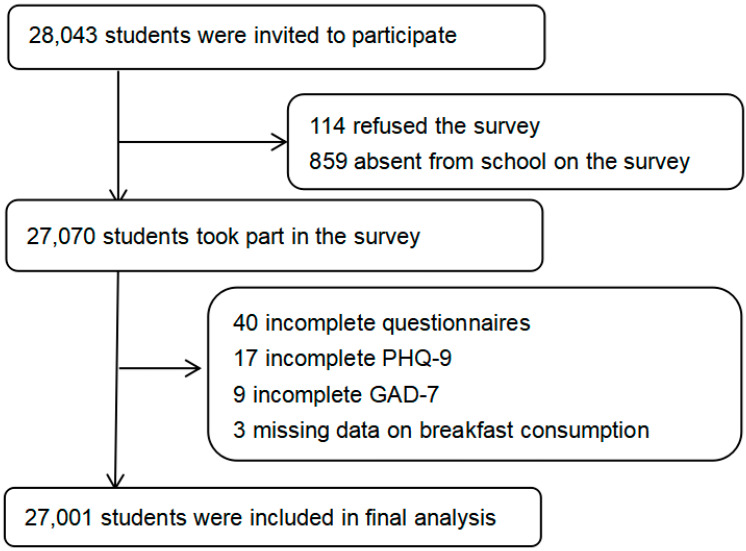
Objective: This study aimed to explore the relationship between breakfast consumption frequency and both depression and anxiety symptoms among middle and high school students in Eastern China. Methods: In this school-based cross-sectional study, 27,001 middle and high school students were investigated in 2022. Multivariable logistic regression models were used to examine the relationship between breakfast consumption frequency and both depression and anxiety symptoms. Results: The percentages of students who consumed breakfast daily, 6 days/week, 4-5 days/week, and ≤3 days/week were 71.0% (95%CI: 69.9-72.2), 8.3% (95%CI: 7.8-8.6), 11.9% (95%CI: 11.2-12.6), and 8.8% (95%CI: 8.2-9.5), respectively. After adjusting for socio-demographic and lifestyle factors, academic performance, self-reported health, and bullying victimization, compared to those consuming breakfast daily, the odds ratios (95%CI) for depression symptoms were 1.32 (1.15-1.52) for those consuming breakfast 6 days/week, 1.66 (1.49-1.84) for those consuming breakfast 4-5 days/week, and 1.74 (1.54-1.97) for those consuming breakfast ≤3 days/week, respectively (p < 0.001). The corresponding figures for anxiety symptoms were 1.31 (1.14-1.51), 1.35 (1.20-1.52), and 1.43 (1.23-1.66), respectively (p < 0.001). Conclusions: Breakfast skipping is common among middle and high school students in Eastern China. The frequency of breakfast consumption is inversely associated with both depression symptoms and anxiety symptoms among adolescents.
Keywords: adolescents; anxiety symptoms; breakfast consumption; depression symptoms.
Conflict of interest statement
The authors declare no conflicts of interest. The funders had no role in the design of the study; in the collection, analyses, or interpretation of data; in the writing of the manuscript; or in the decision to publish the results.
Figures
References
-
- Piao J., Huang Y., Han C., Li Y., Xu Y., Liu Y., He X. Alarming changes in the global burden of mental disorders in children and adolescents from 1990 to 2019: A systematic analysis for the Global Burden of Disease study. Eur. Child Adolesc. Psychiatry. 2022;31:1827–1845. doi: 10.1007/s00787-022-02040-4. - DOI - PubMed
-
- Dong W., Liu Y., Bai R., Zhang L., Zhou M. The prevalence and associated disability burden of mental disorders in children and adolescents in China: A systematic analysis of data from the Global Burden of Disease Study. Lancet Reg. Health West. Pac. 2025;55:101486. doi: 10.1016/j.lanwpc.2025.101486. - DOI - PMC - PubMed
MeSH terms
Grants and funding
LinkOut - more resources
Full Text Sources
Medical
