


From Ordinary to Extraordinary: The Crucial Role of Common Species in Desert Plant Community Stability with Arbuscular Mycorrhizal (AM) Fungi Under Increased Precipitation
- PMID: 40219166
- PMCID: PMC11991153
- DOI: 10.3390/plants14071099
From Ordinary to Extraordinary: The Crucial Role of Common Species in Desert Plant Community Stability with Arbuscular Mycorrhizal (AM) Fungi Under Increased Precipitation
Abstract
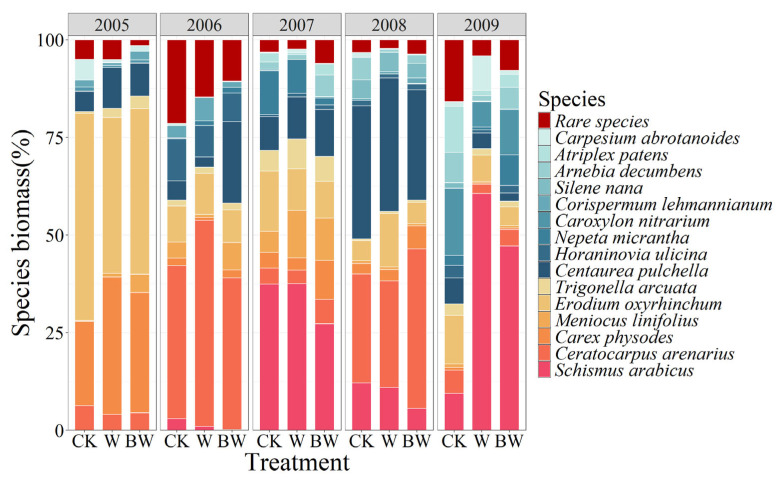
Climate change is altering precipitation patterns in Central Asia's arid zones, destabilizing desert ecosystems. Arbuscular mycorrhizal (AM) fungi, key soil microorganisms forming symbiosis with most plants, critically maintain ecosystem stability, yet their mechanisms in regulating individual plant species to sustain community stability remain unclear. We conducted a 5-year in situ experiment in the Gurbantunggut Desert, testing how AM fungi influence desert plant community stability under increased precipitation. Using a randomized block design with three treatments-control (CK), increased precipitation (W), and precipitation with Benomyl fungicide (BW)-we monitored plant community dynamics. We discovered that both increased precipitation and AM fungi altered plant community structure without affecting diversity. Precipitation boosted aboveground net primary productivity (ANPP) and density, enhancing community stability via dominant species (e.g., Meniocus linifolius), supporting the mass ratio hypothesis. AM fungi further stabilized the community by increasing ANPP and enhancing the common species stability under increased precipitation, while the contribution of rare species was also non-negligible, aligning with the subordinate insurance hypothesis. Overall, our study elucidates how increased precipitation and AM fungi regulate plant community stability at the species level. Specifically, it overcomes key gaps by revealing AM fungi's pivotal role in stabilizing communities through sustaining common species stability.
Keywords: Central Asian deserts; arbuscular mycorrhizal fungi; common species stability; increased precipitation; subordinate insurance hypothesis; temporal stability.
Conflict of interest statement
The authors declare no conflicts of interest.
Figures



References
-
- IPCC AR6 Synthesis Report: Climate Change 2023. [(accessed on 17 December 2024)]; Available online: https://www.ipcc.ch/report/sixth-assessment-report-cycle/
-
- Zhao L., Li L., Li Y., Yang P., Liu X., Zhou Z., Zhong H., Ding Y. Global extreme precipitation characteristics: The perspective of climate and large river basins. Clim. Dynam. 2024;62:1013–1030. doi: 10.1007/s00382-023-06961-x. - DOI
-
- Li G., Yang H., Zhang Y., Huang C., Pan X., Ma M., Song M., Zhao H. More Extreme Precipitation in Chinese Deserts Prom 1960 to 2018. Earth Space Sci. 2019;6:1196–1204. doi: 10.1029/2018ea000538. - DOI
-
- Donat M.G., Lowry A.L., Alexander L.V., O’Gorman P.A., Maher N. More extreme precipitation in the world’s dry and wet regions. Nat. Clim. Change. 2016;6:508–513. doi: 10.1038/nclimate2941. - DOI
Grants and funding
LinkOut - more resources
Full Text Sources
Research Materials
