


Time at High Risk of Hypoglycemia: Validation of a Consensus-Based Continuous Glucose Monitoring-Metric for Hospitalized Patients
- PMID: 40219621
- PMCID: PMC11993535
- DOI: 10.1177/19322968251331600
Time at High Risk of Hypoglycemia: Validation of a Consensus-Based Continuous Glucose Monitoring-Metric for Hospitalized Patients
Abstract
Background: Time at high risk of hypoglycemia (THRH), 3.9 to 5.6 mmol/L, is a continuous glucose monitoring (CGM)-based metric recommended for reporting in hospitalized patients. This study aims to validate THRH as a predictor of hypoglycemia.
Methods: The CGM data from 166 non-intensive care unit (non-ICU) inpatients with type 2 diabetes from the DIATEC trial were analyzed. All participants received basal-bolus insulin therapy. Of these, 82 were monitored with point-of-care glucose testing and blinded CGM, while 84 had open CGM. Linear and negative binomial regression analyses assessed the relationship between THRH and time below range (TBR) (<3.0 mmol/L, 3.0-3.9 mmol/L, and <3.9 mmol/L) and hypoglycemic events. Analyses were conducted for day (07:00-23:00), night (23:01-06:59), and 24-hour periods.
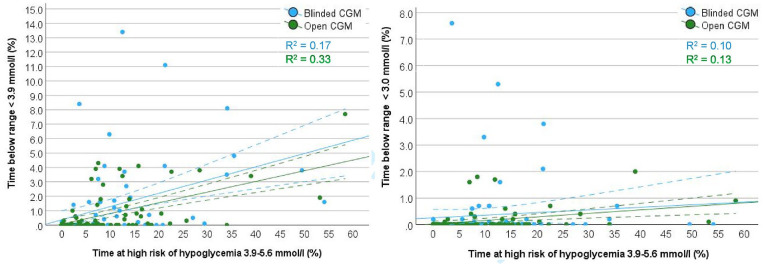
Results: For CGM-monitored patients, every 10%-point increase in THRH was associated with a 0.13%-point increase in TBR (<3.0 mmol/L) (95% confidence interval [CI] = 0.06-0.21), 0.66%-point increase in TBR (3.0-3.9 mmol/L) (95% CI = 0.47-0.86), and 0.74%-point increase in TBR (<3.9 mmol/L) (95% CI = 0.51-0.97), all P < .001. A THRH threshold below 50% was linked to a TBR <3.9 mmol/L of less than 4%, as recommended. Similar results were observed during both day and night analyses and for point-of-care monitored patients, also for hypoglycemic events.
Conclusions: The THRH is strongly associated with hypoglycemia in non-ICU hospitalized patients with type 2 diabetes on basal-bolus insulin. Aiming for THRH below 50% aligns with the recommended TBR target of <3.9 mmol/L below 4%, supporting THRH's role in guiding hypoglycemia prevention strategies.
Keywords: consensus; continuous glucose monitoring; hypoglycemia; inpatient; time at high risk of hypoglycemia.
Conflict of interest statement
The author(s) declared the following potential conflicts of interest with respect to the research, authorship, and/or publication of this article: UPB received speaker fees from Sanofi and Novo Nordisk and has served on advisory boards for Sanofi, Novo Nordisk, and Vertex. Additional authors declare no conflict of interest.
Figures
References
-
- American Diabetes Association Professional Practice Committee. 16. Diabetes care in the hospital: standards of care in diabetes—2025. Diabetes Care. 2025;48(Supplement_1):S321-S334. https://diabetesjournals.org/care/article/48/Supplement_1/S321/157551/16... - PMC - PubMed
-
- Olsen MT, Klarskov CK, Jensen SH, et al.. In-hospital DIAbetes management by a diabetes TEam and insulin titration algorithms based on Continuous glucose monitoring or point-of-care glucose testing in patients with type 2 diabetes (DIATEC)—a randomised controlled trial. Diabetes Care. 2025;48(4):1-11. - PubMed
-
- Cavalcante Lima Chagas G, Teixeira L, R C Clemente M, et al.. Use of continuous glucose monitoring and point-of-care glucose testing in hospitalized patients with diabetes mellitus in non-intensive care unit settings: a systematic review and meta-analysis of randomized controlled trials. Diabetes Res Clin Pract. 2025;220:111986. - PubMed
-
- Olsen MT, Klarskov CK, Bjergaard UP, Hansen KB, Kristensen PL. Summary of clinical investigation plan for The DIATEC trial: inhospital diabetes management by a diabetes team and continuous glucose monitoring or point of care glucose testing—a randomised controlled trial. BMC Endocr Disord. 2024;24:60. - PMC - PubMed
LinkOut - more resources
Full Text Sources
