


Health-related quality of life and survival of patients with hepatocellular carcinoma treated with transarterial chemoembolization and Yttrium-90
- PMID: 40223040
- PMCID: PMC11994534
- DOI: 10.1186/s43046-025-00267-1
Health-related quality of life and survival of patients with hepatocellular carcinoma treated with transarterial chemoembolization and Yttrium-90
Abstract
Background: Hepatocellular carcinoma (HCC) is the fifth most common cancer worldwide. Due to the advanced stage in which HCC presents, most patients are only eligible for transarterial chemoembolization (TACE) or radioembolization (Y90). The purpose of this study is to examine the differences in survival and health-related quality of life (HRQOL) in patients diagnosed with HCC and treated with TACE or Y90.
Methods: Two hundred thirty-four patients with HCC were enrolled in studies examining HRQOL between 2003-2009. HRQOL was evaluated using the Functional Assessment of Cancer Therapy-Hepatobiliary (FACT-Hep). Between-group differences were examined using chi-square and ANOVA. Survival was assessed using Kaplan-Meier and Cox regression analyses.
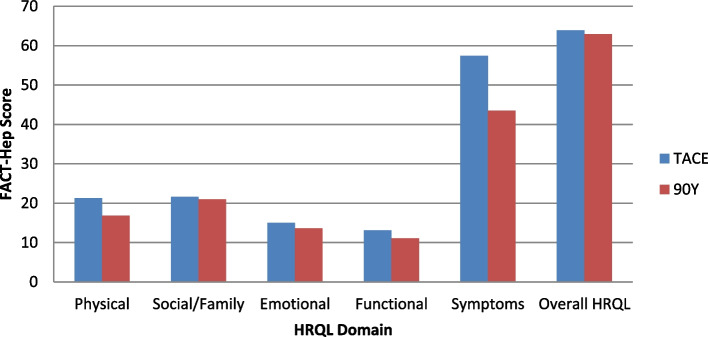
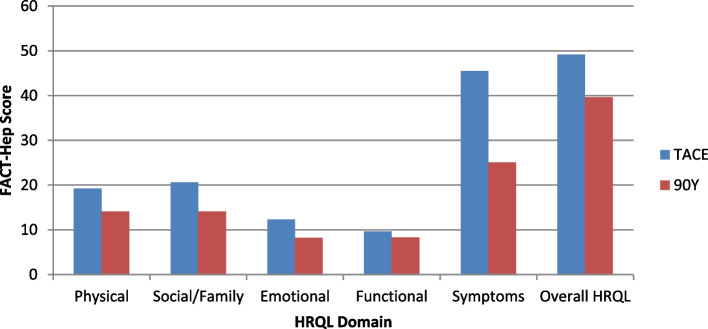
Results: Significant baseline differences between patients treated with TACE versus Y90 were found. Patients who received Y90 tended to be older (p < 0.001), female (p < 0.001), had fewer lesions (p = 0.03), had smaller tumors (p = 0.03), and were less likely to have vascular invasion (p = 0.04). After adjusting for demographic and disease-specific factors, no significant differences in HRQOL were observed at 3 months (p = 0.79) or 6 months (p = 0.75). Clinically meaningful differences were found, with the TACE group reporting greater physical, social, and emotional well-being at 3 and 6 months and greater overall HRQOL at 6 months. No significant differences in survival were found.
Conclusions: Treatment with TACE and Y90 was similar with regard to survival. However, TACE showed statistically and clinically meaningful benefits in physical, social/family, and emotional well-being. Further research is warranted to identify profiles of patients who may demonstrate a preferential response to either TACE or Y90.
Keywords: Health-related quality of life; Hepatocellular carcinoma; Radioembolization; Survival analysis; Transarterial chemoembolization.
Plain language summary
Hepatocellular carcinoma (HCC) is the fifth most common type of cancer worldwide. For most patients with HCC, two procedures known as transarterial chemoembolization (TACE) and radioembolization (Y90), represent their most promising treatment options. The purpose of this study is to examine the differences in survival and health-related quality of life (HRQOL) in patients diagnosed with HCC and treated with TACE or Y90. In this sample, patients treated with TACE reported better HRQOL in the domains of physical, social, and emotional well-being at 3- and 6 months post-treatment and greater overall HRQOL at 6 months. There were no significant differences in patient survival based on the type of treatment they received. More research is needed to identify what treatment factors and patient characteristics might be associated with better HRQOL after being treated with TACE or Y90.
© 2025. The Author(s).
Conflict of interest statement
Declarations. Ethics approval and consent to participate: All procedures performed in these studies were approved by the University of Pittsburgh’s Institutional Review Board (IRB reference numbers: PRO07050143 and PRO0607041). All participants provided written informed consent. Consent for publication: All participants provided written informed consent. No identifying information is included in this publication. Competing interests: The authors declare that they have no competing interests.
Figures
References
MeSH terms
Substances
Grants and funding
LinkOut - more resources
Full Text Sources
Medical
Miscellaneous