


Compositional associations of 24-h physical activities, sedentary time and sleep with depressive symptoms in urban and rural residents: a cross-sectional study
- PMID: 40223075
- PMCID: PMC11995539
- DOI: 10.1186/s12916-025-04051-9
Compositional associations of 24-h physical activities, sedentary time and sleep with depressive symptoms in urban and rural residents: a cross-sectional study
Abstract
Background: Studies investigating the associations of 24-h movement behaviours (including moderate-to-vigorous-intensity physical activity (MVPA), light-intensity PA (LPA), sedentary time (ST) and sleep) with depressive symptoms are scarce. It is also unclear whether possible associations differ between urban and rural residents. Hence, we aimed to investigate these associations in a population-based sample of middle-aged Finnish adults.
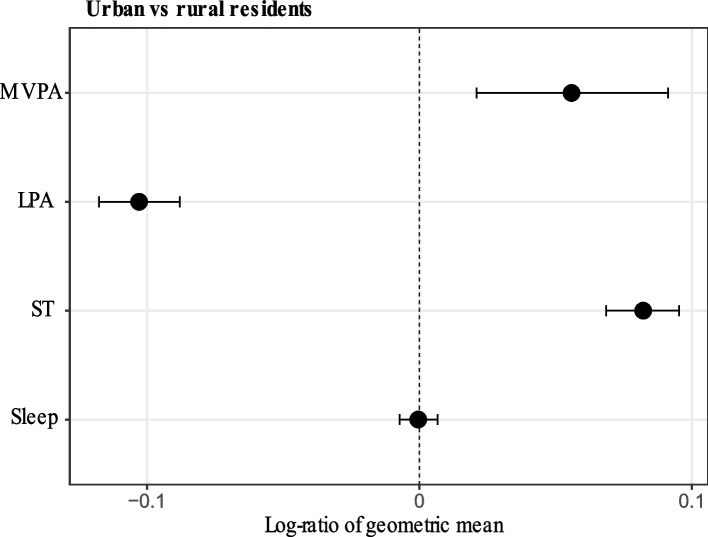
Methods: The study population consisted of 4295 adults, aged 46 years, from the Northern Finland Birth Cohort 1966. The participants wore a hip-worn accelerometer for 14 days. Time spent in sedentary, LPA and MVPA was obtained from accelerometer data and then combined with self-reported sleep duration to obtain the 24-h composition. The residential environment was classified as urban or rural based on the participants' home addresses. Depressive symptoms were assessed using the Beck Depression Inventory-II (BDI-II). Multivariable adjusted regression analysis using a compositional data analysis approach based on isometric log-ratio transformation was used to determine the associations between movement behaviours and depressive symptoms in urban and rural residential environments.
Results: The 24-h movement behaviour composition was significantly associated with the BDI-II score both in urban and rural residential environment. More time spent in sleep relative to other behaviours was associated with lower BDI-II score in rural residential environments. More time spent in ST among urban residents and in LPA among rural residents was associated with higher BDI-II scores. When modelling pairwise reallocations of time, more MVPA or more sleep at the expense of LPA or ST was associated with lower BDI-II score among rural residents. For urban residents, reallocating time from ST to any other behaviour was associated with lower BDI-II score.
Conclusions: Our findings showed that more relative time spent in MVPA and sleep was associated with lower levels of depressive symptoms among rural residents, and more relative time spent in any other behaviour at the expense of ST was associated with lower levels of depressive symptoms among urban residents. These differences should be considered in the prevention and treatment of depressive symptoms. Due to the cross-sectional design of this study, causality cannot be inferred, and further research exploring the mechanisms underlying these associations in diverse populations and longitudinal study settings are needed.
Keywords: Compositional data analysis; Depressive symptoms; Physical activity; Rural; Sedentary time; Sleep; Urban.
© 2025. The Author(s).
Conflict of interest statement
Declarations. Ethics approval and consent to participate: All procedures involving human subjects were approved by the Ethics Committee of the Northern Ostrobothnia Hospital District in Oulu, Finland (94/2011). Written informed consent was obtained from all subjects. Personal identity information was encrypted and replaced with identification codes. Consent for publication: Not applicable. Competing interests: The authors declare no competing interests.
Figures

References
-
- World Health Organization. Depression and other common mental disorders: global health estimates. https://iris.who.int/bitstream/handle/10665/254610/WHO-MSD-MER-2017.2-en.... Accessed 11.3.2025.
-
- Santomauro DF, Mantilla Herrera AM, Shadid J, Zheng P, Ashbaugh C, Pigott DM, et al. Global prevalence and burden of depressive and anxiety disorders in 204 countries and territories in 2020 due to the COVID-19 pandemic. Lancet. 2021;398(10312):1700–12. 10.1016/s0140-6736(21)02143-7. - DOI - PMC - PubMed
MeSH terms
Grants and funding
- OKM/54/626/2019, OKM/85/626/2019, OKM/1096/626/2020, OKM/20/626/2022, OKM/28/626/2023 and OKM/78/626/2023/Opetus- ja Kulttuuriministeriö
- OKM/54/626/2019, OKM/85/626/2019, OKM/1096/626/2020, OKM/20/626/2022, OKM/28/626/2023 and OKM/78/626/2023/Opetus- ja Kulttuuriministeriö
- OKM/54/626/2019, OKM/85/626/2019, OKM/1096/626/2020, OKM/20/626/2022, OKM/28/626/2023 and OKM/78/626/2023/Opetus- ja Kulttuuriministeriö
- OKM/54/626/2019, OKM/85/626/2019, OKM/1096/626/2020, OKM/20/626/2022, OKM/28/626/2023 and OKM/78/626/2023/Opetus- ja Kulttuuriministeriö
- OKM/54/626/2019, OKM/85/626/2019, OKM/1096/626/2020, OKM/20/626/2022, OKM/28/626/2023 and OKM/78/626/2023/Opetus- ja Kulttuuriministeriö
- OKM/54/626/2019, OKM/85/626/2019, OKM/1096/626/2020, OKM/20/626/2022, OKM/28/626/2023 and OKM/78/626/2023/Opetus- ja Kulttuuriministeriö
- 345220 and 345222/Strategic Research Council
- 345220 and 345222/Strategic Research Council
- 345220 and 345222/Strategic Research Council
- 345220 and 345222/Strategic Research Council
- 345220 and 345222/Strategic Research Council
- 336449/Research Council of Finland
- 24000692/Oulun Yliopisto
- 539/2010 A31592/European Regional Development Fund
- 24301140/Oulun Yliopistollinen Sairaala
LinkOut - more resources
Full Text Sources
Medical
Miscellaneous
