


Employment Intention and Associated Factors of Nursing Graduates: A Structural Equation Model
- PMID: 40223874
- PMCID: PMC11972861
- DOI: 10.1155/jonm/7402874
Employment Intention and Associated Factors of Nursing Graduates: A Structural Equation Model
Abstract
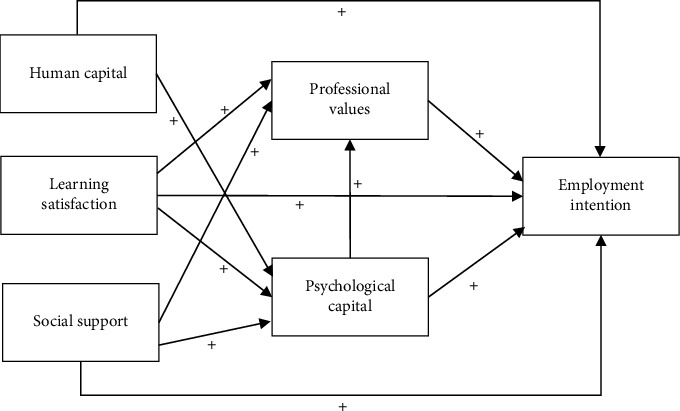
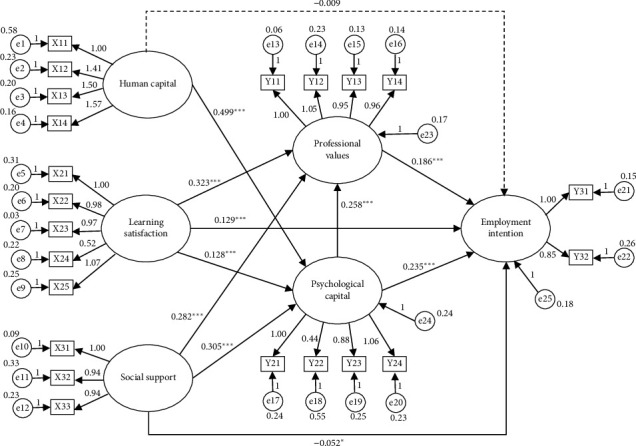
Objective: To assess the associated factors of employment intention among contemporary nursing graduates. Background: In the postepidemic era, the shortage of nurses and the decline in the employment rate have garnered significant attention globally. It is crucial to evaluate the factors associated with the employment intentions of nursing graduates to address the issue of nurse shortage. So far, existing research on the employment intentions of nursing graduates in China has mainly focused on examining the relationship between individual factors and employment intentions. However, there is a notable lack of systematic research grounded in scientific nursing theories that predicts employment intentions and related factors by constructing structural equation models to validate the interrelationships among variables. Methods: A total of 1332 nursing graduates were selected from 15 undergraduate colleges and universities in Shaanxi Province, Northwest China, using cross-sectional multistage cluster sampling. A model was constructed, and variables including human capital, learning satisfaction, social support, professional values, psychological capital, and employment intention were measured through structured questionnaires. Descriptive analysis was conducted using SPSS 26.0, while AMOS 24.0 was utilized for the verification and analysis of structural equation modeling. Results: The final model explained 20.2% of the total variation of nursing graduates' employment intention. Learning satisfaction (B = 0.417, p < 0.001), social support (B = -0.101, p < 0.05), professional values (B = 0.630, p < 0.001), and psychological capital (B = 0.594, p < 0.001) significantly influence employment intention. The total effects of learning satisfaction and psychological capital on employment intention were (0.225 and 0.283), direct effects of (0.129 and 0.235), and indirect effects of (0.096 and 0.048), respectively. Conclusion: The employment intentions of nursing graduates are influenced by various factors, among which psychological capital is the most significant. Implications for Nursing Management: The education departments related to nursing talent cultivation should continuously explore the effectiveness of vocational education, adopt various social support methods, optimize the undergraduate nursing teaching model, and improve the learning satisfaction and human capital level of nursing graduates. This will enhance their psychological capital and help them establish a correct professional value system, thereby increasing the employment intentions of nursing graduates.
Keywords: Roy's adaptation model; employment intention; latent class analysis; nursing graduates; psychological capital.
Copyright © 2025 Xinmin Zhang et al. Journal of Nursing Management published by John Wiley & Sons Ltd.
Conflict of interest statement
The authors declare no conflicts of interest.
Figures
References
-
- Ren H., Li P., Xue Y., Xin W., Yin X., Li H. Global Prevalence of Nurse Turnover Rates: A Meta-Analysis of 21 Studies from 14 Countries. Journal of Nursing Management . 2024;2024(1):p. 5063998. doi: 10.1155/2024/5063998. - DOI
-
- WHO. State of the World’s Nursing 2020: Investing in Education, Jobs and Leadership. 2020. https://www.who.int/publications/i/item/9789240003279 .
MeSH terms
LinkOut - more resources
Full Text Sources
