


The Relationship Between Commuting Stress and Nurses' Well-Being: Considering Gender Differences
- PMID: 40223879
- PMCID: PMC11985249
- DOI: 10.1155/jonm/4414417
The Relationship Between Commuting Stress and Nurses' Well-Being: Considering Gender Differences
Abstract
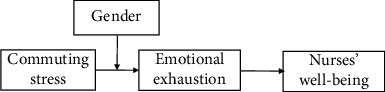
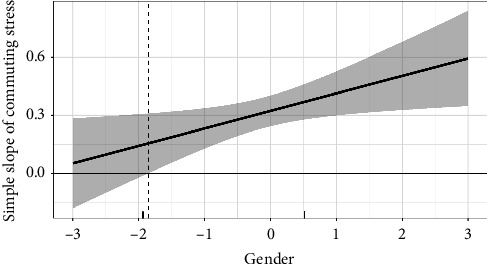
Aim: This research explores how and why commuting stress influences Chinese nurses' well-being. Background: A daily work commute may result in a significant psychological risk factor that can lead to harmful physiological and mental health consequences. Emerging research indicates that nurses experience long-lasting negative effects on their mental health, including burnout, due to the stress of a daily work commute. Methods: The study employed a cross-sectional design involving 380 registered nurses from state-owned hospitals in southern China. Hypotheses were tested using the PROCESS macro developed by Hayes [1]. Results: The stress of commuting indirectly influences nurses' well-being through increased emotional exhaustion. There is an interaction between commuting stress and nurses' gender such that the indirect effect of commuting stress on well-being is stronger for female nurses. Conclusions: The spillover effect of commuting stress in the nursing profession is often underestimated. However, this study underscores its significant impact on nurses' emotional exhaustion and well-being. The research findings emphasize that commuting stress contributes to emotional exhaustion and a decline in nurses' well-being. Implications for Nursing Management: Healthcare organizations should leverage these findings to reinforce the importance of self-care for nurses and to provide nurses with resources to help decrease the potential negative outcomes of commuting stress. The study also shows that female nurses may experience a more pronounced association between commuting stress and emotional exhaustion. As such, healthcare organizations should develop gender-specific interventions and support systems that address the unique challenges faced by female nurses in relation to commuting stress.
Keywords: commuting stress; emotional exhaustion; gender; nurses' well-being.
Copyright © 2025 DanYang Li et al. Journal of Nursing Management published by John Wiley & Sons Ltd.
Conflict of interest statement
The authors declare no conflicts of interest.
Figures

References
-
- Hayes A. F. Introduction to Mediation, Moderation, and Conditional Process Analysis: A Regression-Based Approach . Guilford publications; 2017.
-
- Calderwood C., Mitropoulos T. Commuting Spillover: A Systematic Review and Agenda for Research. Journal of Organizational Behavior . 2021;42(2):162–187.
-
- Dettmers J., Wendt C., Biemelt J. Already Exhausted When Arriving at Work? A Diary Study of Morning Demands, Start-of-Work-Day Fatigue and Job Performance and the Buffering Role of Temporal Flexibility. European Journal of Work and Organizational Psychology . 2020;29(6):809–821.
-
- Gerpott F. H., Rivkin W., Unger D. Stop and Go, Where Is My Flow? How and When Daily Aversive Morning Commutes Are Negatively Related to Employees’ Motivational States and Behavior at Work. Journal of Applied Psychology . 2022;107(2):p. 169. - PubMed
-
- Mauss D., Jarczok M. N., Fischer J. E. The Streamlined Allostatic Load Index: A Replication of Study Results. Stress: The International Journal on the Biology of Stress . 2016;19(6):553–558. - PubMed
MeSH terms
LinkOut - more resources
Full Text Sources
Medical
Research Materials
