


Using Behaviour Diagnostics to Identify Enablers and Barriers to Optimise Nurse and Midwife Manager Leadership Time
- PMID: 40223887
- PMCID: PMC11968169
- DOI: 10.1155/jonm/6498541
Using Behaviour Diagnostics to Identify Enablers and Barriers to Optimise Nurse and Midwife Manager Leadership Time
Abstract
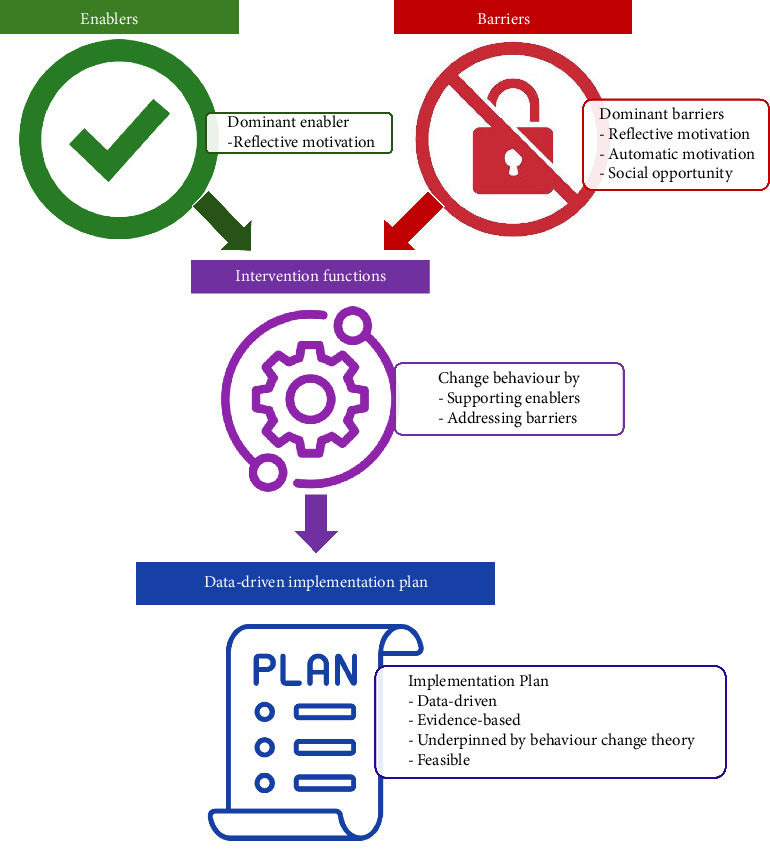
Background: Effective nursing and midwifery leadership benefits patients, staff and organisations. In February 2024, all nurse/midwife managers (N = 89) across one organisation transitioned to five allocated leadership days per week. For many nurse/midwife managers, whose default was to assume the clinical shift leader role when the unit was busy or short staffed, optimising use of five allocated leadership days per week required significant behaviour change. Aim: The aims of this study were to: (i) examine the enablers and barriers to nurse/midwife managers using allocated leadership time to fulfil their core responsibilities and (ii) develop a theory-informed implementation plan to optimise allocated leadership time use. Methods: A survey of all nurse/midwife managers, underpinned by the Theoretical Domains Framework, enabled identification of enablers and barriers to using allocated leadership time. The Behaviour Change Wheel was used to map enablers and barriers, identify intervention functions and behaviour change techniques to form an implementation plan. The APEASE criteria (acceptability, practicability, effectiveness, affordability, side effects/safety and equity) were applied to ensure effective and feasible strategies were selected. Results: The response rate was 62.5% (55/89). Reflective motivation was the dominant enabler (clear goals, intentions and optimism). The most common barriers were reflective motivation (feeling responsible if an adverse event impacted staff or patients; perceptions of lack of control); automatic motivation (feelings of guilt, anxiety and stress if using allocated leadership time when their area is short staffed) and social opportunity (social influences and balancing the expectations of others). A range of intervention functions were necessary to support identified enablers and address identified barriers to nurse/midwife managers optimising their use of allocated leadership time. Conclusions: Behaviour change theory is useful for identifying real-world enablers and barriers of nurse/midwife managers' use of allocated leadership time and developing a theory-informed implementation plan to optimise use of their allocated leadership time.
Copyright © 2025 Julie Considine et al. Journal of Nursing Management published by John Wiley & Sons Ltd.
Conflict of interest statement
The authors declare no conflicts of interest.
Figures


References
-
- Gabel S. Transformational Leadership and Healthcare. Medical Science Educator . 2013;23(1):55–60. doi: 10.1007/bf03341803. - DOI
MeSH terms
LinkOut - more resources
Full Text Sources
