


Determinants of Evidence Implementation by Nurses: #Evidencer Model for the Use of Evidence-Based Practice (#EvidencerMUSEBP)-A Structural Equation Model
- PMID: 40224764
- PMCID: PMC11919092
- DOI: 10.1155/2024/7246547
Determinants of Evidence Implementation by Nurses: #Evidencer Model for the Use of Evidence-Based Practice (#EvidencerMUSEBP)-A Structural Equation Model
Abstract
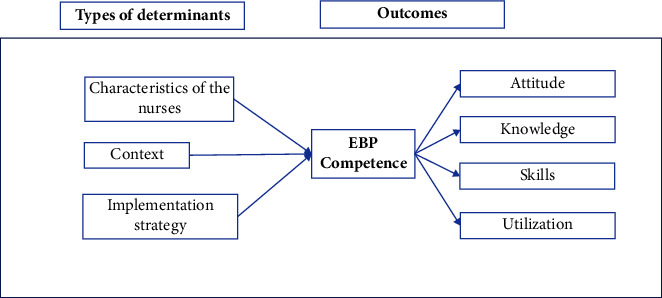
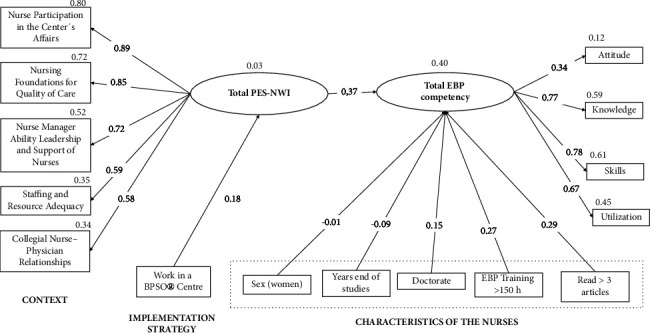
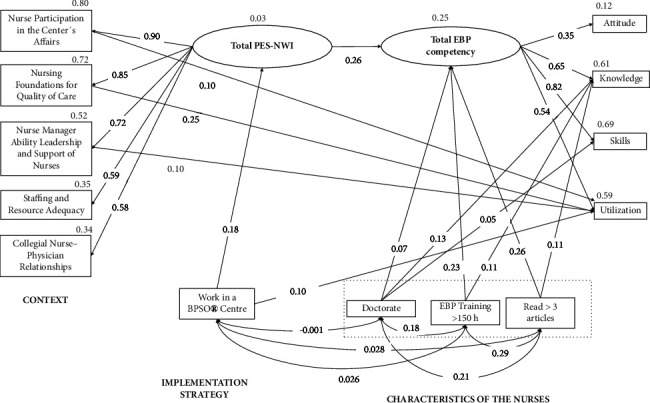
Existing studies have identified specific factors influencing some dimensions of evidence-based practice (EBP) competence and use. However, the way these factors interact still needs to be clarified. The purpose of the study was to test a model based on the Determinant Frameworks that explain the relationships and the direct pathways between the characteristics of the nurses, the context, and the implementation strategies and the dimensions of EBP competence, attitude, knowledge, skills, and use of EBP. A cross-sectional study was carried out in Spain during January and February 2020, involving 2,370 nurses employed in public health centers across all autonomous communities within the National Health System. An online survey was administered to gather data, addressing various topics related to the nurses' characteristics, the context in which they worked, the implementation strategy, and their competence in evidence-based practice (EBP). As depicted in the conceptual framework, a structural equation model was constructed to test the hypothesized relationships among key study variables. The model obtained showed a good fit (χ 2/df = 3.20, p < 0.001; RMSEA = 0.030 [90% CI 0.025, 0.036]; CFI = 0.989; GFI = 0.990; TLI = 0.983). The context, more specifically, the dimensions of nurse participation in the center's affairs, nursing foundations for quality of care, nurse manager ability leadership and support of nurses, and implementation strategy have a direct and positive effect on EBP use. Training in EBP, reading scientific articles, and having a doctorate are associated with higher competence and knowledge in EBP. The final fit shows the #Evidencer model for the use of EBP (#EvidencerMUSEBP) with two main components: the contextual and strategic factors that influence the implementation of EBP and the characteristics of the professionals, such as their training and reading of articles, which have an impact on EBP competence. This model could guide healthcare organizations in proposing comprehensive interventions to improve EBP use and the competency of nurses.
Copyright © 2024 Maria Ruzafa-Martínez et al.
Conflict of interest statement
The author declares that there are no conflicts of interest regarding the publication of this paper.
Figures
References
-
- Melnyk B., Gallagher‐Ford L., English Long L., Fineout-Overholt E. The Establishment of Evidence‐Based Practice Competencies for Practicing Registered Nurses and Advanced Practice Nurses in Real‐World Clinical Settings: proficiencies to improve healthcare quality, reliability, patient outcomes, and costs. Worldviews on Evidence-Based Nursing on Evidence‐Based . 2014;11 - PubMed
-
- Melnyk B. M., Gallagher-Ford L., Zellefrow C., et al. The first U.S. Study on nurses’ evidence-based practice competencies indicates major deficits that threaten healthcare quality, safety, and patient outcomes. Worldviews on Evidence-Based Nursing . 2018;15(1):16–25. doi: 10.1111/wvn.12269. - DOI - PubMed
-
- Ruzafa-Martínez M., Fernández-Salazar S., Leal-Costa C., Ramos-Morcillo A. J. Questionnaire to evaluate the competency in evidence‐based practice of registered nurses (EBP‐COQ Prof©): development and psychometric validation. Worldviews on Evidence-Based Nursing . 2020;17(5):366–375. doi: 10.1111/wvn.12464. - DOI - PMC - PubMed
MeSH terms
LinkOut - more resources
Full Text Sources
Research Materials
Miscellaneous
