


Appreciative Leadership, Workplace Belongingness, and Affective Commitment of Nurses: The Mediating Role of Job Crafting
- PMID: 40224827
- PMCID: PMC11918758
- DOI: 10.1155/2024/2311882
Appreciative Leadership, Workplace Belongingness, and Affective Commitment of Nurses: The Mediating Role of Job Crafting
Abstract
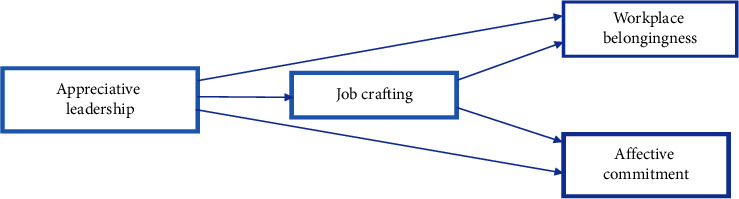
Aim: This study aimed to investigate the appreciation leadership, workplace belongingness, and affective commitment among nurses, with a specific focus on the mediating role of job crafting.
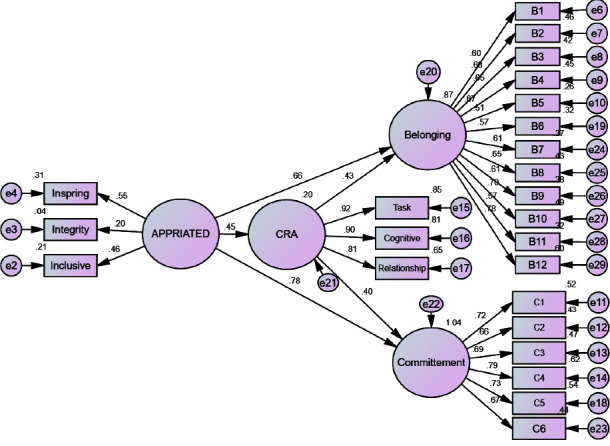
Background: Leadership, particularly in healthcare care, significantly influences employee experiences and outcomes. Appreciative leadership fosters a positive work environment, valuing and motivating employees. However, its impact on workplace belongingness and affective commitment among nurses requires further exploration. Job crafting, a mechanism in which employees shape their roles to align with their preferences, strengths, and values, can serve as a mediator in the relationship between appreciative leadership and outcomes, such as workplace belongingness and affective commitment. Subjects and Methods. A cross-sectional descriptive study was conducted in nurses from two hospitals (Prince Mohammed bin Abdulaziz and Shaqra General Hospital) in Riyadh City, Saudi Arabia. Four standardized scales were used to assess appreciation for leadership, sense of belonging, affective commitment among nurses, and job crafting; 381 nurses were surveyed. AMOS structural equation modeling (SEM) was used to examine the hypothetical model of the study.
Results: APL significantly affects job-crafting behaviors, belonging, and affective commitment among nurses. Furthermore, job-crafting behaviors significantly affect belonging among nurses and commitment.
Conclusions: This indicates that when nurses perceive their leadership positively, their job-crafting behaviors increase, which in turn enhances their sense of belonging at work. Furthermore, these findings indicate that positive leadership perceptions directly improve nurses' commitment to their jobs. This study recommended that educational programs can upgrade leadership styles and change practice levels. Implications for Nursing Management. Nursing managers should focus on cultivating appreciative leadership behaviors, such as providing regular feedback, recognizing achievements, and fostering a supportive work culture. Organizations can encourage the creation of jobs among nurses by offering opportunities for autonomy, skill development, and flexibility in job roles.
Copyright © 2024 Manal Saleh Moustafa Saleh et al.
Conflict of interest statement
The authors declare that they have no conflicts of interest.
Figures
References
-
- Todaro-Franceschi V. Compassion Fatigue and Burnout in Nursing: Enhancing Professional Quality of Life . : Springer Publishing Company; 2024.
-
- Drønnen M. Positive Leadership: Using Positive Psychology for a Better Workplace Culture . Cham: Springer International Publishing; 2022. Factors in the leadership tasks; pp. 53–90.
-
- Amanullah R. Impact of Passive Leadership on Emotional Exhaustion with the Mediating Role of Workplace Incivility and Moderating Role of Affective Commitment . : Faculty of Management & Social Sciences Department of Management Sciences; 2021.
-
- Canlas A. L., Williams M. R. Meeting belongingness needs: an inclusive leadership practitioner’s approach. Advances in Developing Human Resources . 2022;24(4):225–241. doi: 10.1177/15234223221118953. - DOI
MeSH terms
LinkOut - more resources
Full Text Sources
