


Emotional Granularity and Cognitive Reappraisal Affect Social Anxiety and Interpersonal Relationships in Adolescents: A Bayesian Network Analysis
- PMID: 40225730
- PMCID: PMC11987076
- DOI: 10.1155/da/8658973
Emotional Granularity and Cognitive Reappraisal Affect Social Anxiety and Interpersonal Relationships in Adolescents: A Bayesian Network Analysis
Abstract
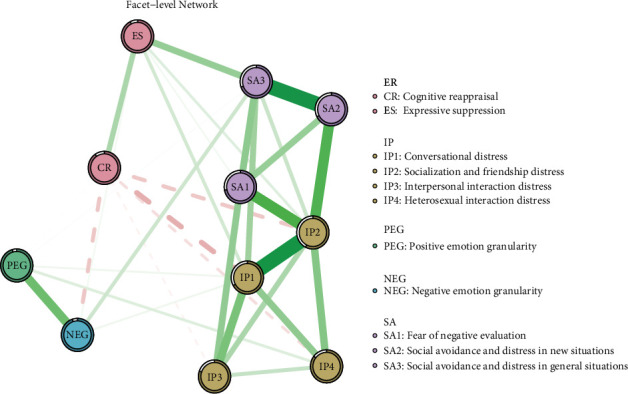
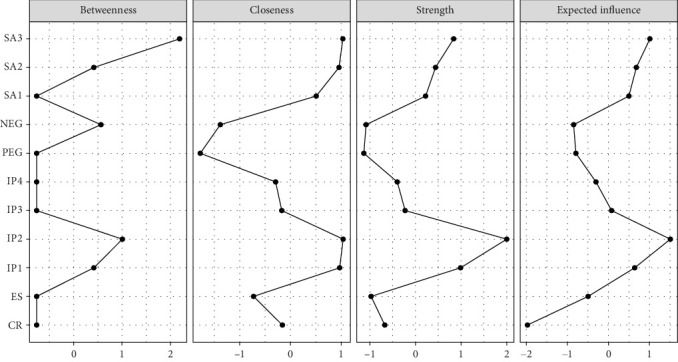
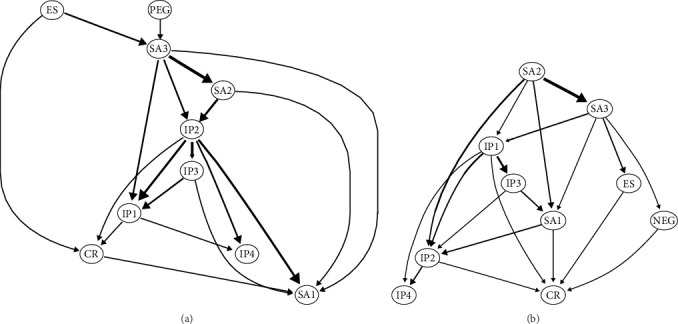
Background: Emotional granularity (EG), the ability to finely distinguish emotional experiences, plays a crucial role in emotion regulation and social interactions. This study measures EG using a standardized experimental procedure and assesses related variables through questionnaires. We employ both undirected graphical Gaussian models (GGM) and directed Bayesian network analysis (NA) to investigate how positive EG (PEG) and negative EG (NEG), in conjunction with emotion regulation, uniquely influences social anxiety and interpersonal relationships. Methods: The sample comprised 407 junior high school students from China, aged 13-14 years old. We utilized the Photo Emotion Differentiation Task (PED task), Emotion Regulation Scale (ERS), Interpersonal Relationship Comprehensive Diagnostic Scale (IRCDS), and Adolescent Social Anxiety Scale (SAS-A) to measure emotional differentiation, emotion regulation, interpersonal relationships, and social anxiety, respectively. Results: The undirected network highlights a pronounced relationship between interpersonal relationships and social anxiety. "Socialization and Friendship Distress" shows the highest expected influence, followed by "Social Avoidance and Distress in General Situations", and "Conversational Distress". Bayesian NA indicates that both PEG and NEG, along with cognitive reappraisal (CR), influence social anxiety and interpersonal relationships. PEG directly affects social anxiety features, whereas NEG is influenced by them. Additionally, females experience more severe issues with interpersonal relationships and social anxiety than males. Conclusion: The study revealed that individuals with lower positive EG directly impact social anxiety and interpersonal issues, and indirectly affect CR. Conversely, negative EG is mainly influenced by social anxiety symptoms and directly affects CR strategies. These findings highlight the importance of EG in adolescent mental health, suggesting that enhancing emotional differentiation could effectively address social anxiety and foster healthier interpersonal relationships.
Keywords: adolescent; emotional granularity; emotional regulation; interpersonal relationship; network analysis; social anxiety.
Copyright © 2025 Wen Lian et al. Depression and Anxiety published by John Wiley & Sons Ltd.
Conflict of interest statement
The authors declare no conflicts of interest.
Figures
References
-
- Barrett L. F., Gross J., Christensen T. C., Benvenuto M. Knowing What You’re Feeling and Knowing What to Do About It: Mapping the Relation Between Emotion Differentiation and Emotion Regulation. Cognition & Emotion . 2001;15(6):713–724. doi: 10.1080/02699930143000239. - DOI
-
- Kashdan T. B., Barrett L. F., McKnight P. E. Unpacking Emotion Differentiation: Transforming Unpleasant Experience by Perceiving Distinctions in Negativity. Current Directions in Psychological Science . 2015;24(1):10–16. doi: 10.1177/0963721414550708. - DOI
-
- Smidt K. E., Suvak M. K. A Brief, but Nuanced, Review of Emotional Granularity and Emotion Differentiation Research. Current Opinion in Psychology . 2015;3:48–51. doi: 10.1016/j.copsyc.2015.02.007. - DOI
Publication types
MeSH terms
LinkOut - more resources
Full Text Sources
Medical
