


Prognostic Role of Adaptive Immune Microenvironment in Patients with High-Risk Myelodysplastic Syndromes Treated with 5-Azacytidine
- PMID: 40227622
- PMCID: PMC11988087
- DOI: 10.3390/cancers17071104
Prognostic Role of Adaptive Immune Microenvironment in Patients with High-Risk Myelodysplastic Syndromes Treated with 5-Azacytidine
Abstract
Background/objectives: There are limited data regarding immunohistochemical profiling of immune cells in bone marrow trephine biopsies of patients with high-risk myelodysplastic syndromes (HR-MDS).
Methods: We sought to objectively quantify, with the use of digital pathology, the density (cells/mm2) of the prominent adaptive immunity cell populations in sixty-four (64) bone marrow trephine biopsies of HR-MDS patients receiving 5-Azacytidine. We focused on CD3(+) T cells, CD8(+) cytotoxic T cells (Tc), helper T cells (Th), Foxp3(+) regulatory T cells (Tregs), CD20(+) B-cells and CD138(+) plasma cells and evaluated the presence and the number of lymphoid aggregates. A control group of twenty "non-MDS" patients was included in the study.
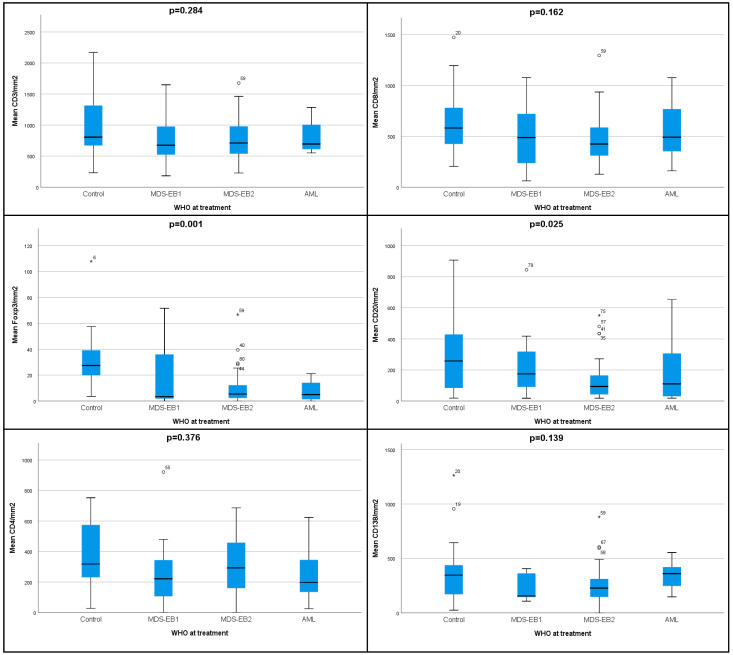
Results: We identified a significant decrease in adaptive immune cell densities in the HR-MDS patients compared to the non-MDS controls. Increased T and Th cell densities correlated with the response to 5-Azacytidine (5-AZA) treatment. Higher T, Tc, Th and plasma cells densities and low B, Tregs and Tregs/T cells ratios correlated with increased overall survival. Reduced Tregs, Tregs/T cells, Tregs/Tc and plasma cells showed improved leukemia-free survival. A modified IPSS-R (IPSS-R-I), combining the initial IPSS-R with the immune populations' parameters, improved overall survival and showed a double-fold increase in Cox calculated hazard ratios.
Conclusions: Immunohistochemical bone marrow immune profiling represents a powerful and easily useable tool for investigating the possible role of bone marrow immune microenvironment in the pathogenesis and progression of MDS, but also its association with the response to 5-AZA treatment and clinical outcomes.
Keywords: 5-Azacitidine; digital pathology; immunoenvironment; immunohistochemistry; myelodysplastic syndromes.
Conflict of interest statement
The authors declare no conflicts of interest.
Figures


References
-
- Kordasti S.Y., Afzali B., Lim Z., Ingram W., Hayden J., Barber L., Matthews K., Chelliah R., Guinn B., Lombardi G., et al. IL-17-producing CD4(+) T cells, pro-inflammatory cytokines and apoptosis are increased in low risk myelodysplastic syndrome. Br. J. Haematol. 2009;145:64–72. doi: 10.1111/j.1365-2141.2009.07593.x. - DOI - PubMed
LinkOut - more resources
Full Text Sources
Research Materials
Miscellaneous
