


Cost-effectiveness of CDK4/6 inhibitors for second-line HR+/HER2- advanced or metastatic breast cancer in China
- PMID: 40229346
- PMCID: PMC11997058
- DOI: 10.1038/s41598-025-97504-3
Cost-effectiveness of CDK4/6 inhibitors for second-line HR+/HER2- advanced or metastatic breast cancer in China
Abstract
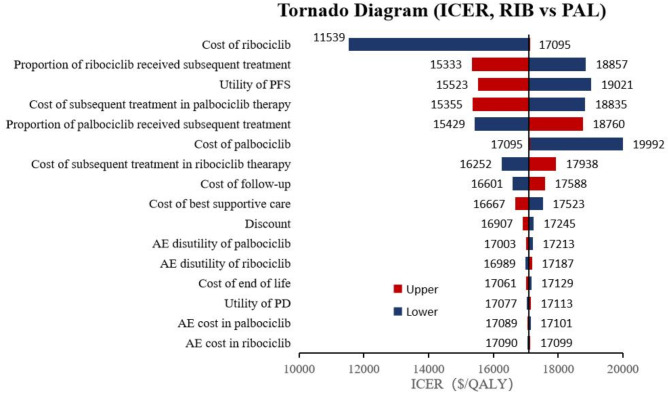
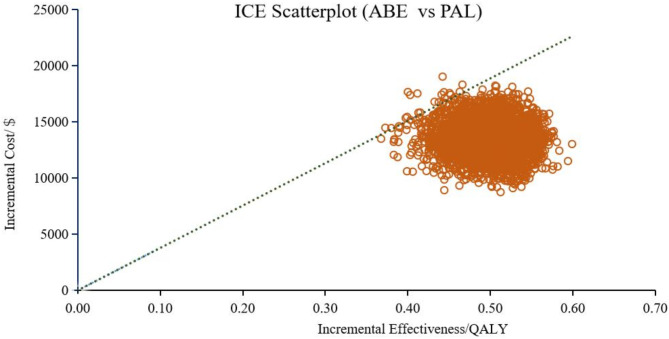
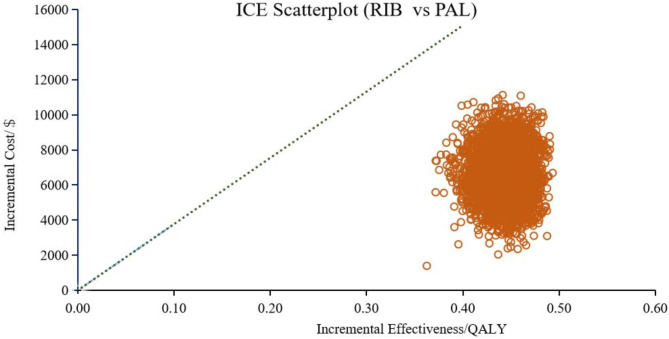
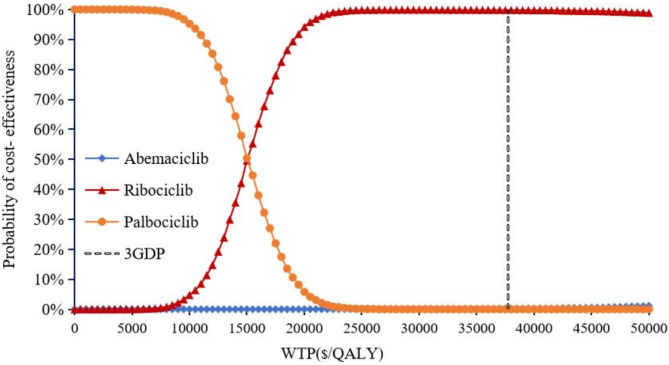
Hormone receptor HR-positive/HER2-negative (HR+/HER2-) breast cancer is the most common subtype in China, representing 60-70% of cases, with a rising incidence due to aging demographics and lifestyle changes. CDK4/6 inhibitors such as palbociclib, ribociclib and abemaciclib have been proven effective in treating HR+/HER2 - advanced or metastatic breast cancer (ABC/MBC), though they may increase healthcare costs. This study aims to compare the efficacy, safety and cost-effectiveness of CDK4/6 inhibitors for the second-line treatment of HR+/HER2 - ABC/MBC from the Chinese healthcare perspective. A cohort-based partitioned survival model was utilized, drawing on the survival data published from PALOMA-3, MONALEESA-3 and MONARCH-2 trials. Costs, and quality-adjusted life years (QALYs) were used to calculate the incremental cost-effectiveness ratio (ICER) over a 15-year time horizon. Deterministic and probabilistic sensitivity analyses were performed to assess the robustness of the model results. In the base-case analysis, the model estimated health benefits to be 2.10 QALYs for palbociclib plus fulvestrant (PAL + FUL), 2.55 QALYs for ribociclib plus fulvestrant (RIB + FUL), and 2.60 QALYs for abemaciclib plus fulvestrant (ABE + FUL), with corresponding costs of $34,423, $41,119, and $48,019. Compared with PAL + FUL, the ICERs were $27,161 per QALY for ABE + FUL and $15,073 per QALY for RIB + FUL. The robustness of these findings was confirmed through uncertainty analyses. Among the three strategies, the most cost-effective probabilities of PAL + FUL, RIB + FUL and ABE + FUL were 0%, 99.8%, and 0.2% under the willingness-to-pay (WTP) threshold of 3 times per-capita gross domestic product ($37,738) in China. This study indicated that both RIB + FUL and ABE + FUL are cost-effective at the WTP threshold compared with PAL + FUL. Notably, RIB + FUL offers the greatest cost-effective advantage for the second-line treatment of HR+/HER2 - ABC/MBC among these three CDK4/6 inhibitors.
Keywords: Breast cancer; CDK4/6 inhibitors; China; Cost-effectiveness; Fulvestrant; HR-positive/HER2-negative.
© 2025. The Author(s).
Conflict of interest statement
Declarations. Competing interests: The authors declare no competing interests. Ethics approval: The data of the PFS/OS was based on previously published trials, and ethics approval or specific consent procedures were not applicable for this study.
Figures




References
MeSH terms
Substances
Grants and funding
LinkOut - more resources
Full Text Sources
Medical
Research Materials
Miscellaneous
