Review
. 2025 Jun;103(6):635-649.
doi: 10.1007/s00109-025-02539-8. Epub 2025 Apr 14.

Exploring endothelial dysfunction in major rheumatic diseases: current trends and future directions

Affiliations
Review

Exploring endothelial dysfunction in major rheumatic diseases: current trends and future directions

Arshiya S Anwar Husaini et al. J Mol Med (Berl). 2025 Jun.

Abstract

The relationship between rheumatic diseases (RDs) and endothelial dysfunction (ED) is intricate and multifaceted, with chronic inflammation and immune system dysregulation playing key roles. RDs, including Osteoarthritis (OA), Rheumatoid arthritis (RA), Systemic Lupus erythematosus (SLE), Ankylosing spondylitis (AS), Psoriatic arthritis (PsA), Sjogren's syndrome (SS), Systemic sclerosis (SSc), Polymyalgia rheumatica (PMR) are characterized by chronic inflammation and immune dysregulation, leading to ED. ED is marked by reduced nitric oxide (NO) production, increased oxidative stress, and heightened pro-inflammatory and prothrombotic activities, which are crucial in the development of cardiovascular disease (CVD) and systemic inflammation. This association persists even in RD patients without conventional cardiovascular risk factors, suggesting a direct impact of RD-related inflammation on endothelial function. Studies also show that ED significantly contributes to atherosclerosis, thereby elevating cardiovascular risk in RD patients. This review synthesizes the molecular mechanisms connecting major RDs and ED, highlighting potential biomarkers and therapeutic targets. Ultimately, the review aims to enhance understanding of the complex interactions leading to ED in rheumatic patients and inform strategies to mitigate cardiovascular risks and improve patient outcomes.

Keywords: Cardiovascular diseases; Chronic inflammation; Endothelial dysfunction; Immune system dysregulation; Rheumatic diseases.


Conflict of interest statement

Declarations. Ethics approval: This study does not involve any human or animal testing. Competing interests: The authors declare no competing interests.

Figures
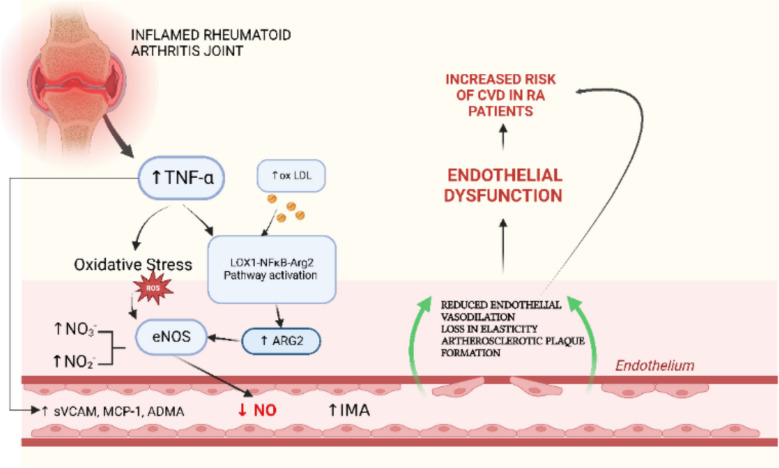
Fig. 1
Fig. 1
Mechanistic illustration of endothelial dysfunction in rheumatoid arthritis. Inflammatory cytokines, particularly TNF-α released from inflamed joints, promote oxidative stress and increase oxidized LDL (oxLDL). This activates the LOX1–NFκB–Arg2 signaling pathway, leading to ARG2 upregulation and eNOS uncoupling, resulting in decreased nitric oxide (NO) bioavailability. The reduction in NO impairs endothelial function, as indicated by increased soluble VCAM- 1, MCP- 1, ADMA, and intima-media thickness (IMT). These changes collectively contribute to reduced vasodilation, vascular stiffness, plaque formation, and a heightened cardiovascular disease risk in RA patients
Fig. 2
Fig. 2
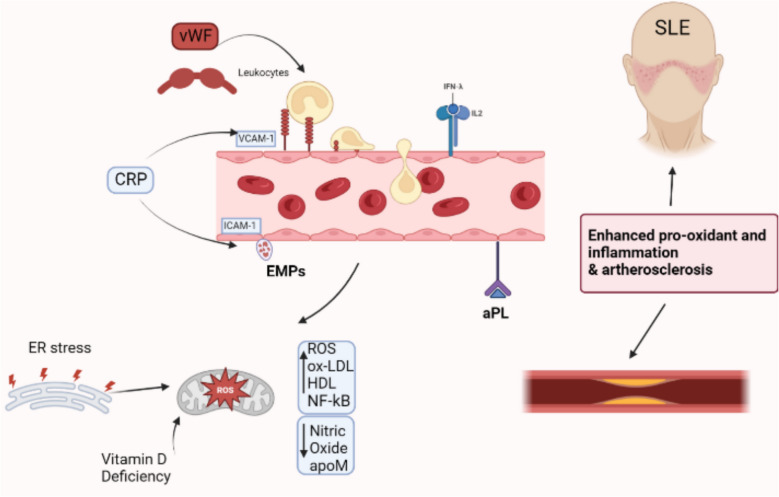
Systemic lupus erythematosus-induced endothelial dysfunction and atherosclerosis. Inflammatory mediators such as CRP, vWF, and leukocytes promote upregulation of adhesion molecules (VCAM- 1, ICAM- 1) and release of endothelial microparticles (EMPs). Type I interferons (IFN-α), interleukins (e.g., IL- 2), and antiphospholipid antibodies (aPL) further contribute to endothelial activation. Concurrently, vitamin D deficiency induces ER stress and reactive oxygen species (ROS) production, increasing oxidative stress (ox-LDL, NF-kB) and reducing nitric oxide (NO) and apoM, thereby impairing vascular homeostasis. These interconnected pathways promote inflammation, pro-oxidant states, and vascular damage, accelerating atherosclerosis in SLE
Fig. 3
Fig. 3
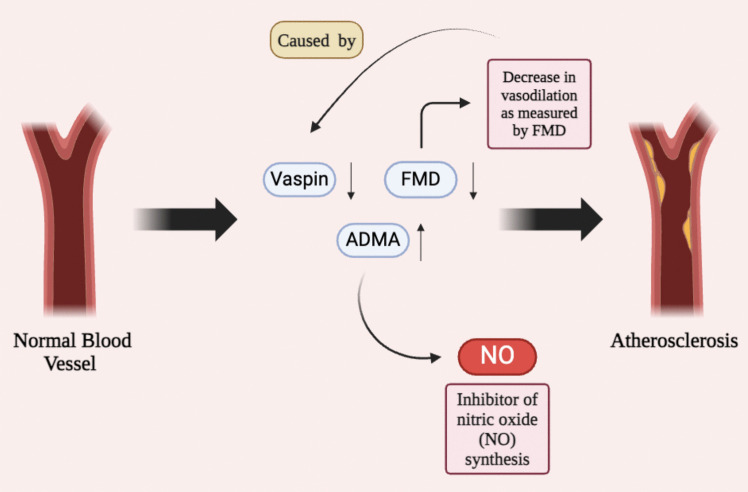
Endothelial dysfunction and atherosclerosis in ankylosing spondylitis. Reduced levels of vaspin lead to decreased flow-mediated dilation (FMD) and elevated concentrations of asymmetric dimethylarginine (ADMA), an endogenous inhibitor of nitric oxide (NO) synthesis. The resulting decrease in NO impairs vasodilation, contributing to endothelial dysfunction and the progression from a normal blood vessel to atherosclerosis
Fig. 4
Fig. 4
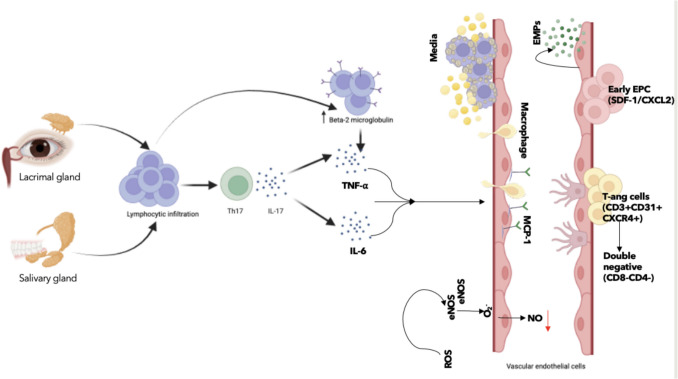
Glandular inflammation and vascular dysfunction in Sjögren’s syndrome. Lymphocytic infiltration of the lacrimal and salivary glands activates Th17 cells and promotes the release of IL- 17, TNF-α, and IL- 6. These cytokines induce macrophage activation, MCP- 1 expression, and endothelial injury through oxidative stress (ROS) and eNOS uncoupling, leading to reduced nitric oxide (NO) production. The vascular compartment shows endothelial microparticles (EMPs), extracellular vesicles (EVPs), and infiltration by specific immune cell populations, including early endothelial progenitor cells (EPCs, SDF- 1/CXCL2 +), T-angiogenic cells (CD3⁺CD31⁺CXCR4⁺), and double-negative T cells (CD8⁻CD4⁻), all contributing to vascular inflammation and dysfunction
Fig. 5
Fig. 5
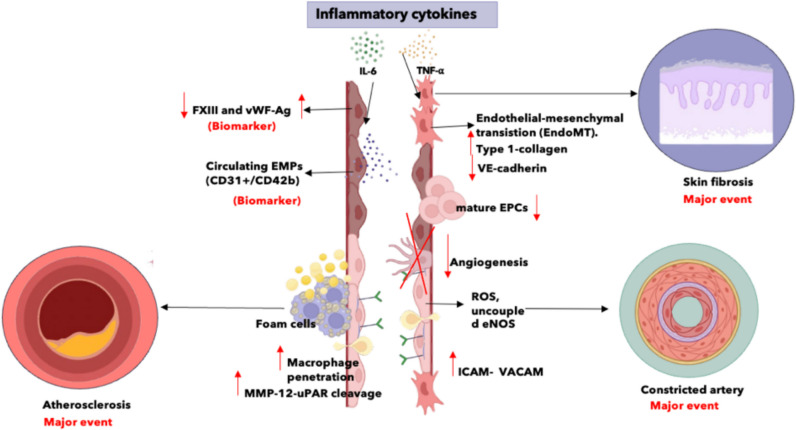
Inflammatory and fibrotic pathways in systemic sclerosis. Increased macrophage infiltration and foam cell formation enhance atherosclerosis, while endothelial-mesenchymal transition (EndoMT)—characterized by reduced VE-cadherin and increased type- 1 collagen—promotes skin fibrosis. Concurrently, elevated reactive oxygen species (ROS) production and uncoupled endothelial nitric oxide synthase (eNOS) induce arterial constriction. Biomarkers such as reduced FXIII and vWF-Ag, increased circulating endothelial microparticles (EMPs, CD31⁺/CD42b), and enhanced MMP- 12-uPAR cleavage highlight these endothelial disturbances

References

    1. Calle E, Gómez-Puerta JA (2018) Chapter 1 - The spectrum of rheumatic diseases. In: Atzeni F et al (eds) Handbook of systemic autoimmune diseases, vol 15. Elsevier, pp 1–13
    1. Kaleta K et al (2024) Endothelial dysfunction and risk factors for atherosclerosis in psoriatic arthritis: overview and comparison with rheumatoid arthritis. Rheumatol Int 44(9):1587–1606 - PMC - PubMed
    1. Murdaca G et al (2012) Endothelial dysfunction in rheumatic autoimmune diseases. Atherosclerosis 224(2):309–317 - PubMed
    1. McCarthy E et al (2016) Endothelial microparticles: pathogenic or passive players in endothelial dysfunction in autoimmune rheumatic diseases? Vascul Pharmacol 86:71–76 - PubMed
    1. Erre GL et al (2018) Prevalence and determinants of peripheral microvascular endothelial dysfunction in rheumatoid arthritis patients: a multicenter cross-sectional study. Mediators Inflamm 2018:6548715 - PMC - PubMed

LinkOut - more resources