


Risk factors and prognosis of pulmonary infection in hepatitis B-related acute-on-chronic liver failure: a retrospective cohort study
- PMID: 40229810
- PMCID: PMC11995551
- DOI: 10.1186/s12890-025-03628-7
Risk factors and prognosis of pulmonary infection in hepatitis B-related acute-on-chronic liver failure: a retrospective cohort study
Abstract
Objective: To identify risk factors for pulmonary infection in patients with hepatitis B virus (HBV)-related acute-on-chronic liver failure (ACLF), assess its impact on prognosis, and develop a prognostic prediction model.
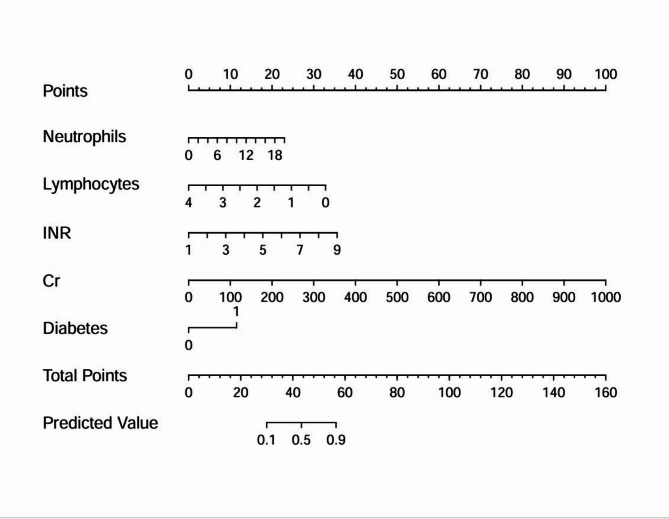
Methods: We retrospectively analyzed the clinical data of 393 patients with HBV-ACLF. Logistic regression was used to analyze the risk factors for lung infection in ACLF patients, as well as the factors affecting the prognosis of those who were infected. Additionally, a prognostic prediction model was established using the Nomogram method.
Results: The incidence of pulmonary infections in patients with ACLF was 38.7%, and patients with ACLF combined with pulmonary infections had a higher short-term mortality rate than those without infections (65.71% vs. 35.02%). Multivariate logistic regression analysis indicated that independent risk factors for pulmonary infection included TBIL, CRP, invasive procedures, peritoneal effusion, and hepatic encephalopathy. Additionally, creatinine, INR, comorbid diabetes mellitus, neutrophil counts, and lymphocyte counts were identified as independent risk factors affecting 30-day mortality in patients with pulmonary infection. Incorporating these risk factors, a new predictive model was established, with an area under the receiver operating characteristic curve of 0.832 (95% CI, 0.765-0.900). This model demonstrated higher discriminatory performance compared to traditional prognostic models such as CTP, MELD, and MELD-Na, with statistically significant differences (P < 0.05).
Conclusion: HBV-ACLF patients are susceptible to pulmonary infection, with fungal infection posing a significant threat. Pulmonary infection is associated with worse prognosis in HBV-ACLF patients. Early identification of risk factors and prognostic assessment can facilitate timely intervention and improve prognosis.
Keywords: Acute-on-chronic liver failure; Hepatitis B; Prediction model; Pulmonary infection; Risk factors.
© 2025. The Author(s).
Conflict of interest statement
Declarations. Ethics approval and consent to participate: The study was approved by the Ethics Committee of the Shanghai Public Health Clinical Center. Owing to the retrospective nature of the research, the Ethics Committee of the Shanghai Public Health Clinical Center waived the requirement for written informed consent. Consent for publication: Not applicable. Competing interests: The authors declare no competing interests.
Figures

References
-
- Liver Failure and Artificial Liver Group IDB, Chinese Medical Association. Chin J Hepatol. 2019;27(1):18–26. 10.3760/cma.j.issn.1007-3418.2019.01.006. Guidelines for Diagnosis and Treatment of Liver Failure (2018 Edition) [J].
-
- Sarin SK, Choudhury A, Sharma MK, Maiwall R, Al Mahtab M, Rahman S, et al. Acute-on-chronic liver failure: consensus recommendations of the Asian Pacific association for the study of the liver (APASL): an update. Hep Intl. 2019;13(4):353–90. 10.1007/s12072-019-09946-3. Epub 2019/06/07. - PMC - PubMed
-
- Jalan R, Gines P, Olson JC, Mookerjee RP, Moreau R, Garcia-Tsao G, et al. Acute-on chronic liver failure. J Hepatol. 2012;57(6):1336–48. 10.1016/j.jhep.2012.06.026. Epub 2012/07/04. - PubMed
-
- O’Leary JG, Reddy KR, Garcia-Tsao G, Biggins SW, Wong F, Fallon MB, et al. NACSELD acute-on-chronic liver failure (NACSELD-ACLF) score predicts 30-day survival in hospitalized patients with cirrhosis. Hepatology (Baltimore MD). 2018;67(6):2367–74. 10.1002/hep.29773. Epub 2018/01/10. - PubMed
MeSH terms
LinkOut - more resources
Full Text Sources
Medical
Research Materials
Miscellaneous
