. 2025 Apr 14;17(1):38.
doi: 10.1186/s13073-025-01463-3.

Bi-allelic variants in BRF2 are associated with perinatal death and craniofacial anomalies

Affiliations

Bi-allelic variants in BRF2 are associated with perinatal death and craniofacial anomalies

Francesca Mattioli et al. Genome Med. .

Abstract

Background: Variants in genes encoding multiple subunits of the RNA Polymerase III complex which synthesizes rRNAs, tRNAs, and other small RNAs were previously associated with neurological disorders, such as syndromic hypomyelination leukodystrophies, pontocerebellar hypoplasia, and cerebellofaciodental syndrome. One new such candidate is BRF2, which encodes a TFIIB-like factor that recruits the RNA polymerase III complex to type 3 promoters to initiate transcription of U6, RnaseP, and 7SK RNAs.

Methods: We combined sequencing with functional analyses to investigate the effects of BRF2 variants.

Results: We observe that a previously reported significant underrepresentation of double transmission of a splice variant results in recessive lethality in three large Icelandic families with multiple perinatal losses. Using data aggregation, we identified an additional seven individuals worldwide from three unrelated families carrying biallelic variants in BRF2. Affected individuals present a variable phenotype ranging from severe craniofacial anomalies with early death to intellectual disability with motor and speech development. In silico 3D modelling and functional analyses showed functional impairment of the identified variants, e.g., differences in target loci occupancy. Zebrafish knocked down for the orthologous brf2 presented with abnormal escape response, reduced swimming velocity and head size, and craniofacial malformations. These defects were complemented by the human wild-type but not mutated BRF2 mRNA further demonstrating their deleteriousness.

Conclusions: Overall, our results support the association of biallelic BRF2 variants with a novel neurodevelopmental disease and provide an additional link between RNA polymerase III, its targets and craniofacial anomalies.

Keywords: Autosomal recessive; BRF2; Craniofacial anomalies; RNA polymerase III.


Conflict of interest statement

Declarations. Ethics approval and consent to participate: Informed consent was obtained from guardians of all participants in this study. The current study was approved by the respective IRBs, specifically the CER (Commission d’éthique de la recherche) of the canton of Vaud (Protocol number: CER-VD 2021–01400), the Lahore College for Women University, the Children’s Mercy Institutional Review Board (study #11120514), and the Ethics Committee of Isfahan University of Medical Sciences (IR.MUI.MED.REC #189087). This research complies with the principles of the Declaration of Helsinki [96]. Consent for publication: Not applicable. Competing interests: RF, AO, PS, GHH, PM, DFG, KS are employees of deCODE genetics/Amgen Inc. The other authors declare no competing interests.

Figures
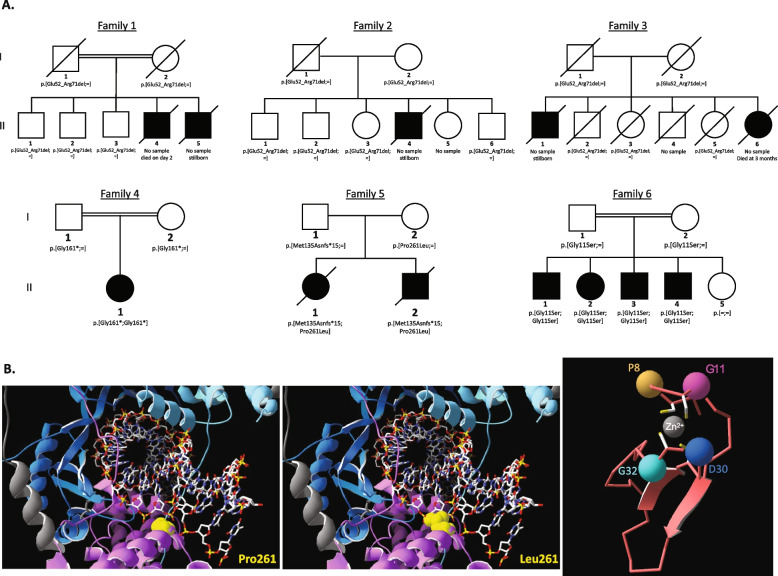
Fig. 1
Fig. 1
Identified biallelic variants in BRF2. A Pedigrees and the genotypes of the reported families. The offsprings of Icelandic families 1–3 were born in the 1970s, the 1950s, and 1920s, respectively. B 3D protein modelling of the identified missense variants. Pro261 highlighted in yellow is in close vicinity with the DNA backbone between two phosphate groups (left panel); the Pro261 is replaced by a Leucine highlighted in yellow in the middle panel. The bulkier sidechain of Leu261 will likely collide with the DNA. The right panel presents a schematic representation of the zinc-finger highlighting the conserved residues Gly11 (purple), Asp30 (dark blue), Gly32 (light blue), and Pro8 (gold). Coordination of the zinc-atom (gray) by the four conserved Cysteine (shown in sidechains) will expose the sidechains of Pro8, Gly11, Asp30, and Gly32
Fig. 2
Fig. 2
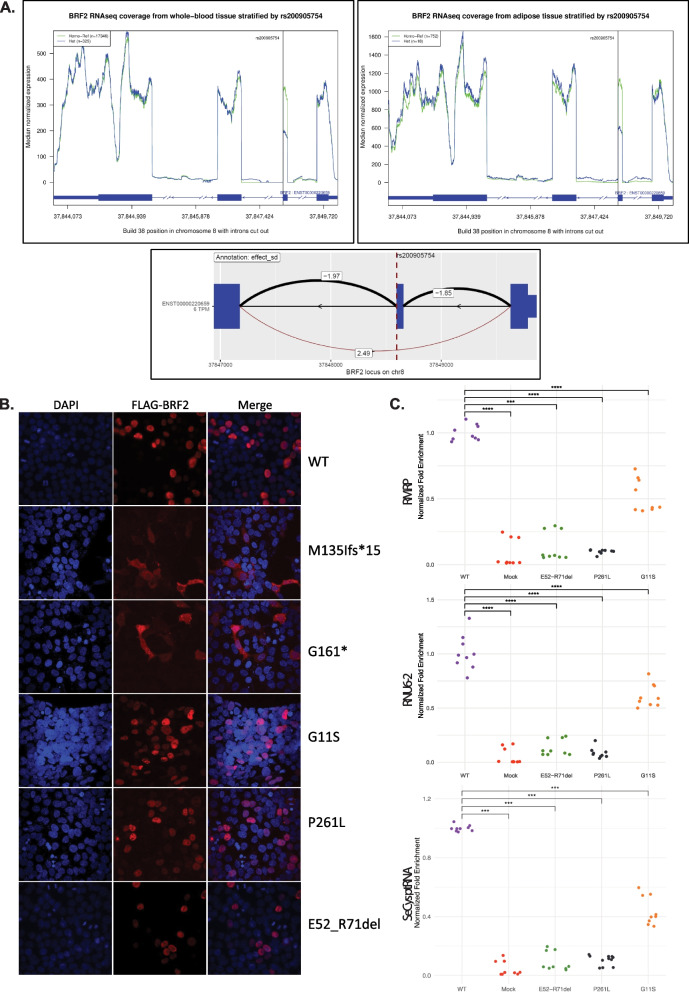
Variants assessments. A Effect on RNA expression of the splice donor variant BRF2(NM_018310.4):c.214 + 1G > A; p.(Glu52_Arg71del) (a.k.a. rs200905754). The median RNA-sequence coverage is reported for heterozygous (in blue) and noncarriers (in green) in blood (left top panel) and adipose tissue (right top panel). The splicing variant (dashed line in bottom panel) perturbs the correct splicing of exon 2 (black isoform, top cis-sQTL) and induces the skipping of that exon (red isoform: effect = 2.49 SD, P = 1.0 × 10−444). The splice junction usage quantification was calculated in terms of PSI (white labels). The dark blue squares represent exons of selected BRF2 transcripts which matched exon–intron boundary of the splice junctions. B Subcellular localization of FLAG-BRF2. Immunofluorescent staining with DAPI (blue) is shown on the left, FLAG-BRF2 (red) in the middle and the merged signals on the right. C ChIP-qPCR normalized fold enrichment analysis of RMRP, RNU6-2, and SeCys ptRNA loci occupancy by N-terminal FLAG-tagged BRF2. Comparison of FLAG-tagged BRF2 wild-type (WT) and mutants (FLAG-BRF2E52−R71del, FLAG-BRF2G11S, and FLAG-BRF2.P261L) HEK293T transfected cells with mock-treated cells. The statistical significance of pairwise comparisons between conditions was determined using the Wilcoxon rank-sum test, and significant differences are indicated with p-value annotations. ****p ≤ 0.0001; ***p ≤ 0.001
Fig. 3
Fig. 3
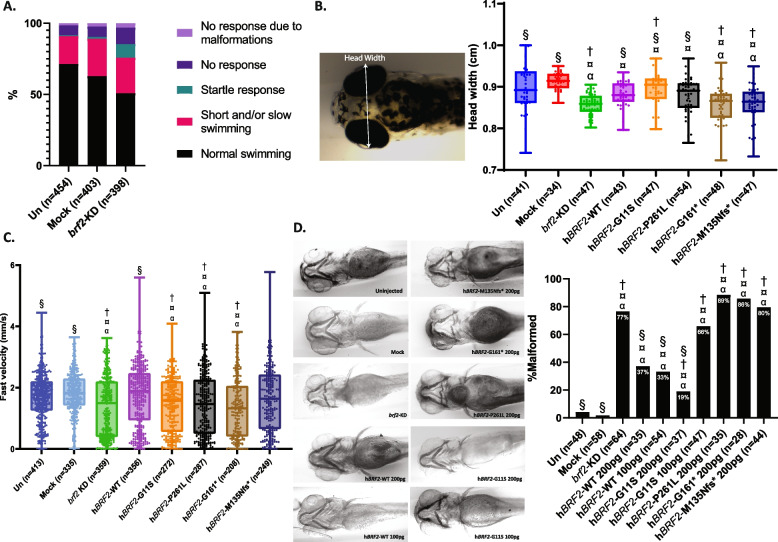
brf2-knocked-down zebrafish. A Touch-response test showing the percentage of the classified swimming movements upon a tactile stimulus on the tail for uninjected (Un), mock-injected (Mock), brf2-knocked down (brf2-KD) zebrafish larvae at 3 dpf. The number of tested larvae is indicated in parenthesis. B Head width (indicated by white arrows in the left panel) measurements Un-, Mock, brf2brf2-KD, and brf2-KD co-injected with human mRNA BRF2 wild-type (hBRF2-WT), Gly11Ser (hBRF2-G11S), Pro261Leu (hBRF2-P261L), Gly161* (hBRF2-G161*), Met135Asnfs*15 (hBRF2-M135Nfs*). The number of tested larvae is indicated in parenthesis. C Swimming fast velocity in the dark of Un, Mock, brf2-KD, and brf2-KD co-injected with human mRNA BRF2 wild-type (hBRF2-WT), Gly11Ser (hBRF2-G11S), Pro261Leu (hBRF2-P261L), Gly161* (hBRF2-G161*), Met135Asnfs*15 (hBRF2-M135Nfs*). D Alcian blue staining in zebrafish larvae at 5 dpf. On the left, representative ventral pictures of the Alcian blue staining showing jaw malformations of brf2-KD co-injected with human RNA BRF2 Pro261Leu (hBRF2-P261L 200 pg), Gly161* (hBRF2-G161* 200 pg), Met135Asnfs*15 (hBRF2-M135Nfs* 200 pg), and half dose of BRF2 Gly11Ser RNA (hBRF2-G11S 100 pg) compared with illustrative pictures of the normal jaw structure observed in Un, Mock, and brf2-KD co-injected with human BRF2 wildtype at normal (hBRF2-WT 200 pg) and half dosage (hBRF2-WT 100 pg) and Gly11Ser (hBRF2-G11S 200 pg). The fraction of the observed deformed jaw structure is presented in the right panel as a percentage. *** P < 0.001; ** P < 0.005; ns = not significant; § significant vs brf2- KD (P < 0.05); ¤ significant vs Mock (P < 0.05); † significant vs h BRF2 -WT (P < 0.05); α significant vs Un (P < 0.05)

References

    1. Verma RP. Evaluation and risk assessment of congenital anomalies in neonates. Children (Basel). 2021;8(10):862. - PMC - PubMed
    1. Kang L, Cao G, Jing W, Liu J, Liu M. Global, regional, and national incidence and mortality of congenital birth defects from 1990 to 2019. Eur J Pediatr. 2023;182(4):1781–92. - PubMed
    1. Perin J, Mai CT, Costa AD, Strong K, Diaz T, Blencowe H, et al. Systematic estimates of the global, regional and national under-5 mortality burden attributable to birth defects in 2000–2019: a summary of findings from the 2020 WHO estimates. BMJ Open. 2023;13(1):e067033. - PMC - PubMed
    1. Marouane A, Olde Keizer RACM, Frederix GWJ, Vissers LELM, de Boode WP, van Zelst-Stams WAG. Congenital anomalies and genetic disorders in neonates and infants: a single-center observational cohort study. Eur J Pediatr. 2022;181(1):359–67. - PMC - PubMed
    1. Meng L, Pammi M, Saronwala A, Magoulas P, Ghazi AR, Vetrini F, et al. Use of exome sequencing for infants in intensive care units: ascertainment of severe single-gene disorders and effect on medical management. JAMA Pediatr. 2017;171(12):e173438. - PMC - PubMed

LinkOut - more resources