


Evaluation of the Diagnosis Accuracy of the AWGS 2019 Criteria for "Possible Sarcopenia" in Thai Community-Dwelling Older Adults
- PMID: 40230404
- PMCID: PMC11994469
- DOI: 10.2147/CIA.S513657
Evaluation of the Diagnosis Accuracy of the AWGS 2019 Criteria for "Possible Sarcopenia" in Thai Community-Dwelling Older Adults
Abstract
Background: The term "possible sarcopenia" was introduced in the Asian Working Group for Sarcopenia (AWGS) 2019 guidelines to characterize individuals at high risk for sarcopenia in primary care settings. However, studies that support the diagnostic accuracy of this criteria remain scarce. Accordingly, the primary aim of this study was to assess the diagnostic accuracy of the AWGS 2019 "possible sarcopenia" criteria for detecting sarcopenia in Thai community-dwelling older adults. Our secondary aim was to explore the use of adjunct variables to improve the diagnostic accuracy of the "possible sarcopenia" criteria for detecting sarcopenia.
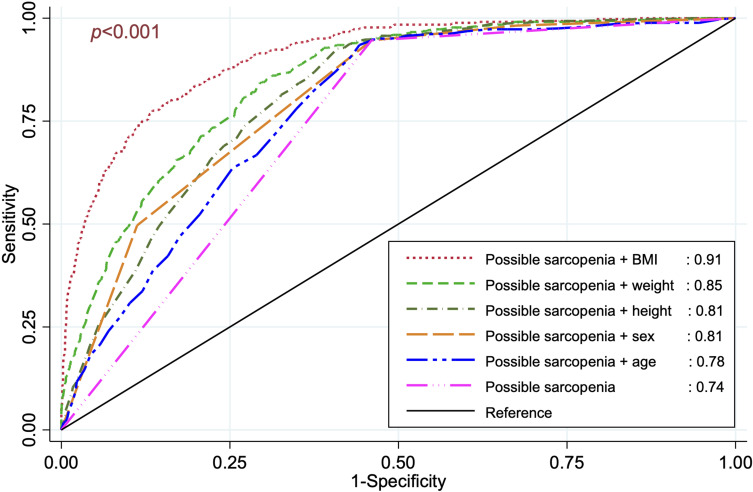
Methods: This study is a secondary analysis of an epidemiological investigation of the prevalence of sarcopenia among Thai older adults that was conducted during 2021-2022. We assessed the performance of the "possible sarcopenia" criteria against sarcopenia diagnoses based on the AWGS 2019 guidelines. In an attempt to improve the diagnostic performance of the AWGS 2019 criteria, we combined the AWGS 2019 criteria with age, sex, height, body weight, or BMI to create modified criteria. The variable that influenced the highest area under the receiver operating characteristic curve (AUC) was incorporated in the modified AWGS 2019 criteria.
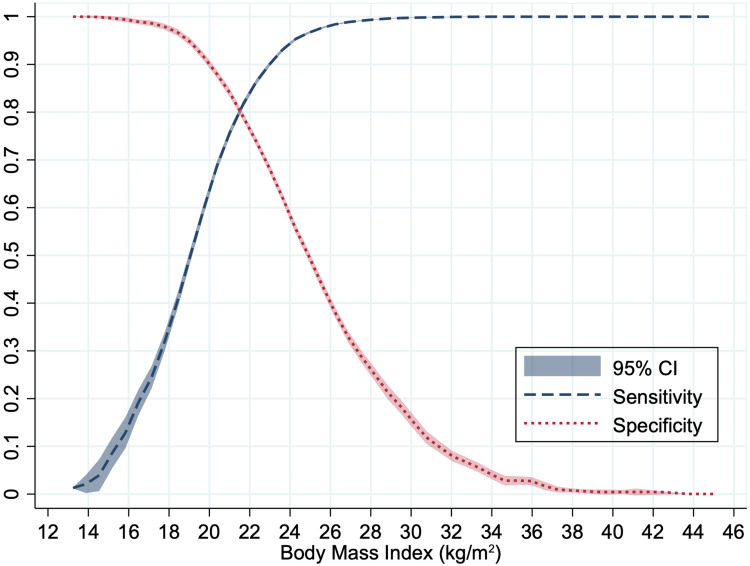
Results: A total of 2456 participants (mean age 69.0 ± 6.1 years, 63.6% female) were included. Of these, 445 (18.1%) patients were diagnosed with sarcopenia. The "possible sarcopenia" criteria showed a sensitivity of 94.6%, a specificity of 54.0%, and an AUC of 74% for detecting sarcopenia. Incorporating BMI improved the AUC by 17%. A BMI cutoff value <24 kg/m² was shown to increase specificity to 72.7%, while maintaining sensitivity at 89.9%.
Conclusion: The AWGS 2019 criteria for "possible sarcopenia" showed excellent sensitivity in detecting sarcopenia but lacked sufficient specificity. The modified AWGS "possible sarcopenia" criteria, which includes a BMI cutoff of <24 kg/m², increased the specificity for detecting sarcopenia while preserving high sensitivity among Thai community-dwelling older adults.
Keywords: Asian Working Group for Sarcopenia 2019 criteria; Thai community-dwelling older adults; diagnostic accuracy; evaluation; “possible sarcopenia”.
© 2025 Adulkasem et al.
Conflict of interest statement
All authors declare no personal or professional conflicts of interest relating to any aspect of this study.
Figures
References
-
- Treviño-Aguirre E, López-Teros T, Gutiérrez-Robledo L, et al. Availability and use of dual energy X-ray absorptiometry (DXA) and bio-impedance analysis (BIA) for the evaluation of sarcopenia by Belgian and Latin American geriatricians. J Cachexia Sarcopenia Muscle. 2014;5(1):79–81. doi: 10.1007/s13539-013-0126-6 - DOI - PMC - PubMed
MeSH terms
LinkOut - more resources
Full Text Sources
