


The effects of different work: Rest durations on physiological, neuromuscular, and ratings of perceived exertion responses during taekwondo-specific high-intensity interval training
- PMID: 40230660
- PMCID: PMC11995739
- DOI: 10.1016/j.jesf.2025.03.002
The effects of different work: Rest durations on physiological, neuromuscular, and ratings of perceived exertion responses during taekwondo-specific high-intensity interval training
Abstract
Purpose: To investigate the effect of different work: rest durations on physiological, neuromuscular, and perceived exertion responses during taekwondo-specific high-intensity interval training (HIIT).
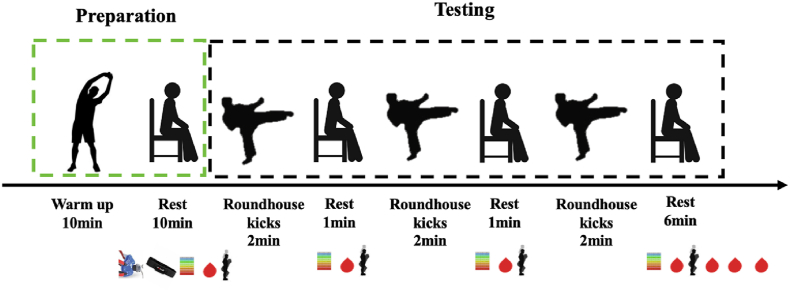
Methods: Thirteen moderate-trained taekwondo athletes (age: 21.7 ± 2.4 years; body mass: 69.1 ± 7.6kg; height: 174 ± 6 cm) completed a familiarization session and three HIIT trials. The trial consisted of three rounds of 2 min roundhouse kicks with 1 min of rest in between. In each round, the work: rest ratio was constant at 1:2, and the work: rest duration varied to be: short (2s:4s), medium (10s:20s), and long (20s:40s). Heart rate (HR) and oxygen uptake ( O2) were continuously measured. Blood lactate concentration ([La-]), countermovement jump (CMJ), and rating of perceived exertion (RPE) were recorded before trials and after each round. Energy contribution was estimated.
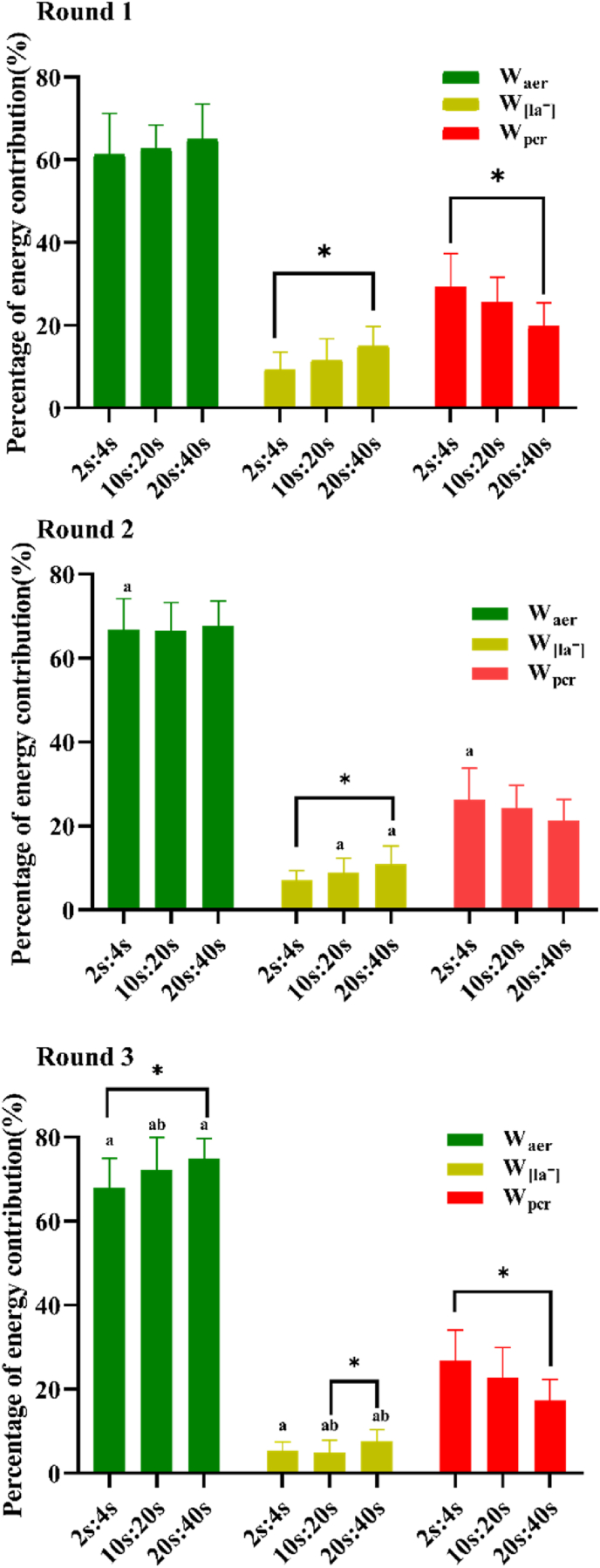
Results: HR, O2, and CMJ were similar across protocols (P > .05) but, [La-] was higher during long than short work: rest duration protocol (P < .05). Relative aerobic energy contribution and RPE in round 3 were higher during long than short work: rest duration protocol (P < .05). Absolute and relative glycolytic energy contribution in rounds 1 and 2 were higher during long than short work: rest duration protocol (P < .05). Relative phosphate energy contribution in rounds 1 and 3 was lower during long than short work: rest duration protocol (P < .05).
Conclusion: Different work: rest durations of taekwondo-specific HIIT influenced [La-], energy system contributions, and RPE. The longer work: rest duration protocol (20s:40s) stressed more the glycolytic, aerobic energy systems and perceived exertion, and less the phosphagen energy system.
Keywords: Combat sport; Energy systems; Heart rate; Oxygen uptake; Work: rest duration.
© 2025 The Society of Chinese Scholars on Exercise Physiology and Fitness. Published by Elsevier (Singapore) Pte Ltd.
Conflict of interest statement
The authors declare no conflict of interest.
Figures
References
-
- Santos JFdS., Dias Wilson V., Herrera-Valenzuela T., Sander Mansur Machado F. Time-motion analysis and physiological responses to taekwondo combat in juvenile and adult athletes: a systematic Review. Strength Condit J. 2020;42(2):103–121. doi: 10.1519/ssc.0000000000000517. - DOI
-
- Lopes-Silva J.P., Da Silva Santos J.F., Artioli G.G., Loturco I., Abbiss C., Franchini E. Sodium bicarbonate ingestion increases glycolytic contribution and improves performance during simulated taekwondo combat. Eur J Sport Sci. 2018;18(3):431–440. doi: 10.1080/17461391.2018.1424942. - DOI - PubMed
LinkOut - more resources
Full Text Sources
