Review
. 2025 Mar 18;4(3Part B):102568.
doi: 10.1016/j.jscai.2025.102568. eCollection 2025 Mar.

Robot-Assisted Cardiovascular Interventions

Affiliations
Review

Robot-Assisted Cardiovascular Interventions

Jon C George et al. J Soc Cardiovasc Angiogr Interv. .

Abstract

Innovation has been the cornerstone of progress in the field of percutaneous coronary intervention (PCI) since its inception. Refinements in procedural technique and interventional tools have improved patient outcomes and overall safety. Despite this progress, however, the health risks posed to operators and staff remain undeniably high. Robotic PCI (R-PCI) offers a new era in coronary revascularization poised to address this dilemma. To date, R-PCI procedures have been widely performed in clinical practice for over a decade and multiple novel endovascular robotic systems are currently under development. This review serves as an up-to-date understanding of R-PCI, focusing on the origins, clinical evidence, current state, and future targets of robotic therapy.

Keywords: robotic endovascular; robotic percutaneous coronary intervention; telerobotic; telestent.


Figures

Central Illustration
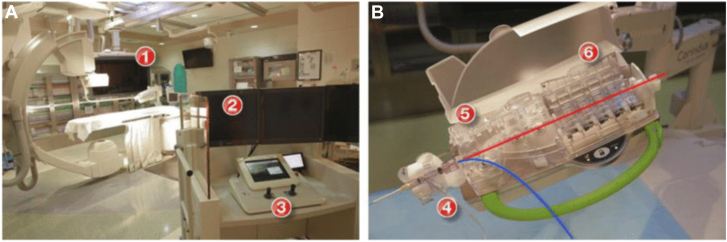
Thefirst-generationvascular robotic system. Panel A: Robotic percutaneous coronary intervention (PCI) platform including robotic arm and cassette (1); interventional cockpit (2); and control console (3). Panel B: Robotic cassette demonstrating placement for the guide wire (red) and the balloon/stent (blue) within the driver for rapid-exchange catheters (4); driver for 0.014′′ guide wires (5); and mechanical torque system (6).
Figure 1
Figure 1
Robotic carotid and renal interventions. The first panel of images (A) demonstrates the first robotic carotid revascularization performed with preintervention images on the left and postintervention images on the right. The second panel of images (B) demonstrates successful bilateral renal revascularization performed robotically with preintervention images on the top bar and postintervention images on the bottom bar. The third panel of images (C) demonstrates successful left anterior tibial artery revascularization performed robotically with a preintervention image on the left and a postintervention image on the right.
Figure 2
Figure 2
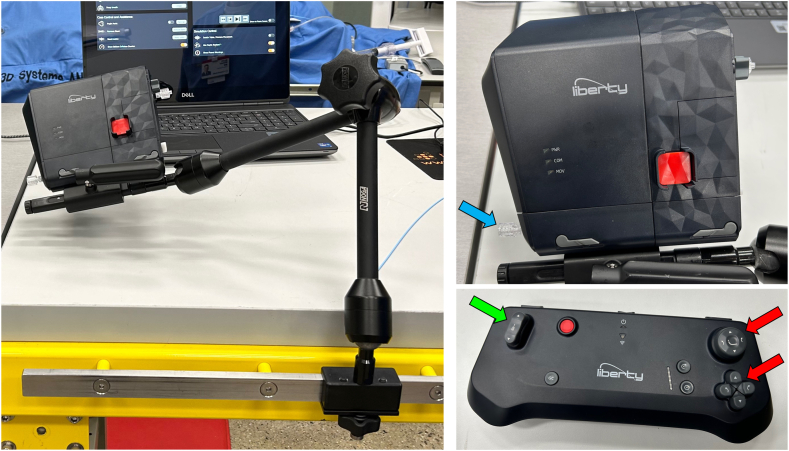
Miniaturized robotic system. The miniaturized disposable robot (upper right) attaches to a bedside articulated arm mounted on the procedure table (left) and is controlled by a wireless handheld controller (lower right). The location for the attachment of a catheter to the robot is shown (blue arrow). The handheld controller has a joystick and buttons for wire manipulation (red arrows) and a button for balloon/stent manipulation (green arrow).
Figure 3
Figure 3
Next-generation electromagnetic robotic system. Shown is a schematic of an emerging next-generation electromagnetic robotic system. (A) The control console takes user inputs to control the magnetic field direction and device insertion speed. (B) The electromagnets generate the external magnetic field which is projected onto the patient and is used to steer the magnetic devices inside the patient. (C) The helical magnetic endovascular device. (D) The motorized advancer unit pushes and rotates the helical magnetic devices. (E) The x-ray image provides visual feedback of the vasculature and the magnetic device. A prototype of this system was recently utilized to perform a preclinical study of trans-Atlantic telerobotic coronary angiography between the US and Europe.,
Figure 4
Figure 4
Myocardial infarction treated with robotic percutaneous coronary intervention (R-PCI). Shown is the pre-PCI (left) and post-PCI (right) angiogram of the first patient enrolled in the REMOTE PCI study on December 1, 2014. The location of the culprit lesion responsible for the myocardial infarction is shown by the red arrow. This robotic percutaneous coronary intervention (PCI) was successfully performed by a physician who was not present in the procedure room housing the patient. Using robotic controls, the physician performed the PCI while located in a separate closed room at a distance of approximately 55 feet from the patient. To our knowledge, this study was the first to evaluate the feasibility of telerobotic PCI.

References

    1. Grüntzig A.R., Senning A., Siegenthaler W.E. Nonoperative dilation of coronary-artery stenosis: percutaneous transluminal coronary angioplasty. N Engl J Med. 1979;301(2):61–68. doi: 10.1056/NEJM197907123010201. - DOI - PubMed
    1. Goldstein J.A., Balter S., Cowley M., Hodgson J., Klein L.W., Interventional Committee of the Society of Cardiovascular Interventions Occupational hazards of interventional cardiologists: prevalence of orthopedic health problems in contemporary practice. Catheter Cardio Interv. 2004;63(4):407–411. doi: 10.1002/ccd.20201. - DOI - PubMed
    1. Klein L.W., Tra Y., Garratt K.N., et al. Occupational health hazards of interventional cardiologists in the current decade: results of the 2014 SCAI membership survey. Catheter Cardiovasc Interv. 2015;86(5):913–924. doi: 10.1002/ccd.25927. - DOI - PubMed
    1. Klein L.W., Miller D.L., Balter S., et al. Occupational health hazards in the interventional laboratory: time for a safer environment. Radiology. 2009;250(2):538–544. doi: 10.1148/radiol.2502082558. - DOI - PubMed
    1. Lisko J.C., Shekiladze N., Chamoun J., et al. Radiation exposure using Rampart vs standard lead aprons and shields during invasive cardiovascular procedures. J Soc Cardiovasc Angiogr Interv. 2024;3(1) doi: 10.1016/j.jscai.2023.101184. - DOI - PMC - PubMed

LinkOut - more resources