


Long-term quality of life outcomes following robotic inguinal hernioplasty: a single-centre experience of 100 cases
- PMID: 40234268
- PMCID: PMC12000100
- DOI: 10.1007/s11701-025-02317-1
Long-term quality of life outcomes following robotic inguinal hernioplasty: a single-centre experience of 100 cases
Abstract
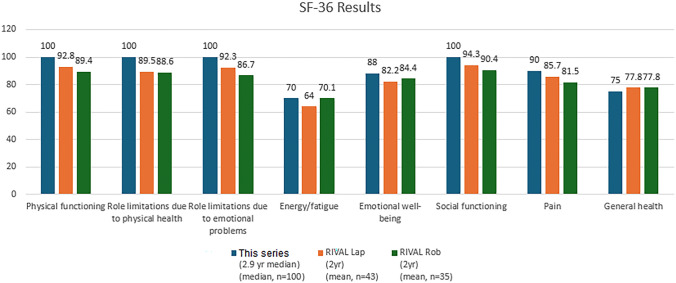
To evaluate the long-term efficacy and health-related quality-of-life (HRQoL) outcomes in patients who underwent robotic-assisted transabdominal preperitoneal (R-TAPP) inguinal hernioplasty in an Australian setting. A cross-sectional analysis of patients who underwent R-TAPP inguinal hernioplasty was performed. Health-related quality of life was assessed using the SF-36 questionnaire. Post-operative outcomes, including chronic pain, opioid requirements, hernia recurrence, and return to activities, were evaluated. A total of 100 patients who completed the SF-36 questionnaire (94 males, 6 females) were included in the study. The median age at operation was 64 years. Of the 77 patients who answered the question on opioid use, 56% used opioids (8% for less than 1 week, 19% for 1 week, 17% for between 1 and 2 weeks, and 9% for more than 2 weeks). Eighty-five percent reported no chronic groin pain at follow-up. The hernia recurrence rate was 1%. The median follow-up period was 35 months. The median time to return to work, driving, and exercise was 1, 2, and 4 weeks, respectively. SF-36 scores showed optimal outcomes (median 100) in physical functioning, role limitations, and social functioning domains. R-TAPP inguinal hernioplasty demonstrates excellent long-term outcomes with high health-related quality-of-life (HRQoL) scores, low chronic pain rates, and minimal recurrence rates. There is the potential for increasing uptake of this procedure with increasing availability and decreasing cost of robotic surgery technology.
Keywords: Inguinal hernia; Quality of life; Robotic surgery.
© 2025. Crown.
Conflict of interest statement
Declarations. Conflict of interest: The authors did not receive any grant support and declare no conflicts of interest. The first author is not a surgeon in training. All authors are in agreement with the content of the manuscript. Ethical approval: Ethics approval was granted by the Institutional ethics committee. Informed consent: Informed consent was obtained from the patient. The manuscript has not been published previously, and is not under consideration elsewhere.
Figures
References
-
- Wagner JP, Brunicardi FC, Amid PK, Chen DC (2015) Inguinal Hernias. In: Brunicardi FC, Andersen DK, Billiar TR, Dunn DL, Hunter JG, Matthews JB et al (eds) Schwartz’s Principles of Surgery 10e. New York, NY, McGraw-Hill Education
-
- Yang C, Deng S (2020) Laparoscopic versus open mesh repair for the treatment of recurrent inguinal hernia: a systematic review and meta-analysis. Annals Palliative Med 9(3):1164–1173 - PubMed
MeSH terms
Substances
LinkOut - more resources
Full Text Sources
