


Polycarboxybetaine in advanced drug delivery systems: From structure-function relationship to therapeutic applications
- PMID: 40236609
- PMCID: PMC11999368
- DOI: 10.1016/j.ijpx.2025.100329
Polycarboxybetaine in advanced drug delivery systems: From structure-function relationship to therapeutic applications
Abstract
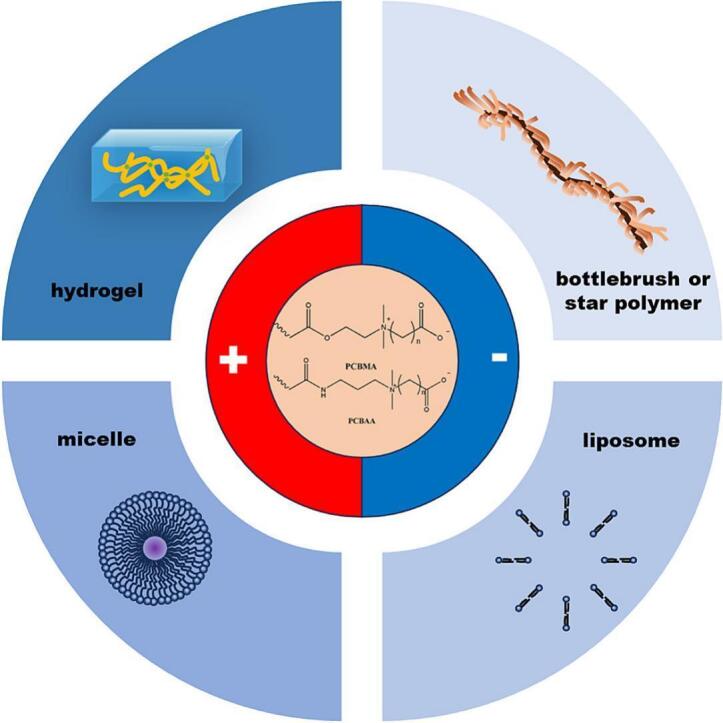
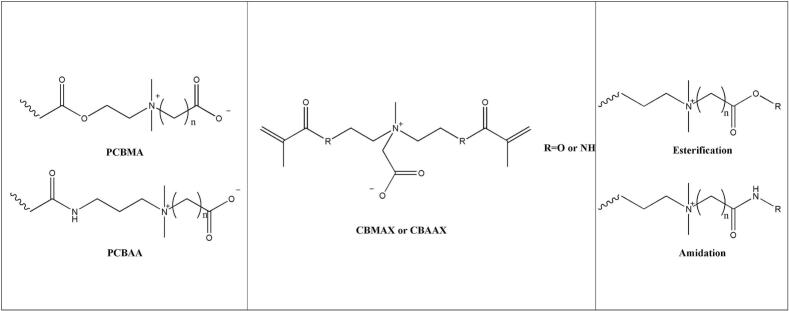
Zwitterionic polycarboxybetaines (PCBs), combining quaternary ammonium cations and carboxylate anions in their repeating units, have emerged as promising materials for drug delivery applications. Their exceptional hydration, biocompatibility, and antifouling properties make them attractive alternatives to polyethylene glycol (PEG), particularly given growing concerns about immunogenicity of PEG. PCBs can be functionalized through various methods, including modification of side-chain moieties, adjustment of spacer length between charged groups, and incorporation of responsive elements. When applied to delivery drug, PCBs have been successfully developed into multiple formats including micelles, hydrogels, liposomes, and nanoparticles. Notably, in protein drug delivery, PCBs demonstrate significant advantages such as enhancing protein stability, extending circulation time, improving penetration through biological barriers, and reducing immunogenicity. Despite these promising features, several challenges remain, including complex synthesis requirements, limited mechanical properties, and pending FDA approval as pharmaceutical excipients. This review provides a comprehensive analysis of PCBs from the structure-function relationship, synthesis methods, and applications in drug delivery systems, while examining current limitations and future prospects.
Keywords: Antifouling; Drug delivery systems; Hydration; Polycarboxybetaine.
© 2025 State Key Laboratory of National Security Specially Needed Medicines, Beijing Institute of Pharmacology and Toxicology. Published by Elsevier B.V.
Conflict of interest statement
The authors declare that they have no known competing financial interests or personal relationships that could have appeared to influence the work reported in this paper.
Figures
References
-
- Ali S.A., Al-Muallem H.A., Mazumder M.A.J. Stimuli-Responsive Macromolecular Architecture by Butler Cyclopolymerizations: Synthesis and applications. Chem. Rec. 2023;23 - PubMed
-
- Anthi J., Vaněčková E., Spasovová M., Houska M., Vrabcová M., Vogelová E., Holubová B., Vaisocherová-Lísalová H., Kolivoška V. Probing charge transfer through antifouling polymer brushes by electrochemical methods: the impact of supporting self-assembled monolayer chain length. Anal. Chim. Acta. 2023;1276 - PubMed
-
- Asadi N., Pazoki-Toroudi H., Del Bakhshayesh A.R., Akbarzadeh A., Davaran S., Annabi N. Multifunctional hydrogels for wound healing: special focus on biomacromolecular based hydrogels. Int. J. Biol. Macromol. 2021;170:728–750. - PubMed
-
- Bai T., Li J.Q., Sinclair A., Imren S., Merriam F., Sun F., O’Kelly M.B., Nourigat C., Jain P., Delrow J.J., Basom R.S., Hung H.C., Zhang P., Li B.W., Heimfeld S., Jiang S.Y., Delaney C. Expansion of primitive human hematopoietic stem cells by culture in a zwitterionic hydrogel. Nat. Med. 2019;25:1566–+. - PubMed
Publication types
LinkOut - more resources
Full Text Sources
