


Electron Extraction Optimization for Carbon-Based Hole-Conductor-Free Perovskite Photovoltaics With Record 1.41 V VOC
- PMID: 40237209
- PMCID: PMC12232247
- DOI: 10.1002/adma.202502436
Electron Extraction Optimization for Carbon-Based Hole-Conductor-Free Perovskite Photovoltaics With Record 1.41 V VOC
Abstract
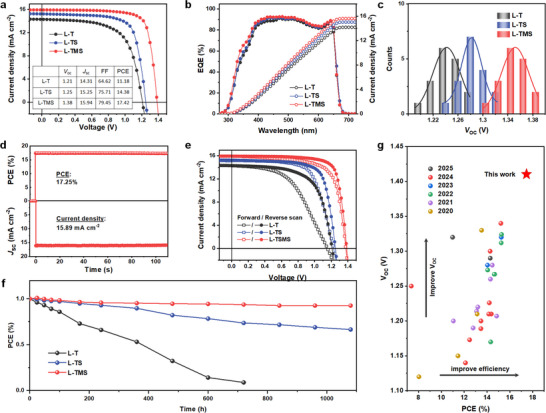
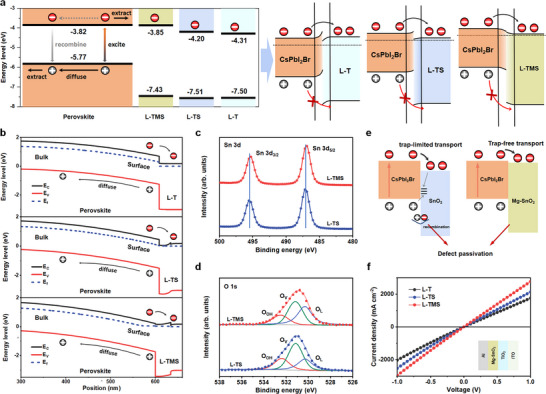
Carbon-based CsPbI2Br perovskite solar cells (PSCs) free of a hole-transport layer (HTL) have emerged as promising photovoltaics due to their low processing cost and superior stability. However, the voltage deficit resulting from inefficient carrier extraction causes insufficient power conversion efficiency (PCE), severely hindering their progress. Here, a gradient electron energy level modulation strategy proves effective in reducing voltage losses through the rapid extraction of photogenerated electrons. This process enhances carrier separation/collection and reduces recombination at the back contact, thereby achieving high-performance photovoltaics. It is demonstrated that the front electron extraction, equally critical as the prevailing back perovskite/carbon contact, accounts for the significant contributing factor of voltage deficit in carbon-based HTL-free PSCs. The resulting PSCs deliver a record open-circuit voltage (VOC) of 1.41 V and a PCE of 17.42% and retain more than 92% of their initial efficiency after 1, 000 h. These results highlight the significant potential of carbon-based HTL-free perovskite photovoltaics.
Keywords: carbon‐based perovskite solar cells; electron extraction; gradient electron energy level; hole‐transport layer free; voltage deficit.
© 2025 The Author(s). Advanced Materials published by Wiley‐VCH GmbH.
Conflict of interest statement
The authors declare no conflict of interest.
Figures
References
-
- Luo C., Zheng G., Gao F., Wang X., Zhan C., Gao X., Zhao Q., Nat. Photon. 2023, 17, 856.
-
- Domanski K., Alharbi E., Hagfeldt A., Grätzel M., Tress W., Nat. Energy. 2018, 3, 61.
-
- Yang G., Ren Z., Liu K., Qin M., Deng W., Zhang H., Wang H., Liang J., Ye F., Liang Q., Yin H., Chen Y., Zhuang Y., Li S., Gao B., Wang J., Shi T., Wang X., Lu X., Wu H., Hou J., Lei D., So S. K., Yang Y., Fang G., Li G., Nat. Photon. 2021, 15, 681.
-
- Chen H., Liu C., Xu J., Maxwell A., Zhou W., Yang Y., Zhou Q., Bati A. S., Wan H., Wang Z., Zeng L., Wang J., Serles P., Liu Y., Teale S., Liu Y., Saidaminov M., Li M., Rolston N., Hoogland S., Filleter T., Kanatzidis M., Chen B., Ning Z., Sargent E., Science 2024, 384, 189. - PubMed
Grants and funding
- Hong Kong Polytechnic University
- ITS/184/23/Fondo Nacional de Ciencia Tecnología e Innovación
- 1-CD94/Program for Top 100 Innovative Talents in Colleges and Universities of Hebei Province
- (1-BD1H)/Centro universitario di ricerca e formazione per lo sviluppo competitivo delle imprese del settore vitivinicolo italiano, Università degli Studi di Firenze
- RI-/Centro universitario di ricerca e formazione per lo sviluppo competitivo delle imprese del settore vitivinicolo italiano, Università degli Studi di Firenze
- iWEAR/Centro universitario di ricerca e formazione per lo sviluppo competitivo delle imprese del settore vitivinicolo italiano, Università degli Studi di Firenze
- 52403250/Innovative Research Group Project of the National Natural Science Foundation of China
- 2019B121205001/Hong Kong Branch of Southern Laboratory of Ocean Science and Engineering Guangdong Laboratory
- ITF-TCFS GHP/380/22GD/Innovation and Technology Commission - Hong Kong
- PRI (Q-CD7X)/Lo Ka Chung Charitable Foundation
- SRFS2223-5S01/Intelligence Community Postdoctoral Research Fellowship Program
- C4005-22Y/State Key Laboratory of Liver Research
- 15307922/State Key Laboratory of Liver Research
- C7018-20G/State Key Laboratory of Liver Research
LinkOut - more resources
Full Text Sources
