


Trends in the Use of Non-Pharmaceutical Interventions in Schools During the COVID-19 Pandemic, February 2021 to December 2023: A Mixed Methods Study
- PMID: 40238418
- PMCID: PMC11942009
- DOI: 10.3390/ijerph22030394
Trends in the Use of Non-Pharmaceutical Interventions in Schools During the COVID-19 Pandemic, February 2021 to December 2023: A Mixed Methods Study
Abstract
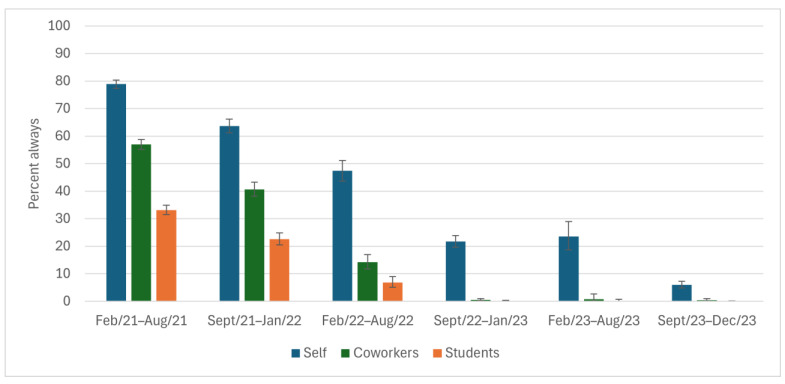
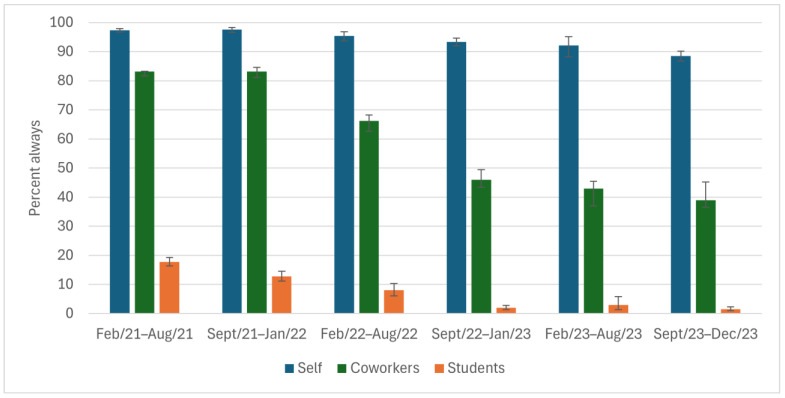
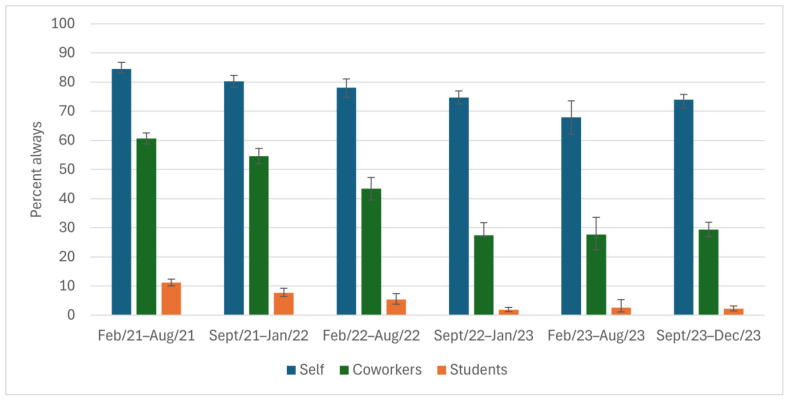
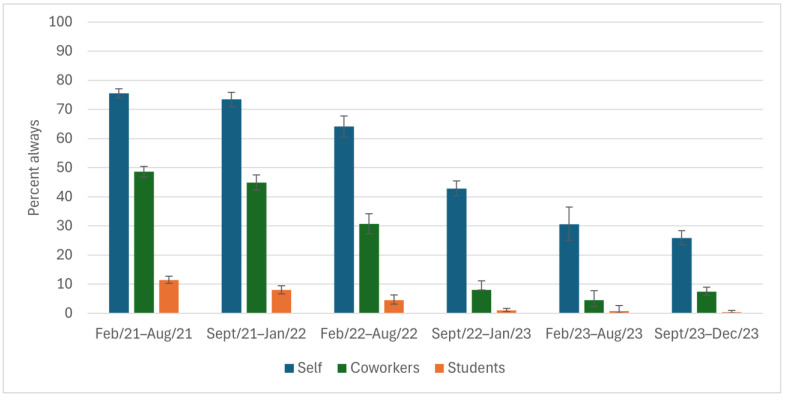
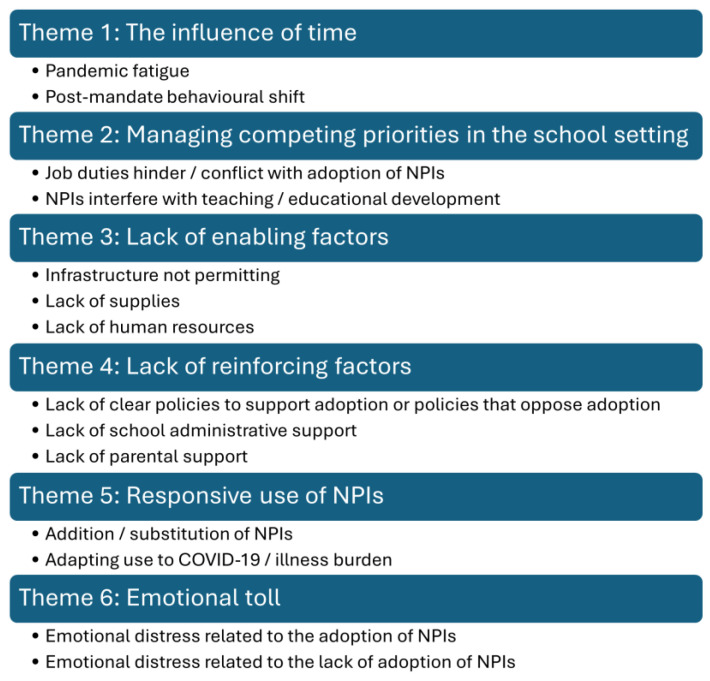
The use of non-pharmaceutical interventions (NPIs) was imperative to avoid prolonged school closures during the COVID-19 pandemic. The purpose of this study was to understand the levels of adherence to and attitudes towards NPIs from February 2021 to December 2023 in schools in Ontario, Canada. Participants reported how frequently they, their coworkers, and their students used five NPIs: hand hygiene, covering coughs, staying home when ill, wearing a mask, and physically distancing. Open text comments provided participants with the option to provide additional details. Our mixed methods approach incorporated a series of descriptive statistics calculated at consecutive time points and thematic analysis. Participants reported higher adherence to NPIs than their coworkers and students, with less than perfect adherence that declined over time. Six themes emerged from the qualitative analysis on NPI use in schools: (1) the influence of time; (2) managing competing priorities; (3) a lack of enabling factors; (4) a lack of reinforcing factors; (5) the responsive use of NPIs; and (6) an emotional toll. To reduce the transmission of future communicable diseases and resultant staff and student sick days, ongoing commitment to hand hygiene, covering coughs, and staying home when ill is required.
Keywords: COVID-19; education worker; hand hygiene; masking; mixed methods; non-pharmaceutical interventions.
Conflict of interest statement
The authors declare no conflicts of interest. The funders had no role in the design of the study, in the collection, analyses, or interpretation of data, in the writing of the manuscript, or in the decision to publish the results.
Figures

Similar articles
-
Implementation and effectiveness of non-pharmaceutical interventions, including mask mandates and ventilation, on SARS-CoV-2 transmission (alpha variant) in primary schools in the Netherlands.PLoS One. 2024 Jun 17;19(6):e0305195. doi: 10.1371/journal.pone.0305195. eCollection 2024. PLoS One. 2024. PMID: 38885240 Free PMC article.
-
Physical interventions to interrupt or reduce the spread of respiratory viruses.Cochrane Database Syst Rev. 2020 Nov 20;11(11):CD006207. doi: 10.1002/14651858.CD006207.pub5. Cochrane Database Syst Rev. 2020. Update in: Cochrane Database Syst Rev. 2023 Jan 30;1:CD006207. doi: 10.1002/14651858.CD006207.pub6. PMID: 33215698 Free PMC article. Updated.
-
Youth Mask-Wearing and Social-Distancing Behavior at In-Person High School Graduations During the COVID-19 Pandemic.J Adolesc Health. 2021 Mar;68(3):464-471. doi: 10.1016/j.jadohealth.2020.12.123. Epub 2021 Jan 24. J Adolesc Health. 2021. PMID: 33500195
-
COVID Protection Behaviors, Mental Health, Risk Perceptions, and Control Beliefs: A Dynamic Temporal Network Analysis of Daily Diary Data.Ann Behav Med. 2024 Jan 1;58(1):37-47. doi: 10.1093/abm/kaad050. Ann Behav Med. 2024. PMID: 37648242
-
Lifting non-pharmaceutical interventions following the COVID-19 pandemic - the quiet before the storm?Expert Rev Vaccines. 2022 Nov;21(11):1541-1553. doi: 10.1080/14760584.2022.2117693. Epub 2022 Sep 5. Expert Rev Vaccines. 2022. PMID: 36039786 Review.
References
-
- World Health Organization Novel Coronavirus (2019-nCoV): Situation Report—1: 21 January 2020. 2020. [(accessed on 30 October 2024)]. Available online: https://www.who.int/publications/m/item/situation-report---1.
-
- Science M., Thampi N., Bitnun A., Born K.B., Blackman N., Cohen E., Cohn R.D., Dubey V., Gallagher-Mackay K., Khan S., et al. Science Briefs of the Ontario COVID-19 Science Advisory Table. Volume 3. The Ontario COVID-19 Science Advisory Table; Toronto, ON, Canada: 2022. Infection prevention and control considerations for schools during the 2022–2023 academic year. - DOI
-
- Whitley J., Beauchamp M.H., Brown C. The impact of COVID-19 on the learning and achievement of vulnerable Canadian children and youth. Facets. 2021;6:1693–1713. doi: 10.1139/facets-2021-0096. - DOI
MeSH terms
Grants and funding
LinkOut - more resources
Full Text Sources
Medical
