


Impact of clinical leadership on frontline nurses' quality of care: work engagement as mediator role
- PMID: 40241003
- PMCID: PMC12004633
- DOI: 10.1186/s12913-025-12515-0
Impact of clinical leadership on frontline nurses' quality of care: work engagement as mediator role
Abstract
Background: Leadership behavior among staff nurses is a critical aspect of healthcare management. Work engagement, characterized by vigor, dedication, and absorption, is a strong predictor of job performance and is believed to enhance the quality of care. However, few studies have explored the relationship between clinical leadership by bedside nurses, work engagement, and quality of care.
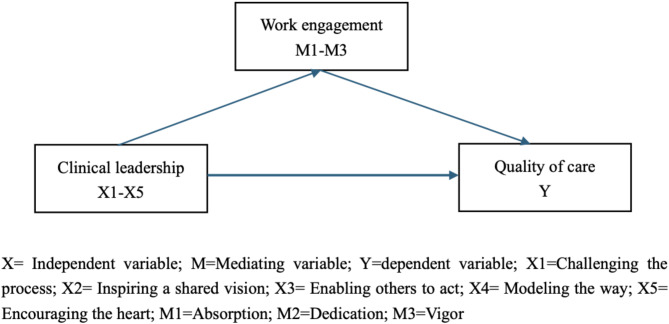
Aims: To explore relationships between clinical leadership and work engagement on the quality of care and to identify pathways through which clinical leadership may influence care quality via work engagement.
Methods: A sample of 1,029 staff nurses from 20 hospitals participated in the study. Three standardized scales were used: The Clinical Leadership Inventory (CLI), the Utrecht Work Engagement Scale-9 (UWES-9), and the nurse-reported quality of care scale. The study followed the STROBE guidelines for cross-sectional research.
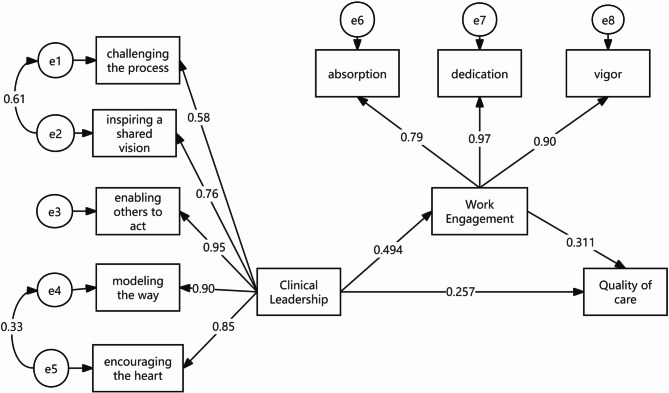
Results: Findings revealed that clinical leadership, work engagement, and quality of care scores were 4.10 ± 0.66, 4.09 ± 1.16, and 3.26 ± 0.60, respectively. Positive correlations were found between all three variables, with correlation coefficients ranging from 0.297 to 0.960 (p <.01). Clinical leadership showed both direct and indirect effects on care quality. When work engagement was included as a mediator, the effect size increased by 0.154 (< 0.001), resulting in a value of 0.411 (< 0.001), with a mediation proportion of 37.56%. The explanatory power of clinical leadership and work engagement for care quality was 75.9%.
Conclusion: Enhanced clinical leadership practices are significantly associated with increased nurse work engagement and improved care quality. Clinical leadership directly influences care quality, as well as indirectly through work engagement. These findings could stimulate further international discussions on healthcare management perspectives.
Implications for practice: Nursing management should implement clinical leadership development programs tailored for frontline nurses, promoting positive leadership behaviors and work engagement. Creating supportive organizational environments that encourage open communication and standardized practices can further enhance clinical leadership and quality of care. This study found that 1) Nursing management should focus on implementing clinical leadership development programs; 2) Clinical leadership training program for bedside nurses can be enhanced through the use of simulation;3) Supportive organizational environments that promote open communication, and standardized practices should be provided by nurse managers.
Keywords: Bedside nurses; Clinical leadership; Healthcare management; Nursing; Quality of care; Work engagement.
© 2025. The Author(s).
Conflict of interest statement
Declarations. Ethics approval and consent to participate: The Research Ethics Subcommittee of the Medical Ethics Committee of the First Affiliated Hospital of Shandong First Medical University accepted this study under Ethics [2023] Lun Shen Zi No. S461. All procedures performed in this study were by the ethical standards of the institutional and/or national research committee and with the 1964 Helsinki Declaration and its later amendments or comparable ethical standards. Consent for publication: Non applicable. Competing interests: The authors declare no competing interests.
Figures
References
-
- Afzal S, Arshad A. Ethical issues among healthcare workers using electronic medical records: A systematic review. Comput Methods Programs Biomed Update. 2021;1:100030. - DOI
MeSH terms
LinkOut - more resources
Full Text Sources
Research Materials
Miscellaneous
