


The role of self-efficacy in internet-based interventions for mental health: A systematic review and meta-analysis
- PMID: 40242832
- PMCID: PMC12002610
- DOI: 10.1016/j.invent.2025.100821
The role of self-efficacy in internet-based interventions for mental health: A systematic review and meta-analysis
Abstract
Introduction: Internet-based interventions (IBI) increase access to evidence-based treatments for mental disorders, but knowledge of their mechanisms of change is limited. Self-efficacy, a key factor in psychotherapy, is especially relevant in IBI due to its self-help focus. We investigated self-efficacy and related constructs as outcomes, predictors/moderators, and mediators in randomized controlled trials.
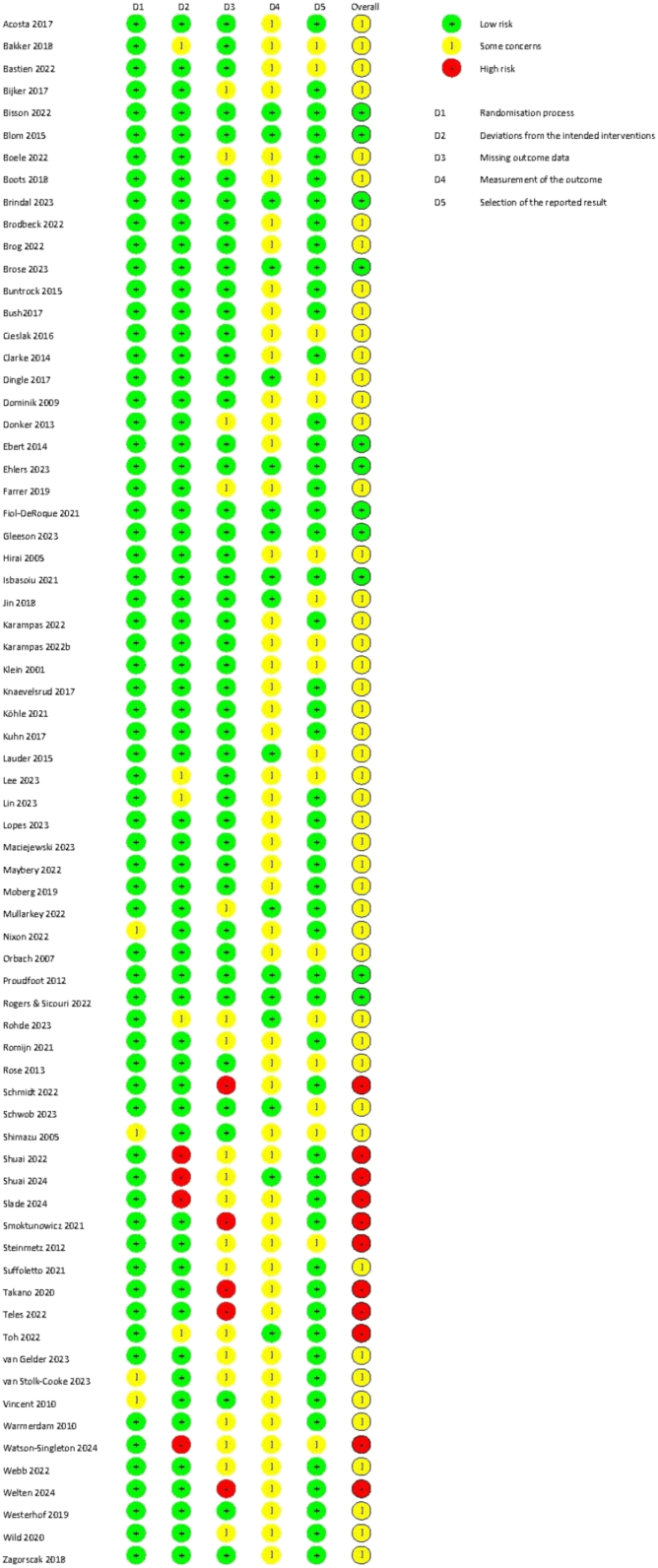
Methods: A systematic search was conducted across PsycINFO, PubMed, CINAHL, and Web of Science. Two reviewers selected studies, extracted data, and assessed bias. Effects were quantified using random effect models and supplemented by narrative syntheses and box score visualizations.
Results: 70 studies (N = 17,407 participants) were included. IBI showed moderate effects on self-efficacy in within (d = 0.47) and between (d = 0.46) comparisons, with guided interventions having the largest effect (d = 0.66). Findings on self-efficacy as a predictor/moderator were mixed, though some studies suggested individuals with lower self-efficacy benefit more. Self-efficacy emerged as a mediator through which IBI affected treatment outcomes.
Conclusion: Self-efficacy appears influential in IBI efficacy and may itself be a valuable treatment target. However, mixed results and methodological limitations in mediator studies highlight the need for further research, particularly on long-term effects.
Keywords: Internet-based interventions; Mastery, digital health; Meta-analysis; Self-efficacy; Systematic review.
© 2025 The Author(s).
Conflict of interest statement
The authors declare that they have no known competing financial interests or personal relationships that could have appeared to influence the work reported in this paper.
Figures


References
-
- Acosta M.C., Possemato K., Maisto S.A., Marsch L.A., Barrie K., Lantinga L., Fong C., Xie H., Grabinski M., Rosenblum A. Web-delivered CBT reduces heavy drinking in OEF-OIF veterans in primary care with symptomatic substance use and PTSD. Behav. Ther. 2017;48(2):262–276. doi: 10.1016/j.beth.2016.09.001. - DOI - PMC - PubMed
-
- American Psychological Association 2022 COVID-19 practitioner impact survey: psychologist workload. APA Reports. 2022 https://www.apa.org/pubs/reports/practitioner/2022-covid-psychologist-wo...
-
- Angerer F., Mennel V., Grund S., Mayer A., Büscher R., Sander L.B., Cuijpers P., Terhorst Y., Baumeister H., Domhardt M. Mechanisms of change in digital interventions for depression: a systematic review and meta-analysis of six mediator domains. J. Affect. Disord. 2025;368:615–632. doi: 10.1016/j.jad.2024.09.055. - DOI - PubMed
-
- Balduzzi S., Rücker G., Schwarzer G. meta: General Package for Meta-Analysis. R package version 4.11-0. 2019. https://cran.r-project.org/package=meta URL.
Publication types
LinkOut - more resources
Full Text Sources
