


Nanopore Long-Read Sequencing as a First-Tier Diagnostic Test to Detect Repeat Expansions in Neurological Disorders
- PMID: 40243408
- PMCID: PMC11988536
- DOI: 10.3390/ijms26072850
Nanopore Long-Read Sequencing as a First-Tier Diagnostic Test to Detect Repeat Expansions in Neurological Disorders
Abstract
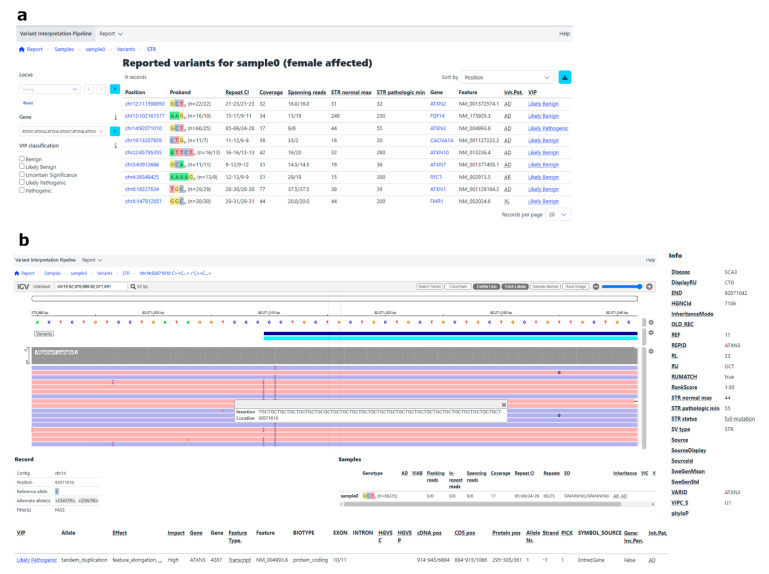
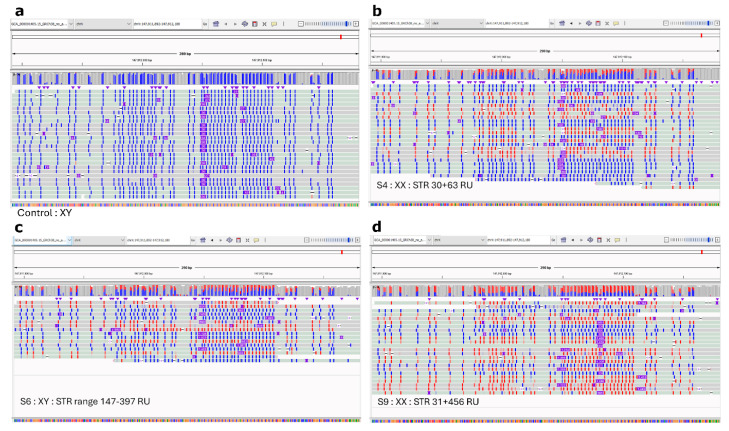
Inherited neurological disorders, such as spinocerebellar ataxia (SCA) and fragile X (FraX), are frequently caused by short tandem repeat (STR) expansions. The detection and assessment of STRs is important for diagnostics and prognosis. We tested the abilities of nanopore long-read sequencing (LRS) using a custom panel including the nine most common SCA-related genes and FraX and created raw data to report workflow. Using known STR lengths for 23 loci in 12 patients, a pipeline was validated to detect and report STR lengths. In addition, we assessed the capability to detect SNVs, indels, and the methylation status in the same test. For the 23 loci, 22 were concordant with known STR lengths, while for the last, one of three replicates differed, indicating an artefact. All positive control STRs were detected as likely pathogenic, with no additional findings after a visual assessment of repeat motifs. Out of 226 SNV and Indel variants, two were false positive and one false negative (accuracy 98.7%). In all FMR1 controls, a methylation status could be determined. In conclusion, LRS is suitable as a diagnostic workflow for STR analysis in neurological disorders and can be generalized to other diseases. The addition of SNV/Indel and methylation detection promises to allow for a one-test-fits-all workflow.
Keywords: Oxford Nanopore Technologies; SNV; fragile X syndrome; indel; long read sequencing; methylation; neurological disorders; short tandem repeat; spinocerebellar ataxia.
Conflict of interest statement
The authors declare no conflicts of interest. The funders had no role in the design of the study; in the collection, analyses, or interpretation of data; in the writing of the manuscript; or in the decision to publish the results.
Figures
References
-
- Crawford H., Abbeduto L., Hall S.S., Hardiman R., Hessl D., Roberts J.E., Scerif G., Stanfield A.C., Turk J., Oliver C. Fragile X syndrome: An overview of cause, characteristics, assessment and management. Paediatr. Child Health. 2020;30:400–403. doi: 10.1016/j.paed.2020.08.007. - DOI
-
- Dolzhenko E., Deshpande V., Schlesinger F., Krusche P., Petrovski R., Chen S., Emig-Agius D., Gross A., Narzisi G., Bowman B., et al. ExpansionHunter: A sequence-graph-based tool to analyze variation in short tandem repeat regions. Bioinformatics. 2019;35:4754–4756. doi: 10.1093/bioinformatics/btz431. - DOI - PMC - PubMed
MeSH terms
Substances
LinkOut - more resources
Full Text Sources
Medical
