


Tibial adaptations to dietary 25-hydroxyvitamin D3 supplementation under two distinct vitamin regimens in young ducks
- PMID: 40245539
- PMCID: PMC12032329
- DOI: 10.1016/j.psj.2025.105145
Tibial adaptations to dietary 25-hydroxyvitamin D3 supplementation under two distinct vitamin regimens in young ducks
Abstract
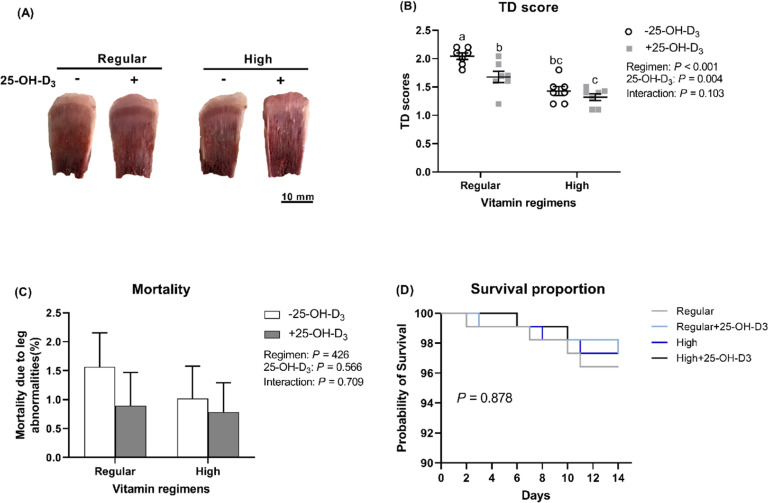
Tibia disorders in modern ducks are frequently associated with rapid weight gain and compromised bone quality, which is defined as the structural and material properties of bone tissue that determines its strength and fracture resistance. These factors significantly increase the risk of fractures and chronic pain. Studies suggest that 25-hydroxycholecalciferol (25-OH-D3), a vitamin D3 metabolite, effectively addresses bone disorders, potentially depending on dietary vitamin regimens, which are determined by the amount and ratio of vitamins in the diet. This study used a 2 × 2 factorial design to evaluate the effects of two vitamin regimens (regular and high) with or without exogenous 25-OH-D3 (0.069 mg/kg) on leg health and tibia quality in meat ducks (1-14 d). The high-vitamin regimen contained greater amounts of all vitamins except biotin and significantly enhanced ash content, tibial microstructure, fracture load, and reduced tibial dyschondroplasia (TD) scores (P < 0.05) compared to the regular regimen, despite no impact on growth performance or tibia length, weight, and diameter (P > 0.05). Additionally, dietary 25-OH-D3 supplementation increased weight gain (P < 0.05), improved bone quality, and strengthened bone formation and resorption processes. Notably, under the regular vitamin regimen, 25-OH-D3 reduced TD scores and enhanced weight gain, tibia mechanical properties, and the serum content of procollagen type I N-terminal propeptide (PN1P) that a marker of bone formation (all P < 0.05). However, these effects were diminished in ducks fed the high-vitamin diet. There were some interactions that were noticed regarding serum 25-OH-D3 content, trabecular area, tibia fracture load, and PN1P levels in the present study (P < 0.05). In conclusion, the biochemical effects of 25-OH-D3 were influenced by the baseline levels of dietary vitamins, a high-vitamin diet or treatment with 25-OH-D3 in a regular vitamin diet improved bone quality and reduced tibial dyschondroplasia by enhancing bone formation.
Keywords: 25-hydroxycholecalciferol; Meat duck; Tibia quality; Vitamin regimen.
Copyright © 2025. Published by Elsevier Inc.
Conflict of interest statement
Declaration of competing interest We declare that we have no financial and personal relationships with other people or organizations that can inappropriately influence our work, and there is no professional or other personal interest of any nature or kind in any product, service and/or company that could be construed as influencing the content of this paper
Figures


References
-
- Bar A., Razaphkovsky V., Vax E., Plavnik I. Performance and bone development in broiler chickens given 25-hydroxycholecalciferol. Br. Poult. Sci. 2003;44:224–233. - PubMed
-
- Bouillon R., Quesada Gomez J.M. Comparison of calcifediol with vitamin D for prevention or cure of vitamin D deficiency. J. Steroid. Biochem. Mol. Biol. 2023;228 - PubMed
MeSH terms
Substances
LinkOut - more resources
Full Text Sources
Research Materials
Miscellaneous
